Why Backing, Permissionlessness, and Liquidity Source Matter
Tokenized stocks are rapidly emerging as one of the most important categories within real-world assets (RWAs). Despite sharing similar tickers or branding, not all tokenized stocks are structured the same way—or offer the same level of reliability. Understanding the differences is essential for investors, builders, and anyone exploring the future of onchain markets.
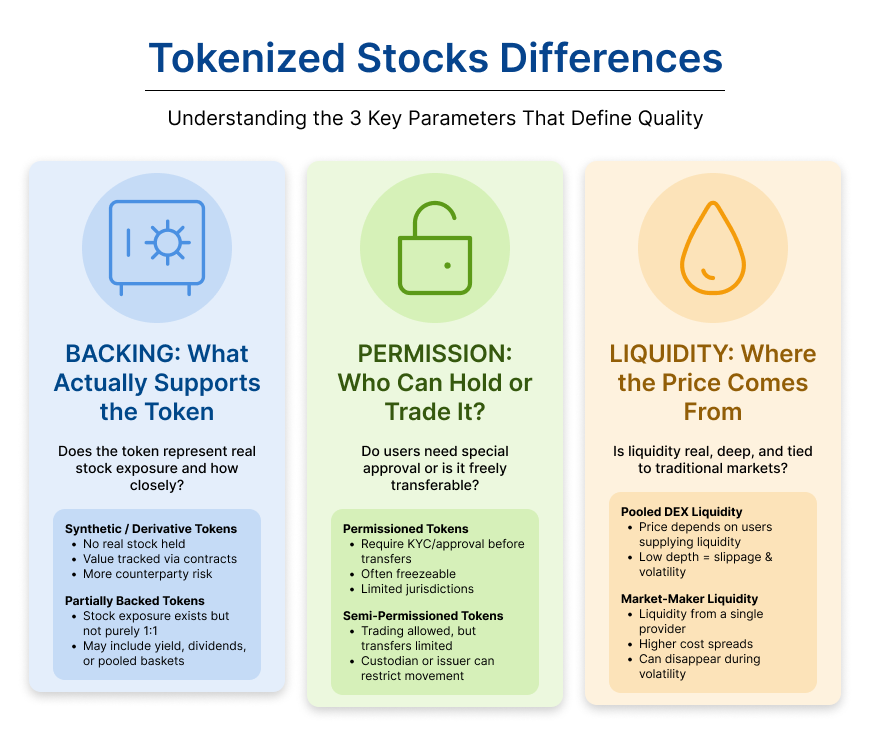
A useful way to compare tokenized stock platforms is through three core parameters: backing, permissionlessness, and liquidity source. Each platform prioritizes these differently, resulting in assets that can vary dramatically in safety, usability, and alignment with real market behavior.
1. Backing: What Supports the Token?
The first question to ask is simple: What actually sits behind the token?
Backed Tokenized Stocks
Some platforms issue tokenized stocks that are backed by real, traditional shares. In these models, the platform (or an affiliated entity) purchases the underlying stock on regulated financial markets and holds it through a licensed custodian, broker, or trust structure. This custodian is responsible for safekeeping the shares, ensuring they are properly recorded, segregated, and subject to applicable regulatory oversight. The onchain tokens are then issued to represent economic exposure to those offchain holdings, creating a tangible link between the digital asset and the real-world equity.
It’s important to note that real stock backing does not always imply a strict 1:1 relationship between tokens and individual shares. In some structures, backing reflects the economic value of the underlying stock rather than a simple share count. This can include dividends paid by the stock or yield generated while the shares are held in custody. As a result, the token may track the full economic exposure of the asset—price movements plus income—while still being supported by real, custodially held equities.
- Pros: Transparent link to real assets, captures full economic exposure.
- Cons: Requires regulated custodianship and careful accounting.
Synthetic or Derivative-Based Tokens
Other platforms issue tokens that only mirror the price of a stock via an oracle or algorithm, without holding any real shares at all.
- Pros: Easy to issue and fully onchain.
- Cons: No redemption, dependent on issuer solvency, and often higher risk.
Takeaway: Backed tokenized stocks—especially those reflecting the full economic value of underlying equities—offer a stronger and more trust-aligned structure than synthetic price trackers.
2. Permissionlessness: Can the Token Move Like Crypto?
Permissionlessness determines whether a tokenized stock can be transferred and used freely across DeFi—or locked down to a small set of approved users.
Permissioned Tokens
These require KYC for transfers and restrict movement to whitelisted addresses.
This structure limits DeFi integration and reduces user autonomy, making permissioned tokenized stocks not that different from centralized platforms that keep users inside a ‘walled garden’.
Permissionless Tokens
These behave like typical crypto assets—free to move between wallets, smart contracts, DEXes, lending markets, and more.
This matters because true tokenization should provide all the advantages of blockchain, not recreate the friction of traditional finance.
Takeaway: Platforms prioritizing permissionless access unlock the full power of tokenized stocks—composability, automation, interoperability, and instant settlement.
3. Liquidity Source: Where Does the Real Trading Depth Come From?
Tokenized stock liquidity is often misunderstood, but it’s one of the most important differentiators.
Onchain AMM Liquidity
Some platforms rely on automated market maker (AMM) pools seeded by users, where liquidity providers deposit pairs of tokens (for example, a tokenized stock and a stablecoin) into a smart contract. Trades are executed against this pool using a mathematical pricing formula, meaning the token’s price is determined by the balance of assets in the pool rather than by real-world market activity. As trades occur, the pool rebalances, causing the price to move based on onchain supply and demand.
However, AMMs come with major limitations:
- shallow liquidity
- high slippage on larger trades
- vulnerability to manipulation
- prices that can drift significantly from real equities
As a result, tokenized stocks traded via AMM-only liquidity often behave very differently from their real-world counterparts, especially during periods of high volatility or low liquidity.
Liquidity Derived Directly From Traditional Markets
The strongest structure sources pricing and liquidity directly from the real equities market. In these models, token supply can expand or contract through mechanisms such as minting and burning, which are tied to activity in traditional stock markets. When demand for the token increases, new tokens may be minted based on real stock exposure being acquired or referenced; when demand decreases, tokens can be burned as exposure is reduced. This keeps the onchain supply aligned with offchain market dynamics.
Rather than depending on static liquidity pools, these structures rely on continuous price references and execution paths connected to traditional exchanges. As a result, the token reflects the depth, efficiency, and pricing behavior of the underlying stock market, even while trading onchain.
This ensures:
- deep liquidity
- tight spreads
- accurate pricing
- resilience during volatility
- real alignment with underlying markets
Takeaway: Tokens connected to traditional-market liquidity behave far more like the actual stock, providing the reliability and consistency traders expect.
Why These Three Factors Matter
When you compare platforms across backing, permissionlessness, and liquidity source, a clear pattern emerges:
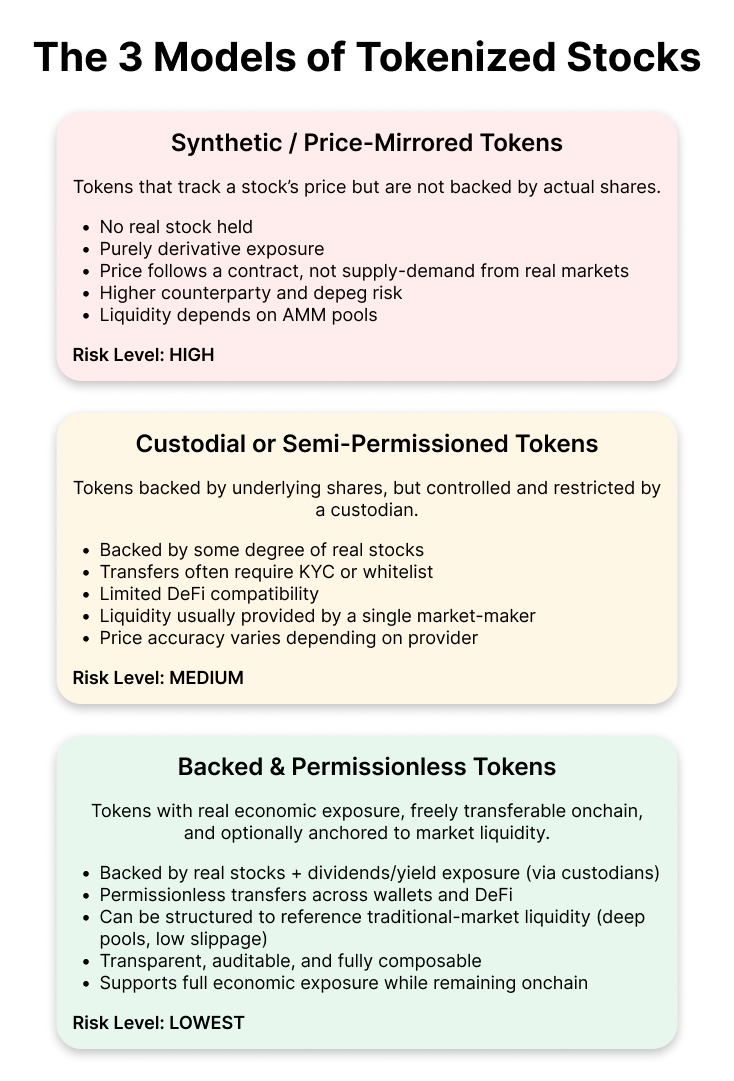
The strongest tokenized stocks are those that are:
✔ backed by real underlying equity (including dividends/yield where applicable)✔ permissionless and freely usable across DeFi✔ priced and supported by liquidity directly from traditional markets
This combination doesn’t just make tokenized stocks safer—it makes them meaningfully useful. It delivers the transparency of onchain assets, the economics of real equity, and the liquidity depth of traditional finance.
Overview of Tokenization Platforms
Across the tokenization landscape, not many platforms check all three boxes. Some offer real backing but restrict transfers. Others are permissionless but synthetic. Others rely entirely on thin AMM pools, which leads to unreliable pricing.
Platforms that integrate:
- real backing,
- permissionless transferability, and
- traditional-market liquidity,
stand out as the most aligned with how tokenized stocks should function.
At the time of writing, only a small number of tokenization providers are working toward checking all three boxes. Examples include projects like xStocks, which offer backed and permissionless tokens but still depend on decentralized exchange liquidity, and Ondo Finance, which is focused on combining real economic backing with permissionless onchain assets and liquidity derived directly from traditional markets. Together, these approaches highlight the different paths platforms are taking as the tokenized equity ecosystem continues to evolve.
Final Thoughts
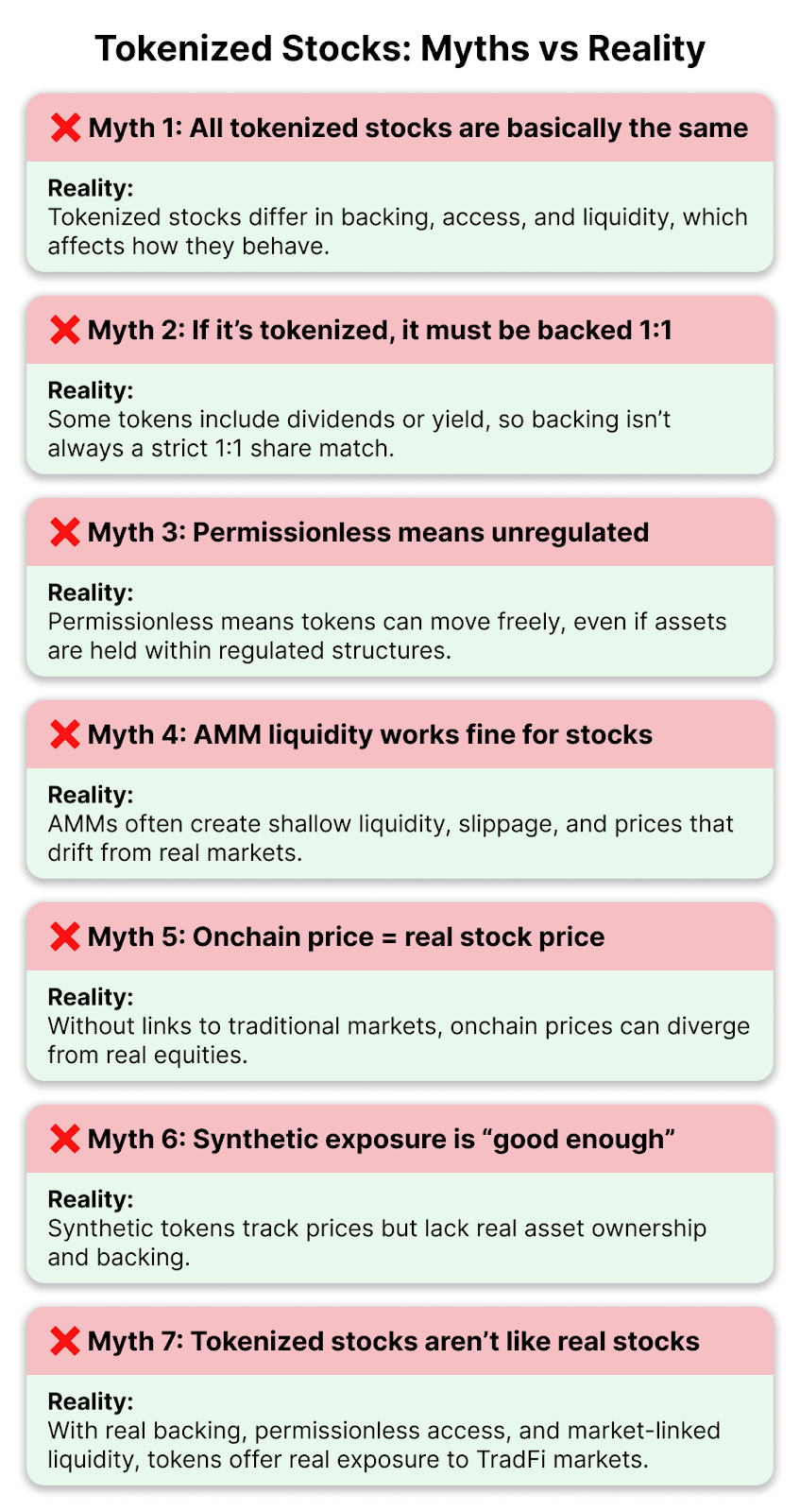
As tokenized stocks grow in popularity, understanding their underlying design becomes essential. The combination of backing, permissionlessness, and traditional-market liquidity is what elevates tokenized stocks from experimental products to credible financial infrastructure.
The platforms that embrace this model—balancing real-world exposure with onchain openness—are best positioned to define the next wave of RWA innovation.
Thank you for checking out our Are All Tokenized Stocks the Same article! Make sure to follow us on X(Twitter) and let us know your thoughts. Sign up for our newsletter to stay up to date with MEW releases, and check out our weekly podcast Crypto Currents for the latest news in crypto.