
Real-World Assets (RWAs) are tokenized versions of real estate, bonds, stocks, commodities, and other financial instruments and are rapidly becoming one of the most practical use cases for blockchain. Beyond speculation and native digital tokens, RWAs represent tangible economic value brought onchain, but not all blockchains are equal when it comes to hosting and scaling RWA activity.
Below we explore the leading networks used for RWAs today, what kinds of real-world assets they support, why each is well-suited to this role, and where RWA infrastructure is headed next.
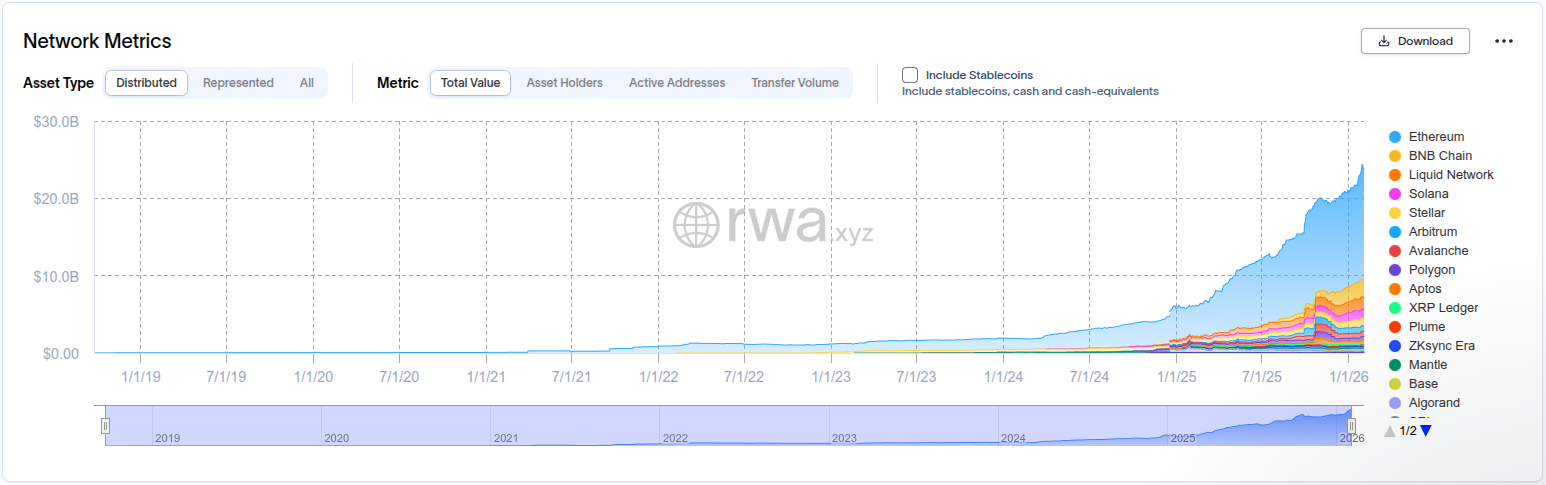
Source: RWA.xyz
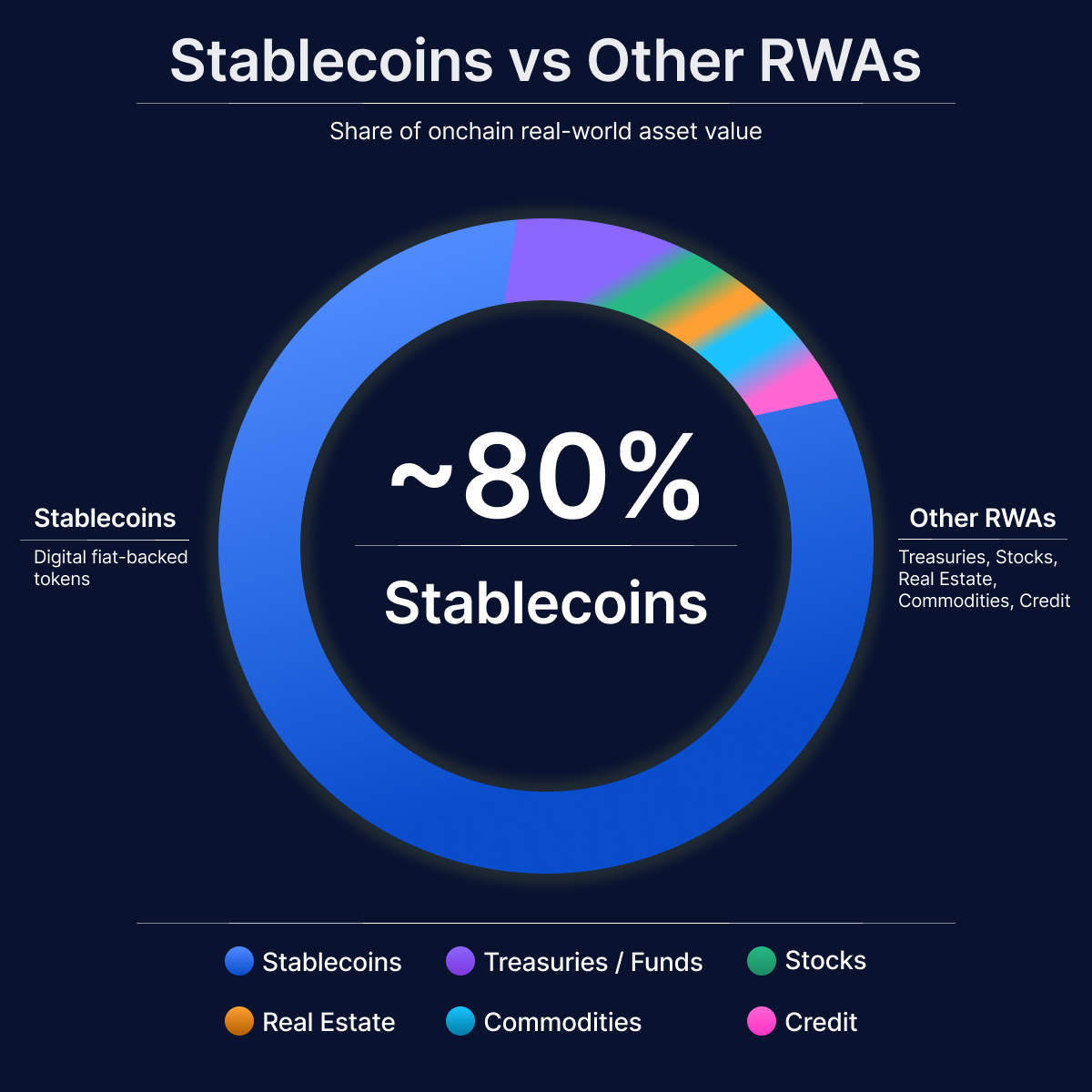
Ethereum
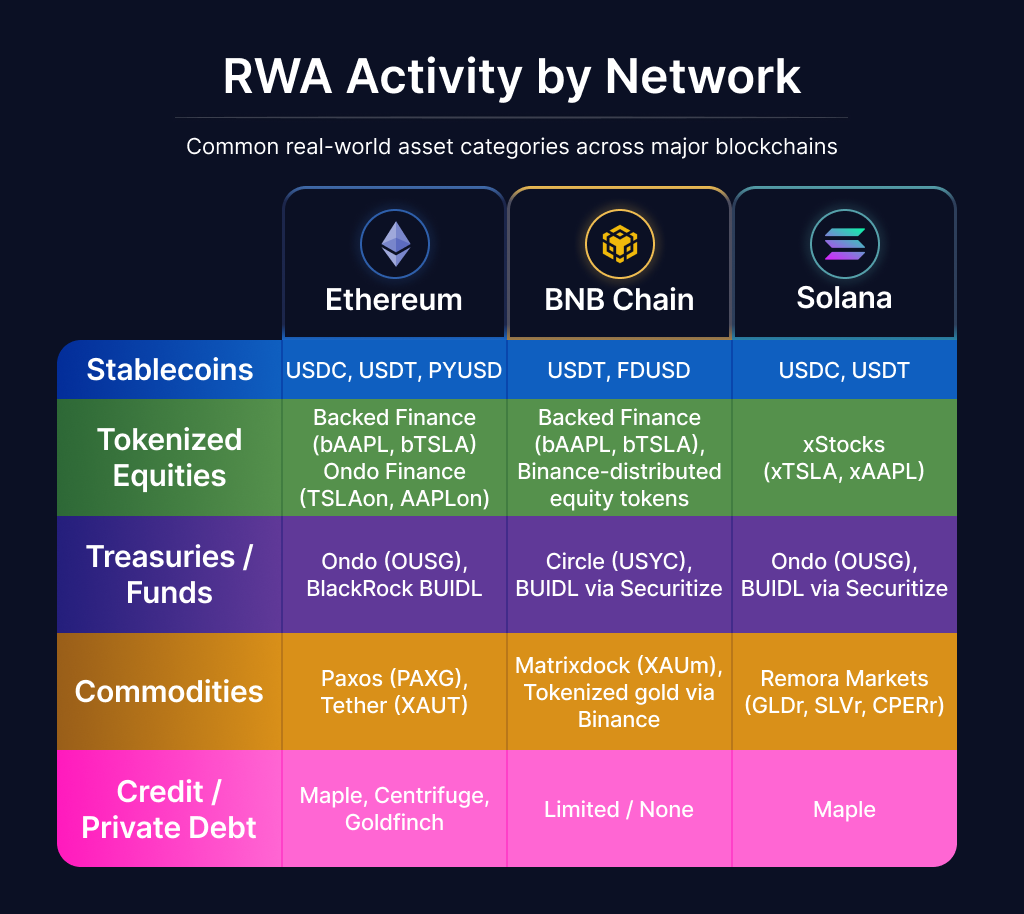
Ethereum hosts a large share of onchain RWA activity and is commonly used for both stablecoin issuance and tokenized financial instruments.
Most major stablecoins—including USDC, USDT, and DAI—originate on Ethereum, and many other blockchains rely on Ethereum-issued stablecoins through bridging mechanisms. In addition to stablecoins, Ethereum is used for tokenized money market funds, tokenized U.S. Treasury exposure, tokenized bond products, and structured credit instruments.
Ethereum has emerged as the network of choice for major institutional RWA issuers including Goldman Sachs, Visa, BlackRock (BUIDL Fund), JPMorgan (tokenized money market funds), Franklin Templeton (FOBXX), Fidelity (FIDD), Ondo Finance (OUSG and Global Markets), Synthetix,, and Maple Finance.
Several DeFi protocols also incorporate RWAs into their balance sheets or collateral frameworks, particularly for treasury-backed or yield-generating assets. For example, MakerDAO supports RWA–backed vaults using tokenized Treasuries and structured credit to help back DAI. Aave has explored the use of tokenized treasury instruments within institutional lending markets, while protocols such as Spark and Morpho facilitate allocations into treasury-backed or cash-equivalent tokens to generate onchain yield. Layer-2 networks built on Ethereum extend this ecosystem by providing lower transaction costs while maintaining compatibility with Ethereum’s tooling and standards.
Ethereum’s strong position as the primary network for RWAs is supported by its long-standing reliability, smart contract infrastructure, widely adopted token standards, large developer ecosystem, and extensive integration with custody providers, oracles, and compliance tooling. Currently, Ethereum holds over 60% market share of tokenized RWAs (up to 75% with Layer-2 networks), and this domination is expected to continue and grow.
BNB Chain
BNB Chain supports a range of RWA-related activity, with a strong emphasis on stablecoins and exchange-integrated tokenized assets.
Stablecoins circulate widely on BNB Chain and are commonly used for trading, payments, and settlement within its ecosystem. Tokenized commodities, yield-bearing products, and certain synthetic or structured RWAs are also issued on the network. In some cases, asset exposure is closely connected to centralized exchange infrastructure rather than being purely native to onchain protocols.
BNB Chain’s compatibility with Ethereum’s virtual machine allows many RWA projects to deploy similar smart contracts and tooling across both networks. Some RWAs on BNB Chain include tokenized U.S. Treasury products from VanEck (VBILL), OpenEden’s yield-bearing USDO stablecoin, Matrixdock’s gold-backed XAUm, Backed Finance’s xStocks, and private-credit or fund tokens such as Paimon HYD and JUSD. Transaction fees and confirmation times are generally lower than on Ethereum mainnet, which can be relevant for applications that involve frequent transfers or smaller transaction sizes.
BNB Chain’s RWA usage is often associated with platforms that combine centralized exchange services with blockchain-based token representations of traditional assets. Notable examples include Binance itself, which has historically offered tokenized equities and commodity products in certain regions, as well as partners and issuers like Matrixdock, OpenEden, and VanEck that use BNB Chain to distribute tokenized gold, stable-yield products, and treasury-backed assets.
Solana
Solana hosts a growing amount of RWA activity, particularly in stablecoins and selected tokenized financial instruments.
USDC and other stablecoins are widely used on Solana for payments, trading, and settlement. In addition, some tokenized treasury products, structured funds, and institutional tokenization experiments have been deployed using Solana’s token standard. Examples include Ondo Finance’s Solana-based treasury products, tokenized funds issued via platforms like Backed Finance, and pilot deployments by asset managers experimenting with onchain fund shares and yield-bearing instruments using Solana SPL tokens. These products typically rely on offchain custodians that hold the underlying assets while tokens represent economic exposure.
Solana’s architecture emphasizes high throughput and low transaction costs, which can be relevant for applications requiring fast settlement or high transaction volume. This design is particularly relevant for use cases such as high-volume stablecoin payments, frequent rebalancing of tokenized funds, and active secondary trading of tokenized treasuries or other RWAs. The network also provides native token functionality that simplifies asset issuance and transfer.
RWA activity on Solana continues to expand alongside broader growth in its DeFi and institutional tooling ecosystem.
Emerging RWA-Focused Networks
Several networks are developing infrastructure specifically aimed at supporting RWA issuance and compliance.
Plume Network is an EVM-compatible blockchain designed with native support for compliance features, permissioned assets, and identity integrations. Its focus is on providing infrastructure specifically for tokenized real-world assets rather than general-purpose DeFi. Early ecosystem participants include RWA-focused platforms such as Centrifuge-style credit structures, tokenized fund issuers, and infrastructure providers building compliant issuance and transfer frameworks on EVM. The network is positioning itself primarily toward tokenized credit, funds, and institutional-grade RWAs.
Stellar has a long history in asset issuance and payments and includes built-in features for asset creation, transfer restrictions, and issuer controls. These characteristics have supported tokenized fiat, funds, and payment-oriented RWAs. Notable deployments include Circle’s USDC on Stellar, Franklin Templeton’s tokenized money market fund, and various fiat-backed stablecoin issuers and remittance providers. Stellar is commonly used for stablecoins and regulated digital representations of fiat and funds.
Algorand supports asset issuance through its native asset standard and has been used for tokenized real estate, securities, and other regulated instruments, with an emphasis on fast finality and predictable transaction costs. Examples include Lofty AI for tokenized real estate, Republic for tokenized private investments, and other platforms experimenting with tokenized funds and securities. Algorand activity has spanned real estate, private assets, and selected financial instruments.
Avalanche is a general-purpose smart contract network that has seen growing institutional experimentation with RWAs, often using custom subnets or permissioned deployments. Examples include Intain for structured finance and asset-backed securities, WisdomTree for tokenized funds, and pilot initiatives involving banks and asset managers exploring tokenized bonds and funds. Avalanche’s subnet architecture is commonly cited as a reason it is used for permissioned or institution-specific RWA environments.
Polygon is widely used by traditional financial institutions issuing tokenized funds, bonds, and cash-equivalent products. Examples include Franklin Templeton’s tokenized money market fund, Hamilton Lane’s tokenized private equity fund, and Siemens’ onchain bond issuance. Polygon’s EVM compatibility and existing enterprise relationships have supported its use for tokenized funds and securities.
Canton Network is a privacy-enabled, permissioned blockchain network designed specifically for regulated financial institutions and market infrastructure. Participants and builders include entities such as Goldman Sachs, Broadridge, DTCC, and other major banks and financial infrastructure providers. Canton is primarily focused on tokenized securities, collateral, repo, and interbank financial instruments rather than retail-facing RWAs.
These networks represent different approaches to supporting RWAs, ranging from purpose-built compliance layers to performance-optimized general blockchains.
Conclusion
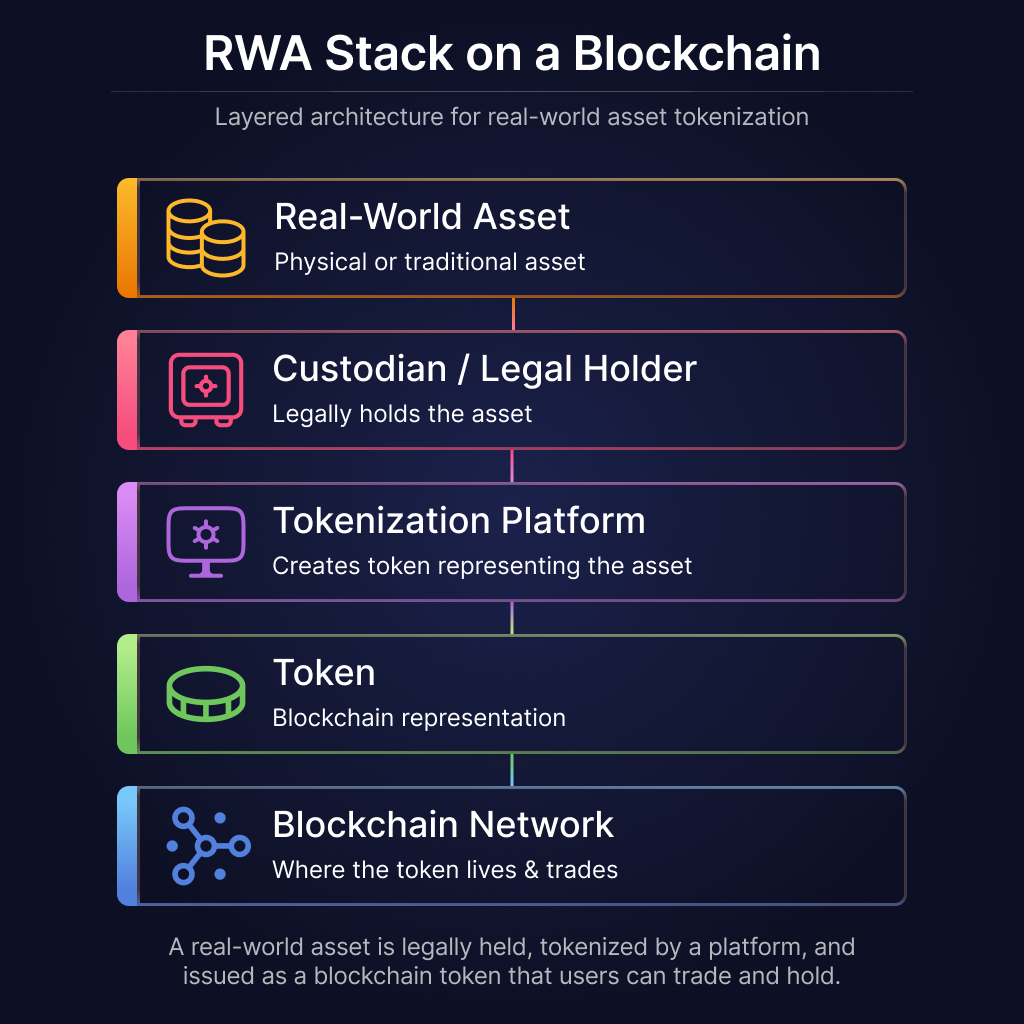
Real-world asset tokenization is spreading across various blockchain networks, with each network servicing a particular segment of the RWA ecosystem. Ethereum currently serves as a primary venue for stablecoins and regulated tokenized financial products. BNB Chain supports stablecoin activity and exchange-integrated tokenized assets, while Solana provides a high-throughput environment for stablecoins and selected tokenized instruments.
Alongside these established networks, several blockchains are building infrastructure specifically designed for compliant asset issuance, identity management, and permissioned tokens. These efforts indicate a broader trend toward specialized environments for different asset classes and regulatory requirements.
As traditional financial assets continue to move onchain, RWA activity is expected to remain distributed across multiple networks rather than consolidating onto a single chain. Network selection will likely depend on factors such as regulatory alignment, settlement requirements, cost, and integration with existing financial systems.
Thank you for checking out our Top Networks for Real-World Assets (RWAs) article! Make sure to follow us on X(Twitter) and let us know your thoughts. Sign up for our newsletter to stay up to date with MEW releases, and check out our weekly podcast Crypto Currents for the latest news in crypto.