
US stock markets close at 4 p.m. ET and stay shut all weekend. Tokenized stocks live on a blockchain, so they can be traded at 2 a.m. on a Sunday. That is useful if you live outside US time zones, but it raises a new question: what sets the price when the real market is closed? This article covers the benefits, the trade-offs, and how traditional exchanges are moving toward longer hours too.
Disclaimer: This article is for educational and informational purposes only and is not financial, investment, or trading advice. Tokenized stocks may not be available in all regions, and prices outside market hours can be more volatile. Always do your own research.
Jump To:
- Terms to Know
- Why Trade Outside Market Hours?
- The Challenges
- Traditional Markets Are Moving Toward Longer Hours
- Trading Tokenized Stocks Around the Clock: What to Keep in Mind
Terms to Know
- Tokenized stock: A blockchain token that tracks the price of a real stock, typically backed by shares held by a custodian.
- Underlying: The real stock or ETF a token tracks.
- Regular trading hours: 9:30 a.m. to 4 p.m. ET, Monday to Friday, excluding market holidays.
- Slippage: The gap between the price you expect and the price you actually get.
- Liquidity: How easily an asset can be converted into another asset or cash. Larger trades have less effect on the price in markets with more buyers and sellers, known as deeper liquidity.
- Price gap: A jump between a market's closing price and its next opening price.
Why Trade Outside Market Hours?
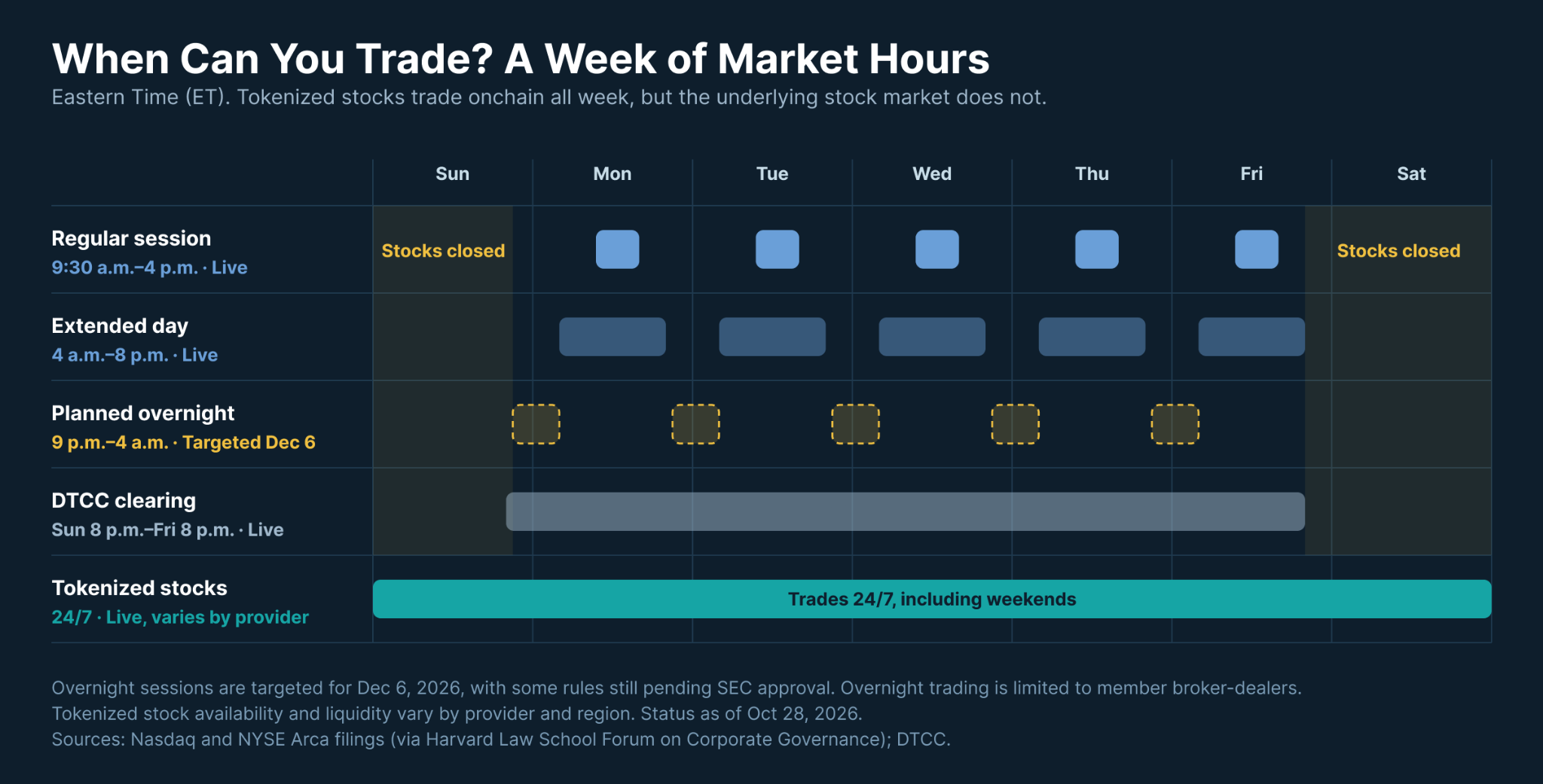
US markets are open about 6.5 hours a day, five days a week. For someone in Singapore or Berlin, that session lands in the middle of the night. Tokenized stocks remove that constraint on the onchain side:
- Global access: Trade when it suits your time zone, not New York's, which is especially useful when getting US stocks from outside the US. Availability still depends on the provider and your region.
- Faster reactions: News that lands after the close, like earnings or economic data, can be acted on right away instead of at the next open.
- Always-on wallet: Tokens sit in your own wallet, so you can move or swap them whenever you choose.
Tokenized Stock Trading When Markets Are Closed
Trading at night does not mean the stock market is open. Three things are worth understanding.
Thinner liquidity and slippage. Fewer buyers and sellers are active when US markets are closed. Larger orders can move the price more, and the price you receive can differ from the quote. Many swap interfaces show a minimum amount you will receive, which is worth checking before you confirm.
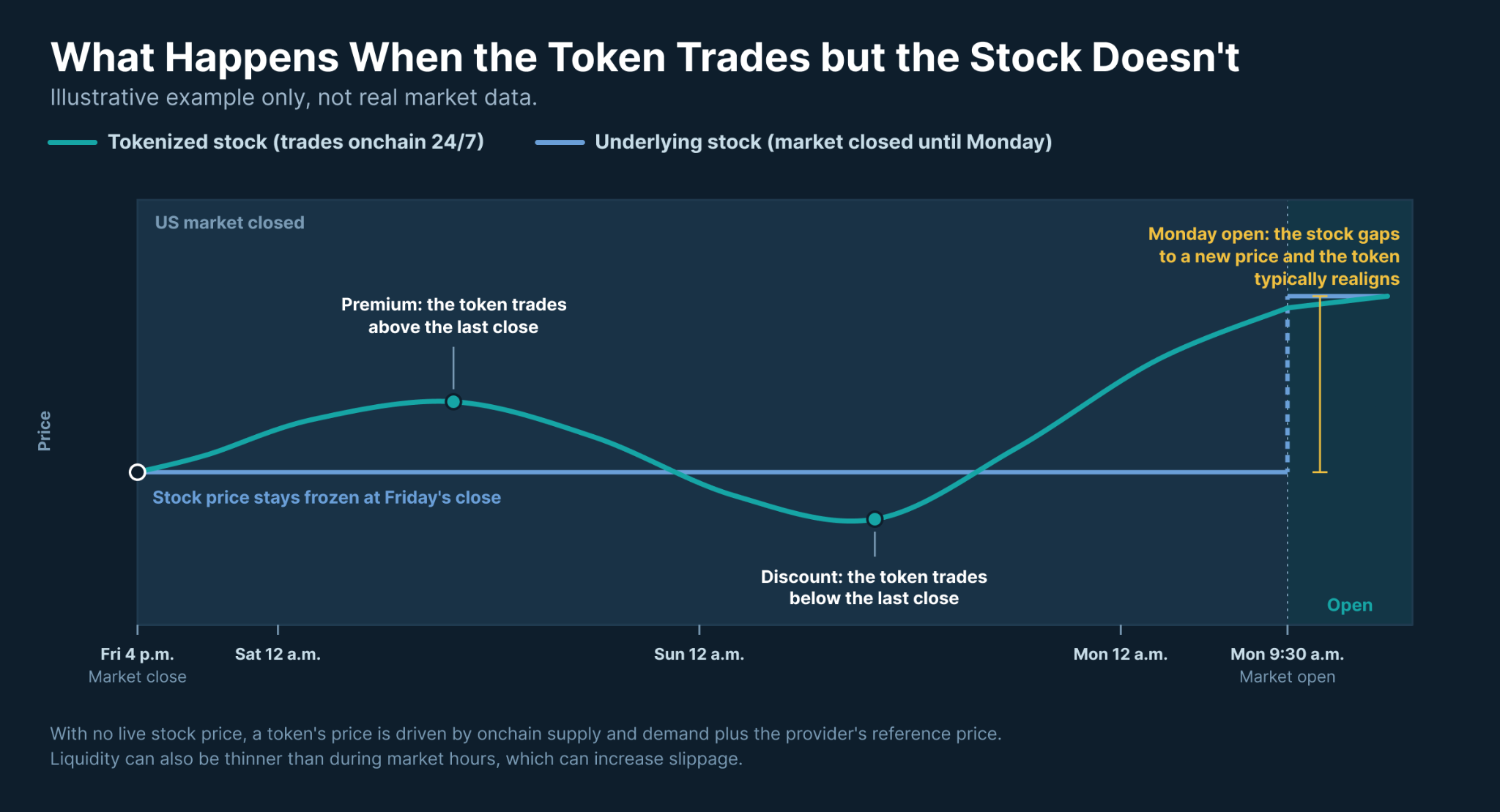
The token trades, but the stock doesn't. With the real market closed, there is no live stock price to follow. The token's price is then driven by onchain supply and demand, plus whatever reference price the provider uses, such as the last close. That can leave the token at a premium or discount to the last close. When the market reopens, the stock can gap, meaning it opens at a price different from its last close. The token and the stock usually realign at that point. Whether you can mint or redeem tokens while the market is closed depends on the issuer.
Corporate actions and news. Dividends, splits and mergers are processed on market time, and exchanges plan trading halts for some of them. A token trading overnight may not reflect these events until the market reopens. Our article on corporate actions explains how they work.
Traditional Markets Are Moving Toward Longer Hours
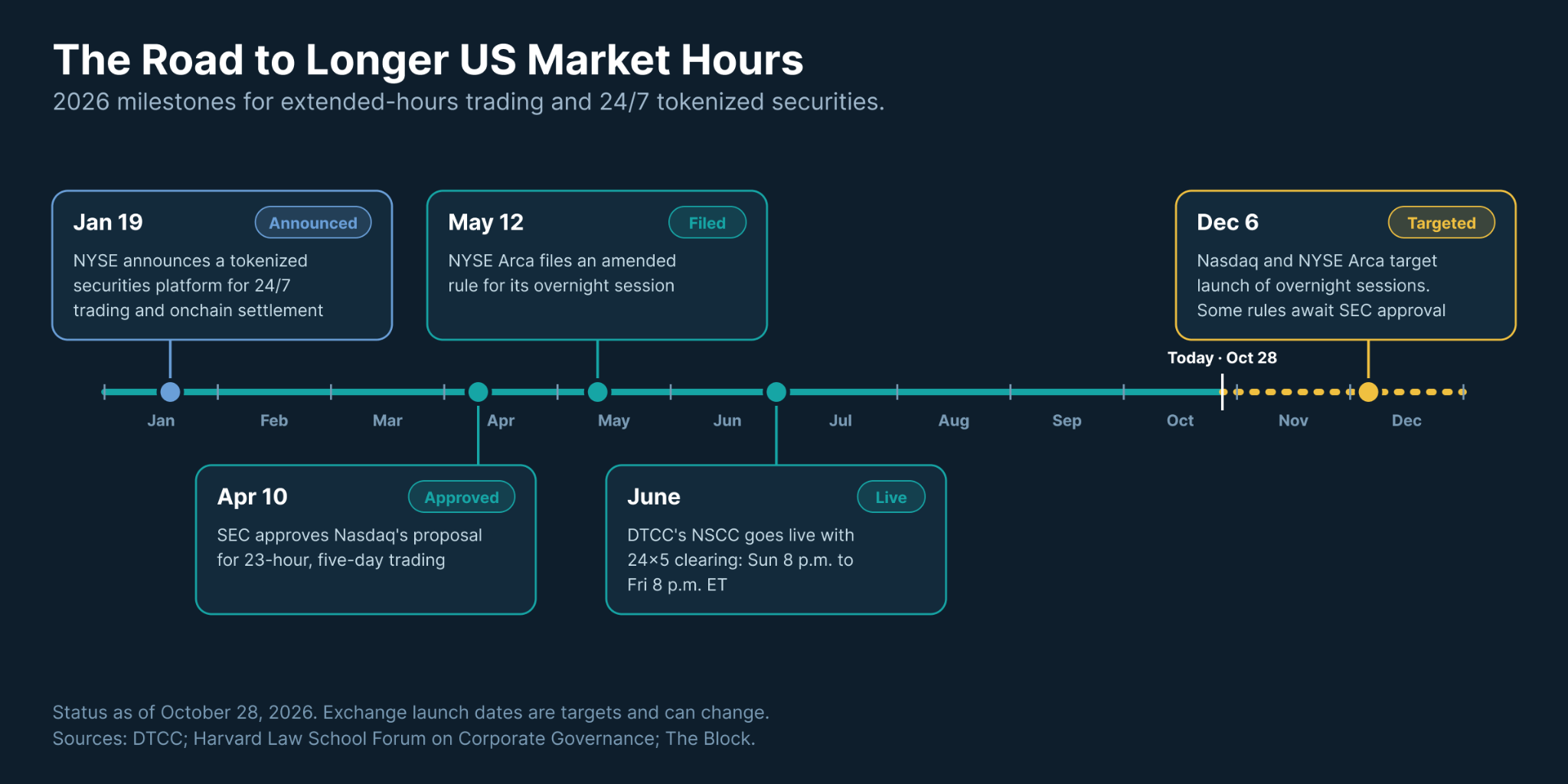
The gap between tokens and their underlying stocks is narrowing from the other side. US markets already run extended sessions, and the infrastructure behind them is being upgraded for near-round-the-clock trading. As of late October 2026:
Together, the planned overnight sessions would put US markets at about 23 hours a day, five days a week, with a one-hour pause from 8 to 9 p.m. ET Monday to Thursday. Overnight trading is limited to member broker-dealers, so retail access would run through a broker. NYSE has also announced a platform for 24/7 trading and onchain settlement of tokenized securities, subject to regulatory approval.
Even with longer hours, weekends and holidays stay closed for the underlying stock, so price gaps between tokens and stocks are likely to shrink rather than disappear.
Trading Tokenized Stocks Around the Clock: What to Keep in Mind
Tokenized stocks offer flexibility that traditional markets can't yet match: trade from any time zone, any day of the week. Outside regular hours, a token and its stock can drift apart and liquidity can thin out, so it helps to understand how a given product prices and settles. As exchanges and clearing systems extend their hours, those differences are likely to narrow. To see how this works in practice, read our article on Tokenized Stocks in MEW.
Thank you for checking out our article on Trading Tokenized Stocks Outside Market Hours! Make sure to follow us on X(Twitter) and let us know your thoughts. MEW rewards active traders — see our Rewards page for all ongoing campaigns. Sign up for our newsletter to stay up to date with MEW releases, and check out our weekly podcast Crypto Currents for the latest news in crypto. For more on stocks and ETFs and how they're evolving onchain, check out our articles on What Are RWAs?, Are All Tokenized Stocks the Same? and What Are ETFs?.