
If you're just getting into trading, you'll quickly come across a couple of terms that refer to different types of trading: spot trading and derivatives trading. It’s important to understand the distinction because they work very differently and come with different levels of risk, flexibility, and complexity.
Let's break them down in a simple way.
What is spot trading?
Spot trading is the most straightforward type of trading.
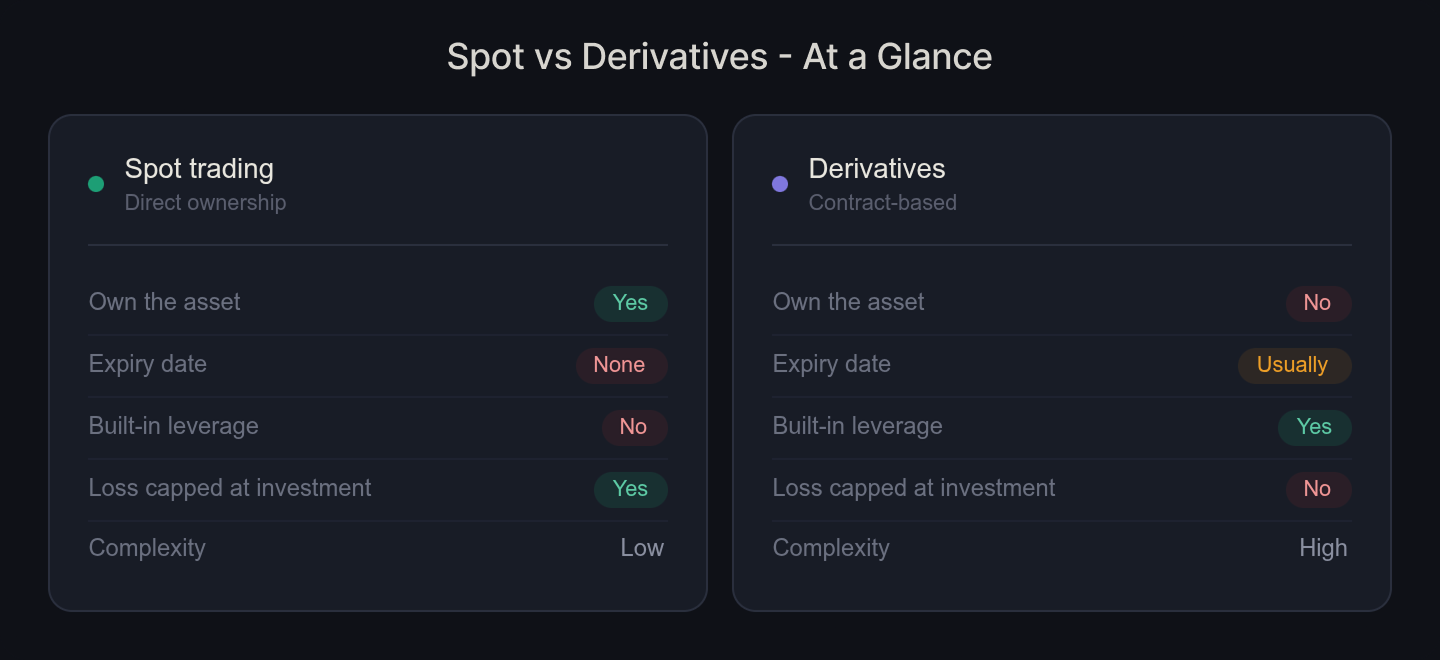
It means buying or selling an asset for immediate delivery. When you buy something on the spot market, you actually own it.
Key characteristics:
- You own the asset (stocks, crypto, commodities, etc.)
- Trades settle "on the spot" — instantly or very quickly
- Profit comes from the price going up and you collect that profit when you sell the asset for the higher price
- No expiry date — you can hold the asset for as long as you want, there's no deadline forcing you to sell
- No built-in leverage — you're only ever trading with money you actually have, which keeps the risk straightforward
- Your losses are capped at what you invested — the asset can drop in value, but it can never go below zero, so you can't lose more than you put in
- Lower complexity compared to derivatives
Example: If you buy Bitcoin on a spot exchange, it goes into your wallet. You now own that Bitcoin and can hold or sell it whenever you want.
What is derivatives trading?
Derivatives trading is more advanced.
Instead of owning the asset, you trade contracts that track the price of an asset. Your profit or loss depends on how the price moves — not on owning the asset itself.
Key characteristics:
- You don't own the underlying asset — you're trading a contract that tracks its price
- Most derivatives have an expiry date — meaning the contract has a deadline, after which it closes automatically (perpetual contracts are the exception)
- You can profit from both rising and falling prices — you choose a direction (up or down), and if the market moves the way you predicted, you profit; if it moves against you, you lose
- Often involves leverage (borrowed funds) — this amplifies both your potential gains and your potential losses
- Your losses are not capped at your initial investment — depending on the instrument and leverage used, it's possible to lose more than you put in
Example: If you buy a Bitcoin futures contract, you don't hold any actual Bitcoin. You're simply betting on whether the price will go up or down by a certain date.
Types of derivatives
The name of this type of trading comes from the concept itself — a derivative derives its value from an underlying asset. That asset can be a stock, a cryptocurrency, a commodity, an index, or virtually anything else that has a price.
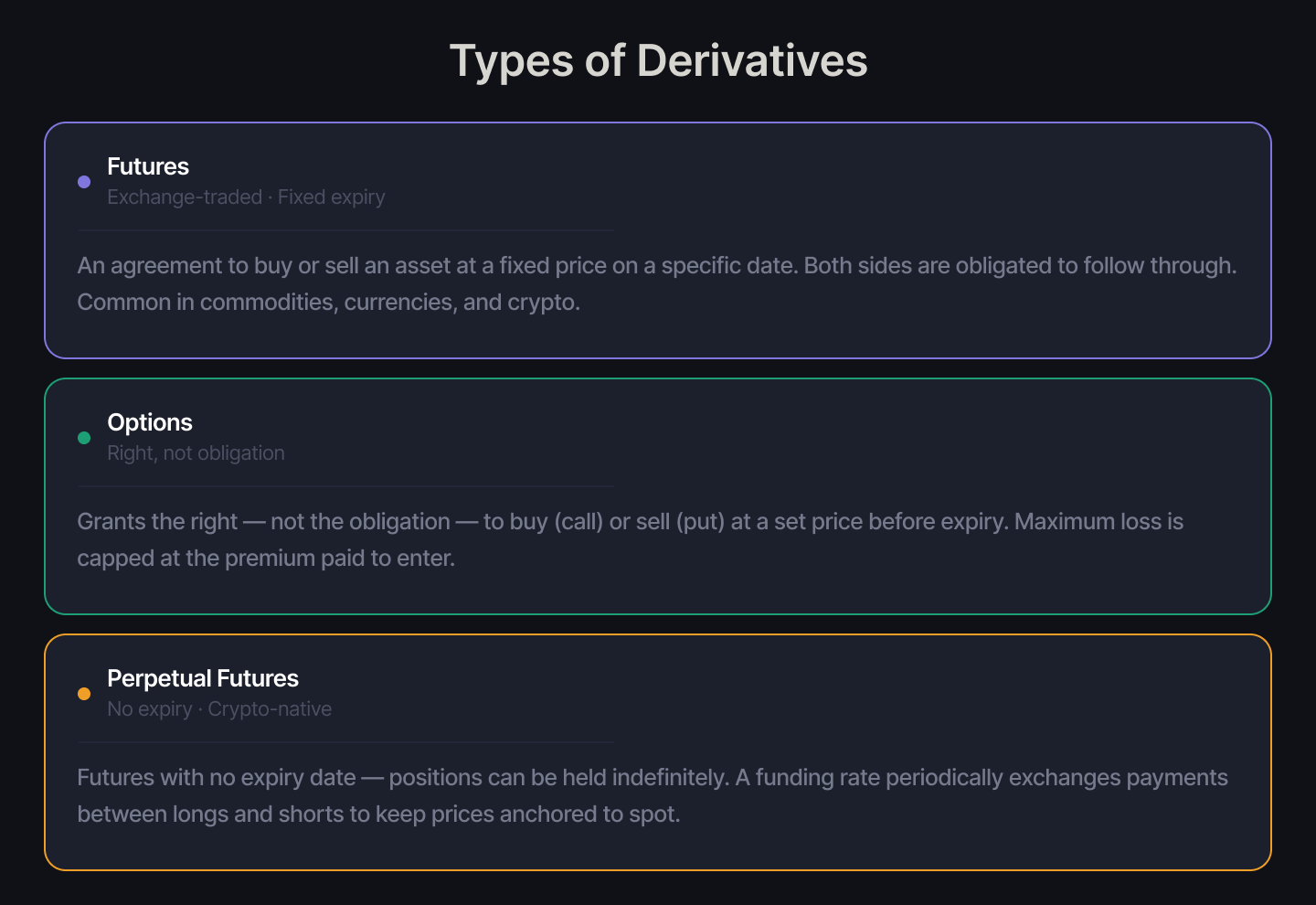
There are several types of derivative instruments, each working a little differently:
Futures are agreements to buy or sell an asset at a fixed price on a specific future date. Both parties are locked in — neither can walk away. They're common in commodities like oil and gold, as well as in crypto markets.
- Example: You agree to buy 1 Bitcoin at $80,000 in 30 days. Whether the price goes to $60,000 or $100,000 by then, you're locked into that $80,000 price — for better or worse.
Options give you the right — but not the obligation — to buy or sell an asset at a set price before a certain date. If the trade doesn't go your way, you can let the contract expire. Your maximum loss is just the upfront fee (called the premium) you paid to enter.
- Example: You pay a $200 premium for the right to buy Bitcoin at $80,000 within the next month. If Bitcoin rises to $90,000, you exercise your option and profit. If it drops to $60,000, you simply let the contract expire — you only lose the $200 premium.
Perpetual futures are like regular futures we covered above, but with no expiry date. You can hold the position as long as you want. They're hugely popular in crypto. A mechanism called the funding rate periodically exchanges small payments between traders on each side of the market to keep the contract price aligned with the real spot price.
- Example: You open a long (buy) position on Bitcoin at $80,000 with no expiry. Usually, you only have to pay a fraction of the $80,000 as collateral, depending on chosen leverage (see more on leverage below). As long as you keep the position open and maintain enough margin (meaning, add more funds if your losses eat into your collateral) , the position stays active — whether that's for one hour or three months. You can profit when Bitcoin price rises above your entry of $80,000.
The following instruments are not usually encountered by everyday retail traders and more commonly used by institutions, but are worth knowing about:
Forwards are agreements between two parties to buy or sell an asset at a predetermined price on a specific future date. They are negotiated directly between two parties (as opposed to on an exchange), binding on both sides, and are settled at the agreed date.
Swaps are agreements between two parties to exchange financial obligations over time, like a series of forwards. Most commonly this involves swapping a fixed interest rate for a floating one. These are mainly used by institutions and trade privately, not on public exchanges.
Contracts for Difference (CFDs) are similar to forwards, but have no fixed expiration date and are purchased through a broker instead of being agreed on by two parties. Profit (or loss) is determined based on the difference between the price when the trade is opened and closed. CFDs are not legal in the US due to their high risk and leverage.
What about leverage and margin?
As you learn more about trading, you will also encounter references to leverage and trading on margin. This is where things get more interesting — and more risky.
Leverage means controlling a position that's larger than the funds you actually have, by borrowing the rest. It's available in both spot and derivatives trading, but it works a bit differently in each.
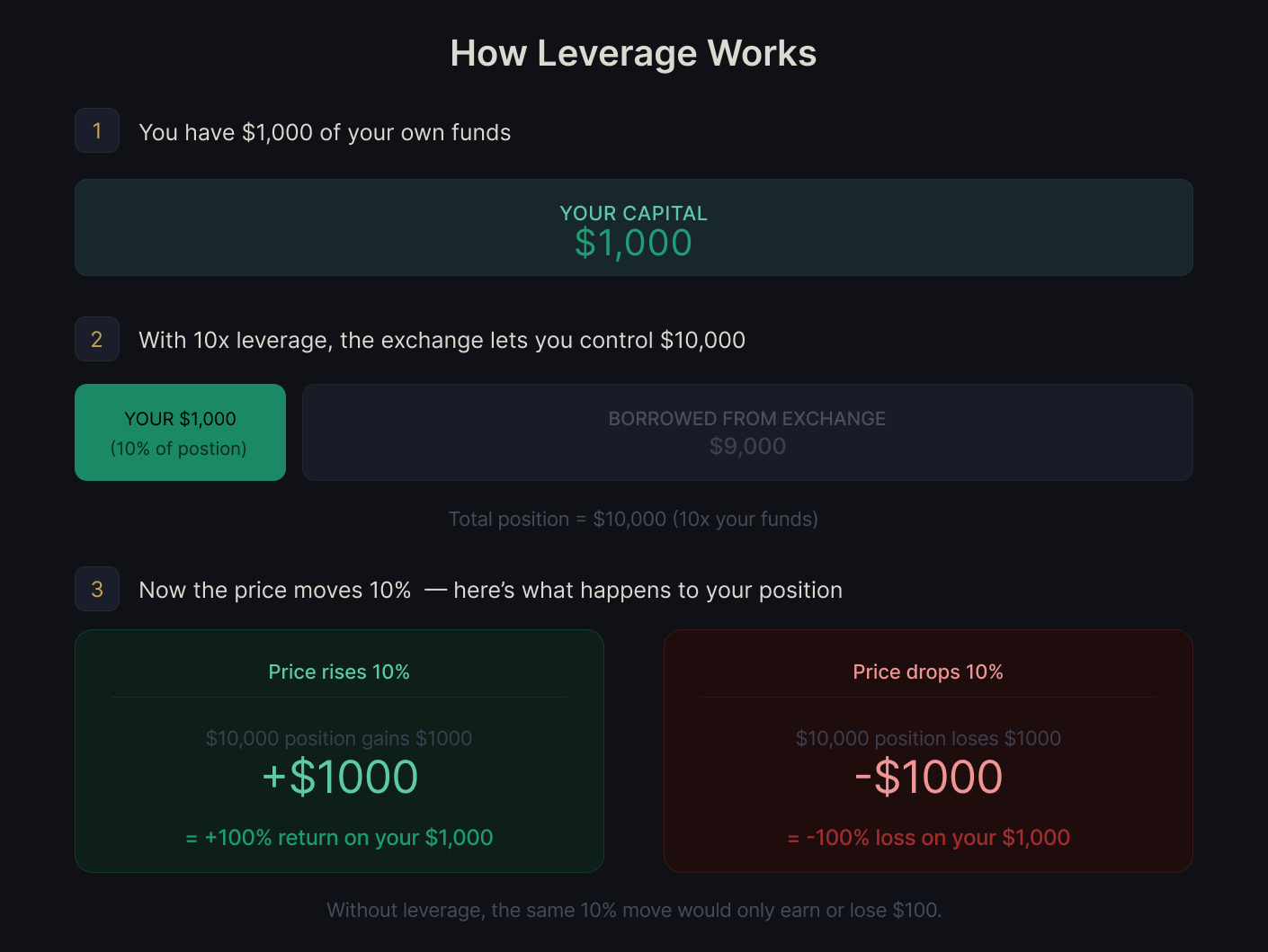
Think of it this way: with $1,000 and 5x leverage, you control a $5,000 position. A 10% price move in your favour earns you $500 — a 50% return on your $1,000. But a 10% move against you wipes out $500, half your capital. Leverage cuts both ways.
Spot margin trading
In spot margin trading, you borrow funds from your broker or exchange to buy more of an asset than your capital alone would allow. You still own the underlying asset — part of it is just financed with borrowed funds, on which you pay interest.
The reason someone would do this is simple: if you're confident an asset's price is going up, margin lets you increase your position size and get more out of that move than you could with your own funds alone. Instead of making $100 on a 10% gain, you might make $300 — because you borrowed to hold a larger position. Of course, the same logic works in reverse if the price drops.
If losses bring your account below a certain threshold, you'll get a margin call — meaning you either add more funds, or your position gets automatically closed to repay the loan.
- Example: You have $1,000 and borrow another $2,000 to buy $3,000 worth of Bitcoin. If Bitcoin drops 30%, your position is now worth $2,100 — barely enough to cover the $2,000 you borrowed. At this point, the exchange may issue a margin call. If you don't top up your account, your position gets closed, the $2,000 loan is repaid, and you've lost almost all of your original $1,000.
Derivatives with leverage
Derivatives are designed with leverage built in. When you open a futures or perpetual contract, you only put up a fraction of the total position value as margin. But your profits and losses are based on the full position size.
In crypto markets especially, leverage on derivatives can reach 50x, 100x, or even higher — meaning even a small price move can wipe out your margin entirely.
Despite the risk, perpetual contracts in particular have exploded in popularity in crypto. They're fast, flexible, require no expiry management, and allow traders to take large positions with relatively little capital. For skilled traders — and the crypto degens — perps are the instrument of choice precisely because of the high stakes. The potential to turn a small move into a large gain is the appeal. The flipside is that the same mechanics can wipe an account just as quickly.
- Example: You open a long position on Bitcoin at $80,000 using 10x leverage, putting up $1,000 as margin. This gives you a $10,000 position. If Bitcoin rises 10% to $88,000, your position gains $1,000 — doubling your margin. But if Bitcoin drops just 10% to $72,000, your $1,000 margin is entirely wiped out and your position gets liquidated. You don't need a 50% crash to lose everything — at 10x leverage, a 10% move against you is enough.
Key Differences
Spot trading involves direct ownership of an asset, no expiry dates, and losses capped at the amount invested. It's the most straightforward and low-risk way to participate in a market.
Derivatives don't involve owning the underlying asset. They're time-bound instruments (except perpetuals), carry inherent leverage, and can result in losses that exceed the initial margin deposited. They're used for a wide range of purposes, from hedging existing positions to speculating on price direction.
Leverage amplifies exposure in both directions. Whether applied through spot margin or derivatives, it increases both the potential return and the potential loss relative to the capital committed. Understanding your liquidation price — the point at which your position is automatically closed — is an essential part of trading any leveraged instrument.
Thank you for checking out our article on the Difference of Spot, Derivatives and Leverage Trading! Make sure to follow us on X(Twitter) and let us know your thoughts. Sign up for our newsletter to stay up to date with MEW releases, and check out our weekly podcast Crypto Currents for the latest news in crypto.