A Simple Guide to Exchange-Traded Funds
Exchange-Traded Funds (ETFs) are one of the most widely used investment products in modern financial markets. They allow investors to gain exposure to a basket of assets—such as stocks, bonds, or commodities—through a single security that trades on a stock exchange. Instead of buying many individual assets, investors can purchase one ETF share that represents a portion of the entire portfolio held by the fund.
ETFs were originally developed within traditional financial markets and have grown into a multi-trillion-dollar industry used by both retail and institutional investors. Today they are also beginning to appear in blockchain ecosystems as tokenized financial assets, bringing familiar investment structures into decentralized infrastructure.
How ETFs work
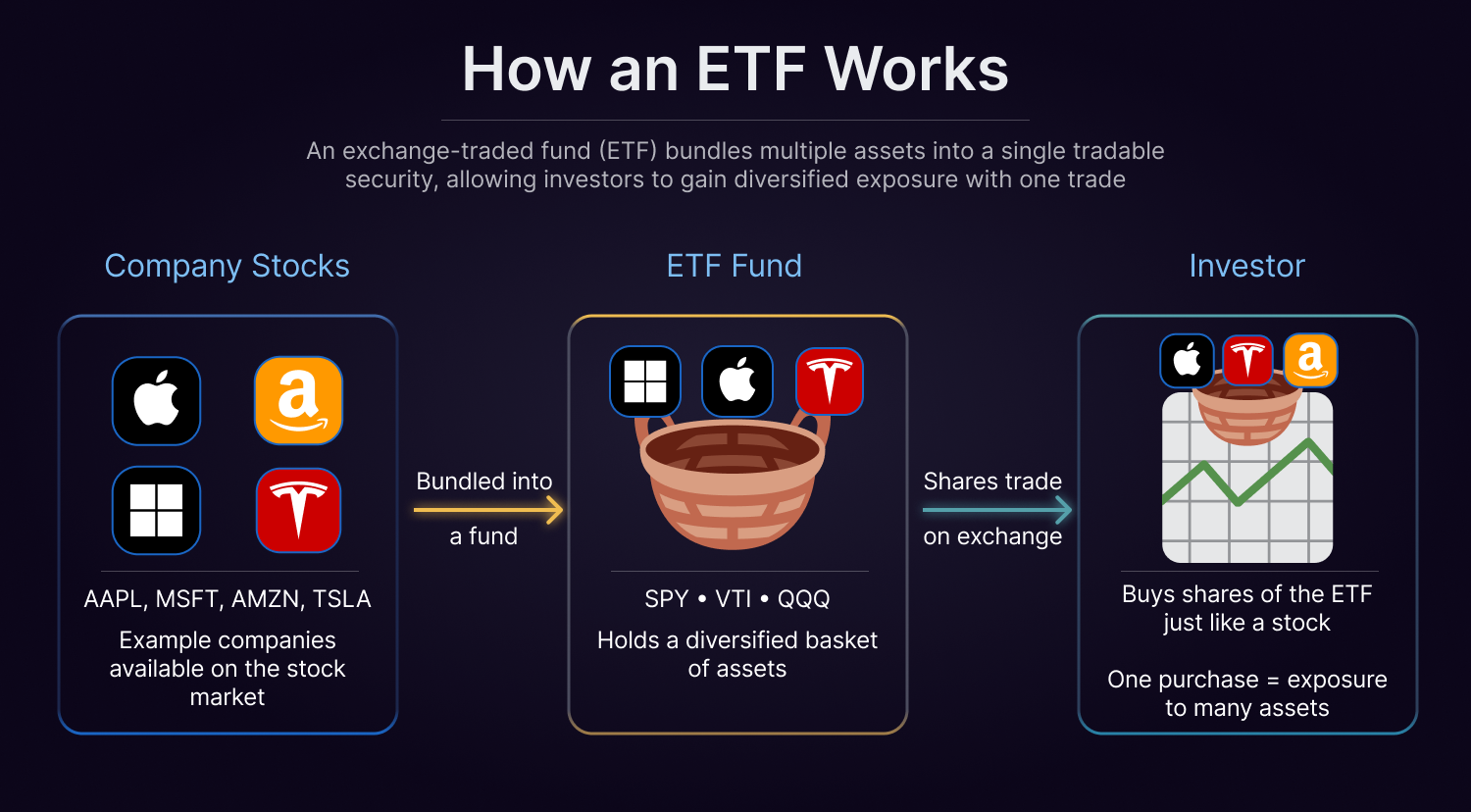
An Exchange-Traded Fund is an investment fund that holds a collection of assets and trades on an exchange in the same way as a stock. When someone buys shares of an ETF, they are purchasing exposure to the assets contained within that fund rather than to a single company or security.
This structure allows ETFs to track a wide range of financial markets. Some ETFs follow major stock indexes, while others track commodities, bonds, or specific sectors of the economy. Because they trade on exchanges throughout the day, investors can buy and sell ETF shares whenever markets are open, just like ordinary stocks.
Examples of Popular ETFs
Some of the most widely traded ETFs track major financial indexes. An index is a benchmark that tracks the performance of a group of securities representing a specific market, sector, or strategy. By following an index, ETFs allow investors to gain exposure to many assets at once rather than selecting individual stocks. For example, SPDR S&P 500 ETF Trust ($SPY) follows the performance of the S&P 500, providing exposure to hundreds of large U.S. companies such as Apple, Microsoft, and Amazon. It is one of the largest ETFs in the world and is commonly used as a benchmark for the U.S. stock market.
Another well-known fund is Invesco QQQ Trust ($QQQ), which tracks the Nasdaq-100 and focuses heavily on technology and growth companies including Nvidia, Apple, and Microsoft. Investors seeking exposure to the broader U.S. market often use Vanguard Total Stock Market ETF ($VTI), which includes thousands of companies across large-, mid-, and small-capitalization stocks.
ETFs are not limited to equities. Commodity funds such as SPDR Gold Shares ($GLD) are designed to track the price of gold, giving investors exposure to the commodity without needing to hold the physical metal.
Why ETFs Became So Popular
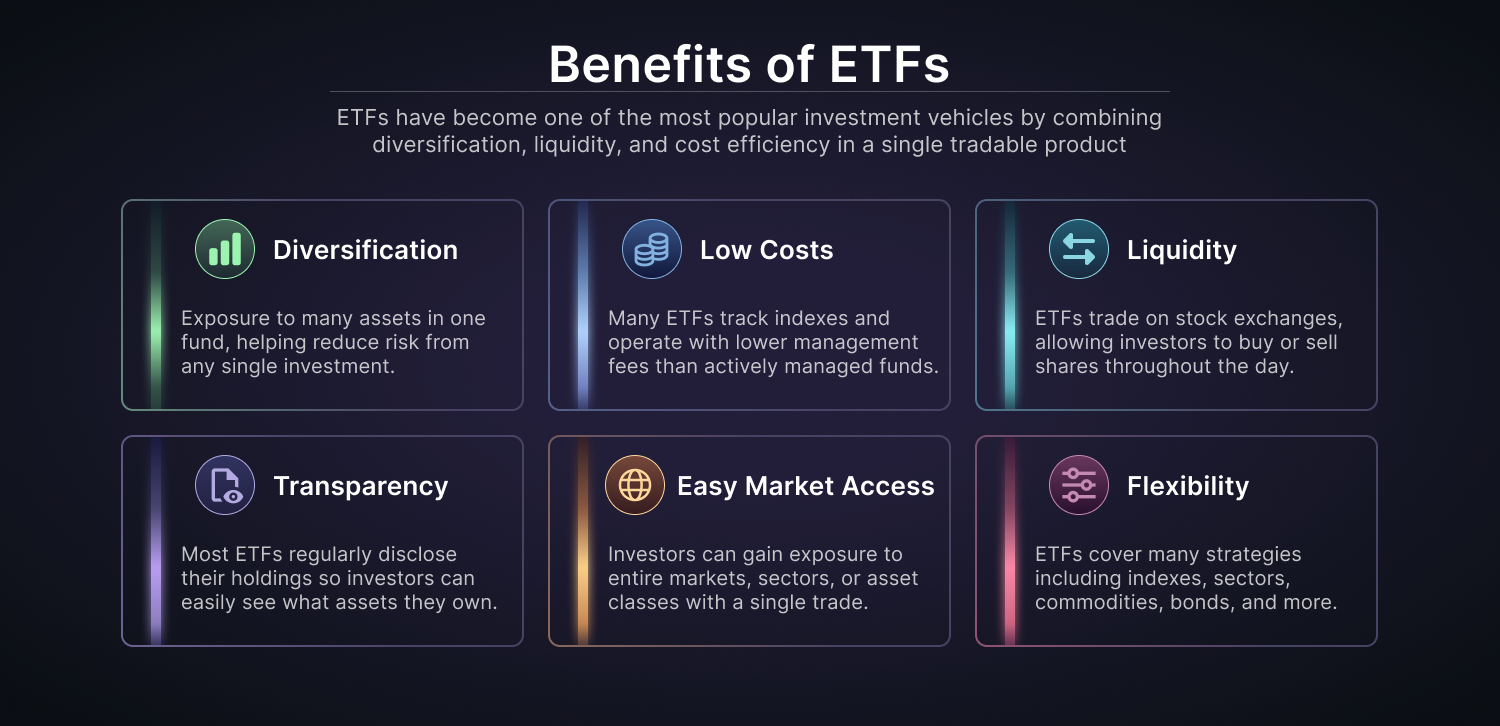
ETFs have grown rapidly in popularity because they provide a simple and efficient way to diversify investments. Instead of researching and purchasing dozens of individual securities, investors can gain exposure to an entire market, sector, or strategy through a single trade. This makes ETFs particularly useful for long-term portfolio building and simplifies portfolio construction for both new and experienced investors.
Cost efficiency has also played a major role in their growth. Many ETFs are designed to track an index rather than actively select investments, allowing them to operate with lower management fees than many traditional funds. Because ETFs trade on exchanges like individual stocks, they also offer strong liquidity, enabling investors to buy or sell shares throughout the trading day.
Another key advantage is transparency. Most ETFs regularly disclose the assets they hold, making it easy for investors to understand exactly what they own. By combining diversification, lower costs, liquidity, and transparency, ETFs offer a convenient alternative to buying individual stocks while still providing broad exposure to financial markets.
ETFs vs Index Funds vs Mutual Funds
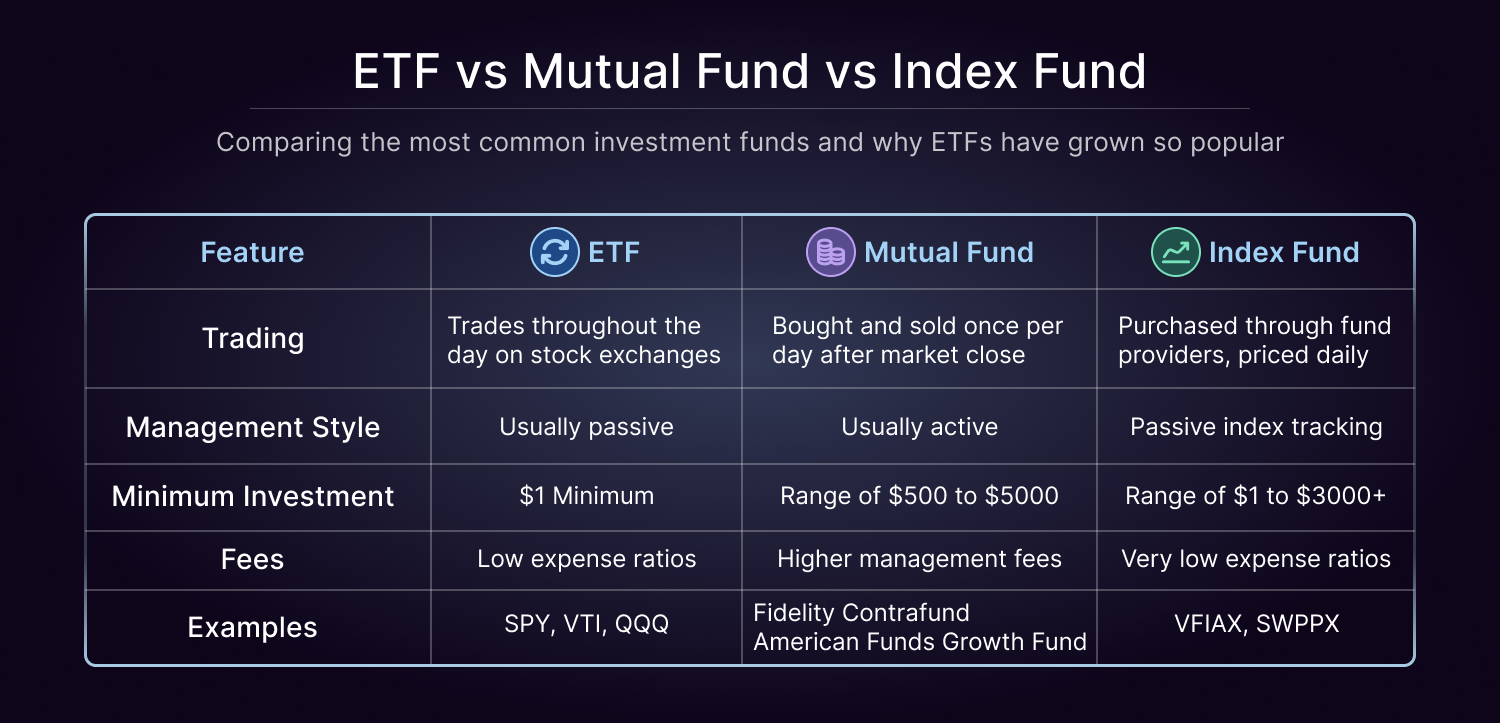
ETFs are often compared with index funds and mutual funds because all three pool money from investors to buy a diversified set of assets. The key differences largely come from how they are traded and managed.
ETFs trade on exchanges throughout the day, meaning investors can buy or sell them at market prices whenever markets are open.
Index funds typically track a specific index, but are purchased directly from fund providers and priced only once per day after markets close.
Mutual funds represent the broader category of pooled investment funds. Many of them are actively managed, meaning professional managers select investments in an attempt to outperform the market. This active management can lead to higher fees compared with ETFs or index funds that simply track an index.
What Are Tokenized ETFs?
As financial assets move onto blockchain infrastructure, ETFs are beginning to appear in tokenized form. A tokenized ETF is a digital token issued on a blockchain that represents ownership or economic exposure to an ETF or ETF-like investment basket.
These tokens are designed to mirror the value of their underlying assets while benefiting from blockchain features such as faster settlement and global accessibility. Investors can potentially trade them with fewer intermediaries and in smaller fractional amounts than traditional markets allow.
Projects working in the tokenized asset space, including platforms like Ondo Finance, Backed Finance and Synthetix, are exploring ways to represent traditional financial products—including ETFs—on blockchain networks.
Examples of tokenized ETF-style assets include SPYon and QQQon from Ondo Finance, along with products like bSPY and bNDX issued by Backed Finance, which mirror popular ETF exposures onchain. This emerging sector is part of the broader trend known as real-world asset tokenization, where traditional financial instruments are represented as blockchain-based tokens.
The Future of ETFs
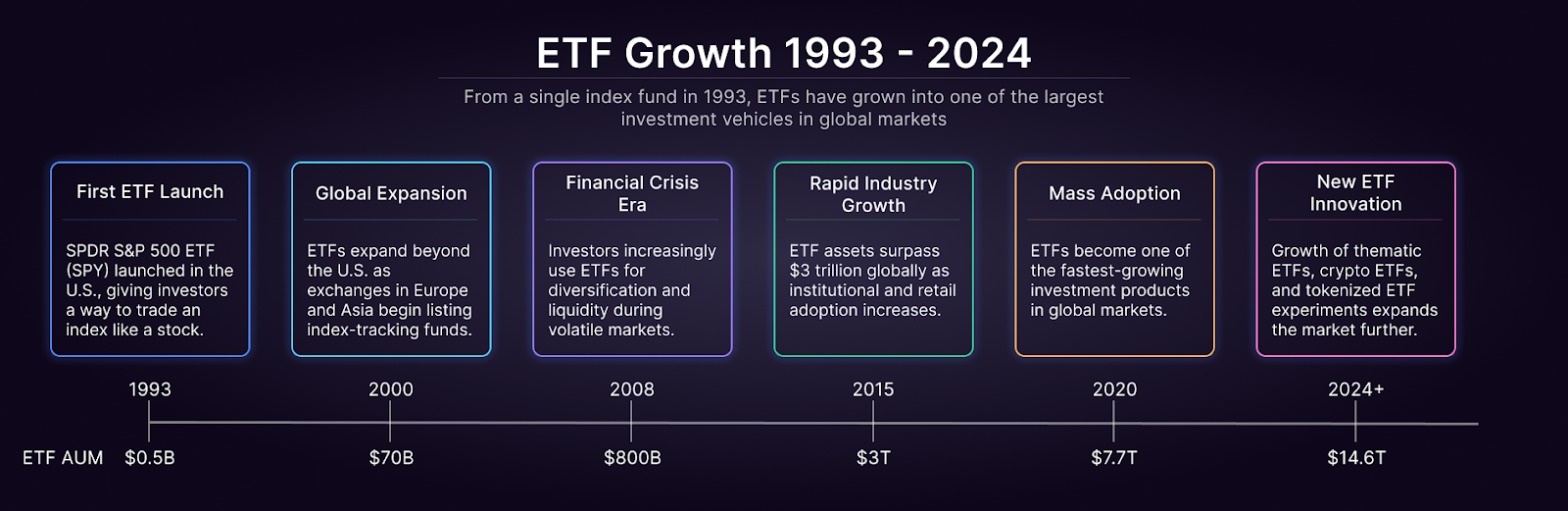
The ETF industry has grown dramatically over the past two decades and now represents trillions of dollars in global assets. Their combination of diversification, liquidity, and low costs has made them one of the most widely adopted financial products in modern investing.
Looking forward, several trends could shape the next phase of ETF evolution. New thematic funds are emerging that focus on specific sectors such as artificial intelligence, clean energy, and robotics. At the same time, technology may allow investors to create increasingly customized baskets of assets that function similarly to ETFs.
Blockchain technology may also play a role in the future of ETFs. Tokenized investment funds could enable global trading, fractional ownership, and near-instant settlement, potentially expanding access to these products far beyond traditional financial markets.
Final Thoughts
ETFs have transformed the investment landscape by making diversified portfolios easier and more affordable for millions of investors.
By combining the diversification of traditional funds with the flexibility of stock trading, ETFs have become one of the most widely used financial tools in modern markets.
As financial products increasingly move onto blockchain networks, tokenized ETFs may represent the next evolution, merging traditional investing with the speed and accessibility of digital assets.
Thank you for checking out our article on What Are ETFs! Make sure to follow us on X(Twitter) and let us know your thoughts. Sign up for our newsletter to stay up to date with MEW releases, and check out our weekly podcast Crypto Currents for the latest news in crypto.