Untangling the narratives and interactions between two of tech’s most exciting frontiers
Artificial intelligence and crypto have become the twin lightning rods of modern technology—high-velocity, high-risk, and always at the center of market sentiment. When AI booms, some say users flee crypto; others claim AI interest fades when crypto rallies. Lately, a common explanation for crypto downturns has been: “The AI bubble drained the oxygen from the room.”
The reality is more nuanced. The AI surge both does and does not impact crypto—depending on which angle you take. Perhaps neither industry can be viewed in isolation from the other, but the outcome is not necessarily zero-sum. Here's the balanced breakdown.
Disclaimer: The information provided in this article is for educational and informational purposes only and should not be considered financial, investment, or trading advice. Always do your own research and consult with a qualified financial advisor before making any investment decisions. Cryptocurrency and AI markets are highly volatile and carry significant risk.

Why People Believe an AI Bubble Is Forming
Before asking whether the AI boom affects crypto, it helps to understand why so many people think an AI bubble exists in the first place. Over the past year, conversations about AI valuations have intensified—not just in tech circles, but across mainstream media, corporate boardrooms, and financial markets. The concern is simple: AI spending is exploding faster than AI revenue.
Supporters of the “bubble” view argue that the signs look familiar. AI startups are being valued at levels far beyond their current earnings, GPU demand is so intense that companies are buying hardware faster than they can even deploy it, and many business models rely more on theoretical future productivity than clear, immediate monetization. To these observers, AI resembles previous tech cycles—cloud, mobile, blockchain—where enthusiasm briefly outpaced what the technology could deliver in the short term.
But the counterargument is just as strong. Many analysts claim calling it a bubble misunderstands what’s happening. Unlike speculative tech booms of the past, AI already generates real revenue in areas like chips, cloud services, and enterprise automation. Corporations aren’t buying GPUs because it’s trendy—they’re doing it because there are measurable efficiency gains on the table. And historically, every foundational technology looks overbuilt at the start: the early internet, cloud datacenters, even smartphones. What once appeared excessive often became essential.
In other words, the debate isn’t whether AI is overhyped—it’s whether we’re witnessing excess optimism or the early infrastructure phase of a technology that will underpin everything. This debate matters for crypto because it shapes how people interpret crypto’s performance next to AI’s explosive rise.
Why People Believe the AI Bubble Hurts Crypto
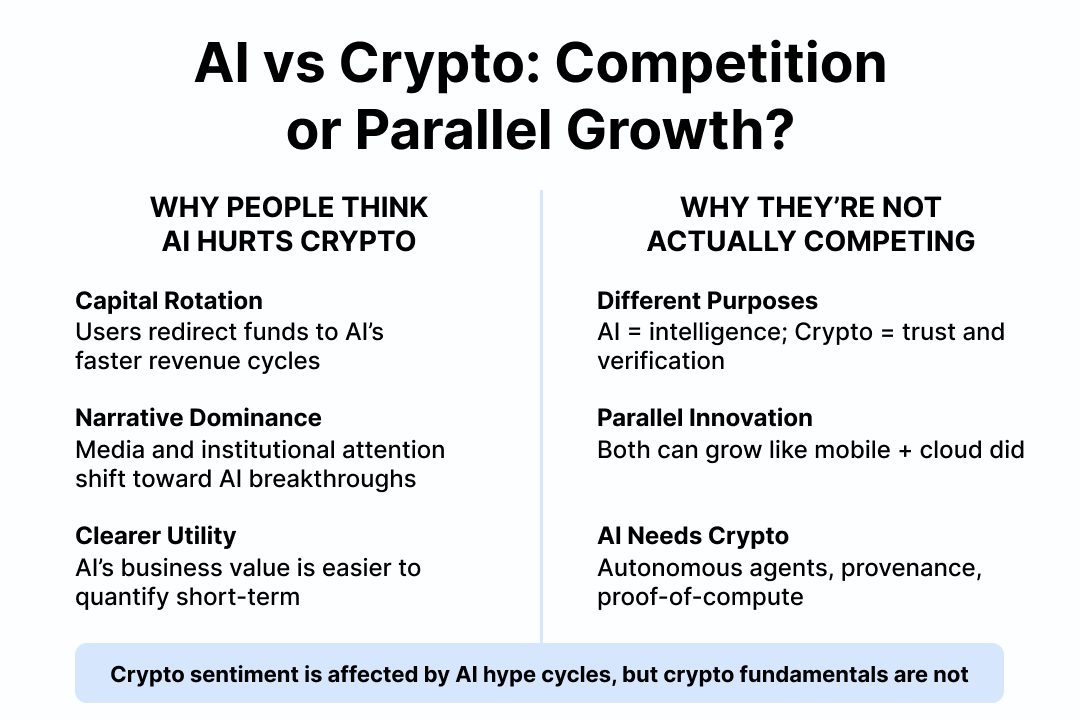
1. Capital Rotation in Risk Markets
Venture capital, hedge funds, and users have finite attention and finite capital. When AI infrastructure companies show near-instant revenue (chips, GPUs, cloud services, enterprise tools), capital naturally rotates into what looks like the “safer” high-growth frontier.
- AI startups raise billions.
- GPU-rich companies show real earnings.
- Crypto projects—especially early-stage ones—often don’t.
So the argument is: capital flows where momentum is strongest, and recently, that momentum has been AI.
2. Narrative Dominance
Markets run on stories as much as fundamentals. Today, AI is the strongest narrative in tech—driving headlines, boardroom strategy, enterprise budgets, and stock-market excitement.
Crypto also has a major unfolding narrative—Real-World Assets (RWAs)—but it’s harder for most people to understand, especially when its underlying value is more abstract than AI’s immediately clear use cases.
Narrative dominance matters because attention drives liquidity.
3. AI Is Easier To Understand
AI’s value proposition is easy to see:
- Faster work
- Cheaper labor
- Better automation
- Direct enterprise adoption
Crypto’s pitch—decentralization, self-custody, new financial primitives—is powerful long-term but harder to quantify in quarterly earnings.
This creates the perception that crypto is “speculative,” while AI is “productive.”
4. If the AI Bubble Pops, Markets Could Fall—and Crypto Often Follows
A more macro version of the argument is: If AI crashes, risk markets crash—and crypto usually correlates with risk markets.
When liquidity dries up, tech stocks fall, volatility rises, and users de-risk, crypto frequently gets dragged down with everything else.
But whether crypto strictly follows the broader market is debated:
- When liquidity is tight, crypto does tend to correlate with tech stocks and high-beta assets.
- During strong crypto-native cycles, it decouples and trades on its own narratives (2017 ICO boom, 2020–21 DeFi + NFTs).
- In true crisis events, everything correlates—crypto included.
This argument says: even if AI and crypto aren’t competing directly, a bursting AI bubble could still suppress crypto prices simply because both sit in the same high-volatility asset class.
Why Crypto and AI Are Not Actually Competing
But here’s the other side: the idea that crypto depends on AI’s hype cycle—or vice versa—oversimplifies two radically different industries.
1. They Serve Different Needs
AI focuses on intelligence.Crypto focuses on trust.
AI increases what machines can do.Crypto increases how securely systems operate without centralized control.
You can have:
- AI without decentralization
- Crypto without intelligence
They solve entirely different problems.
2. Both Can Grow in Parallel
Just as cloud and mobile were parallel revolutions, AI and crypto can accelerate each other without cannibalizing demand.
Historical tech booms show this clearly:
- Mobile didn’t kill cloud.
- Cloud didn’t kill social.
- Social didn’t kill gaming.
Different tech revolutions often reinforce each other rather than replace each other.
3. AI’s Rise Actually Increases Demand for Crypto Infrastructure
Some emerging intersections:
- AI agents that need wallets for autonomous transactions
- AI compute marketplaces that run on blockchain coordination
- Proof-of-authenticity for AI-generated content
- Decentralized identity to confirm what is real vs synthetic
- Tokenized datasets or model ownership
The more AI scales, the more the world needs cryptographic verification, secure digital value, and trustless infrastructure.
AI expands; crypto becomes the foundation for verifying that expansion.
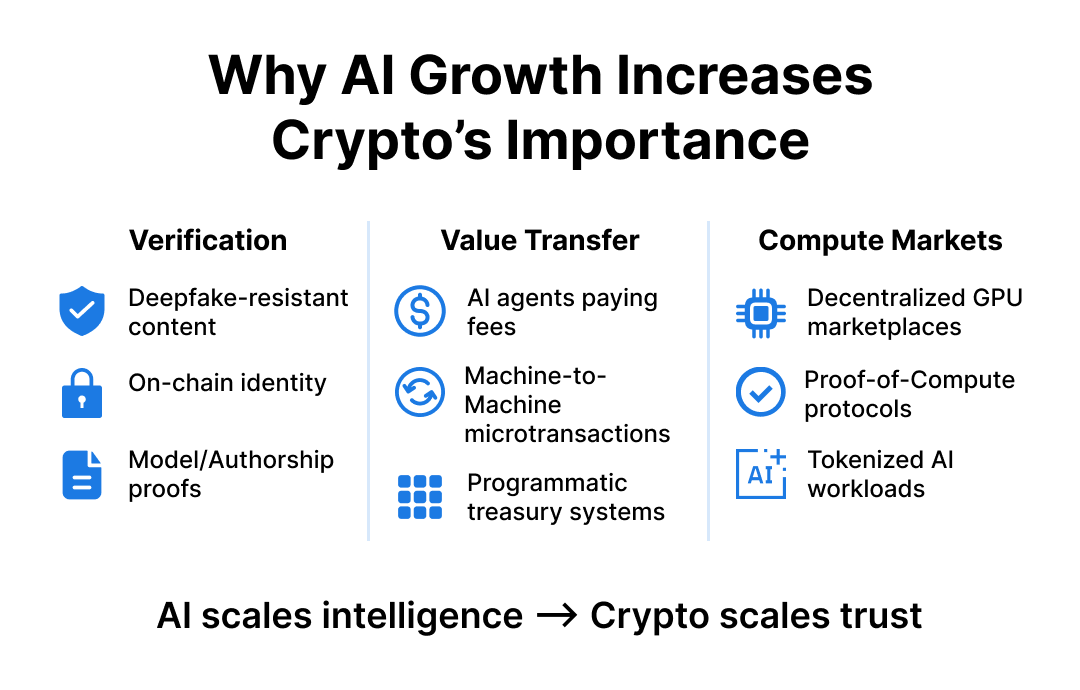
AI x Crypto Synergies
Verification
AI is generating more content and decisions than ever, but it’s getting harder to know what’s real. Crypto helps fix that by providing tools to verify where data came from, whether a model actually ran, and whether something has been tampered with. At the same time, AI helps make crypto systems smarter—spotting fraud, predicting network issues, and improving trading tools. AI creates, crypto verifies, and together they make digital information more trustworthy.
Value Transfer
As AI agents start acting on their own — buying data, accessing services, or paying for compute power — they need a way to move money without human approval. Crypto is the natural fit: it works globally, automatically, and without banks. AI then improves how these crypto systems run by making transactions more efficient and better timed. The relationship is simple: AI makes decisions, and crypto gives those decisions a way to move value instantly and reliably.
Compute Markets
Both AI and crypto depend on massive compute power, but crypto adds something new: decentralized marketplaces where anyone can rent out unused GPUs, and anyone can buy compute power with transparent pricing. This helps AI access cheaper, more flexible computing while also ensuring the work is verifiable. Meanwhile, AI makes these networks faster and more efficient. As AI demand skyrockets, decentralized compute becomes a powerful alternative to centralized cloud providers.
Final Thoughts: The Two Frontiers Are Distinct—But Complementary
AI and crypto are not rivals.They are different layers of the digital future:
- AI helps us create value.
- Crypto helps make sure that value is verifiable and secure.
Even if an “AI bubble” pulls momentary attention or capital away from crypto, the long-term trajectory of decentralized infrastructure remains unaffected. In fact, as AI grows more powerful—and more capable of generating value, misinformation, or autonomous actions—the need for verifiable, decentralized systems becomes even greater. As the market realizes this, capital tends to rotate back into Crypto x AI projects, reinforcing that the two sectors aren’t rivals at all, but complementary forces. AI scales intelligence; crypto scales trust. And in the future, the technologies work best when they operate together, not apart.
Thank you for checking out our What Does the AI Bubble Mean for Crypto article! Don't forget to download Enkrypt for a seamless web3 multichain wallet experience. We would love to hear from you on our social media about any guide suggestions you have for the future. Also, if you enjoy using mobile cryptocurrency wallets, give our MEW Mobile app a try, it's available on both iOS and Android platforms!