
Before perps, before options, before crypto derivatives existed at all — there were futures. They're one of the oldest financial instruments around, and they're the foundation that most of modern derivatives trading is built on. If you've ever read about perpetual futures (perps) and felt like you were missing some context, this is that context.
Let's break down what futures contracts actually are, how they work, and why they matter in crypto.
This article is for educational purposes only and does not constitute financial advice. Trading derivatives involves significant risk. Always do your own research before participating.
Jump to:
- A Quick Origin Story
- How Futures Contracts Work
- A Concrete Example
- Futures in Crypto
- Futures vs. Perpetual Futures
- Futures vs. Options
- From Wheat Fields to Wallets
- Interactive Futures Simulator
A Quick Origin Story
Futures didn't start with crypto, or even with stocks. They started with farmers.
In 19th century America, farmers faced a real problem: they'd grow a crop, bring it to market, and have no idea what price they'd get. If the harvest was huge that year, prices might crash. If buyers showed up expecting a certain supply and it wasn't there, prices could spike unpredictably. It was chaotic for everyone.
Futures contracts were the solution. A farmer and a buyer would agree in advance on a price for a set quantity of wheat, corn, or cattle — to be delivered on a specific future date. Both sides locked in the deal. The farmer knew what they'd earn. The buyer knew what they'd pay. No surprises.
The Chicago Board of Trade (now part of the CME Group) formalized this system in 1848, and it's been running ever since. Today, futures exist for oil, gold, interest rates, stock indices, currencies — and yes, crypto.
How Futures Contracts Work
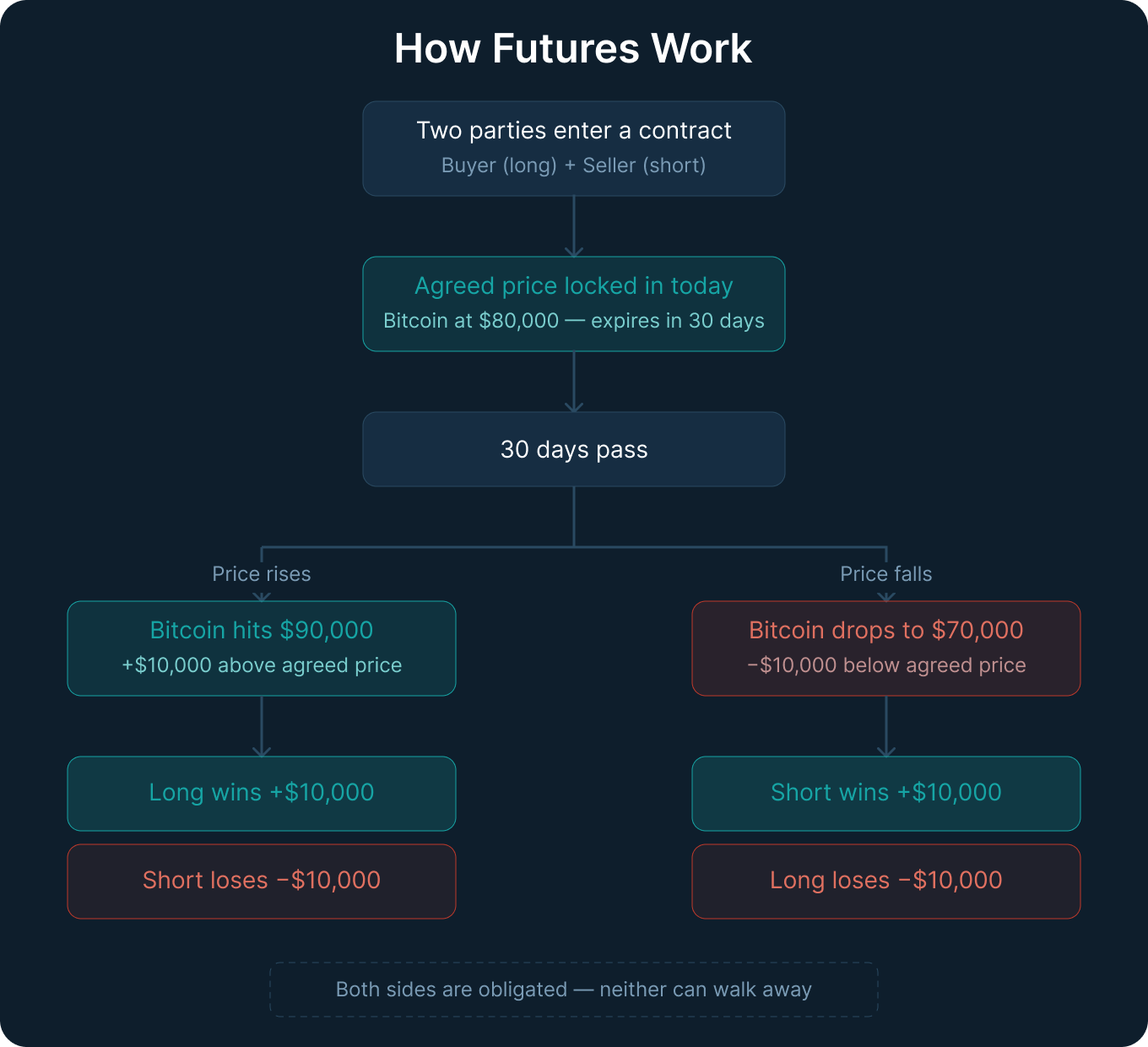
The core mechanic is simple: two parties agree on a price today, for a transaction that happens later.
Say it's January and Bitcoin is trading at $80,000. You believe the price will be higher by March, so you buy a Bitcoin futures contract at $80,000, expiring in 60 days. Someone on the other side of that trade thinks it'll be lower — they're selling at $80,000.
Come March, one of two things happens:
- Bitcoin is at $90,000. You had the right to buy at $80,000, so you're up $10,000. The seller is down $10,000.
- Bitcoin is at $70,000. You're obligated to buy at $80,000, which is now $10,000 above market. You're down $10,000. The seller wins.
There's no optionality here — both sides are locked in. That's what makes futures different from options (more on that below).
In crypto, almost all futures are cash-settled, meaning no actual Bitcoin changes hands. Your profit or loss is simply paid out in cash (or stablecoins) at expiry. In commodities markets, physical settlement can mean actual barrels of oil or bushels of wheat — which is why traders who accidentally hold a contract to expiry sometimes end up with truckloads of stuff they didn't want.
A Concrete Example
Let's put some numbers to it.
You open a long Bitcoin futures contract at $80,000, expiring in 30 days. The contract requires $4,000 margin (representing 5x leverage on a $20,000 notional position — let's keep the math clean).
Select a scenario below to see how the position will play out:
This is why knowing your liquidation price before entering any leveraged trade is essential — it tells you exactly how much the market can move against you before your margin is gone.
Futures in Crypto
Crypto adopted futures early. Bitcoin futures launched on the CME (Chicago Mercantile Exchange) and CBOE (Chicago Board Options Exchange) back in 2017, which was a big deal at the time — it was the first sign that traditional financial institutions were taking crypto seriously enough to offer regulated derivatives products around it.
Today, futures trade on both centralized platforms like Binance, Bybit, and OKX, as well as on regulated traditional exchanges like the CME. Most crypto futures follow standard expiry cycles — monthly or quarterly — though exact dates vary by platform.
Who uses them and why:
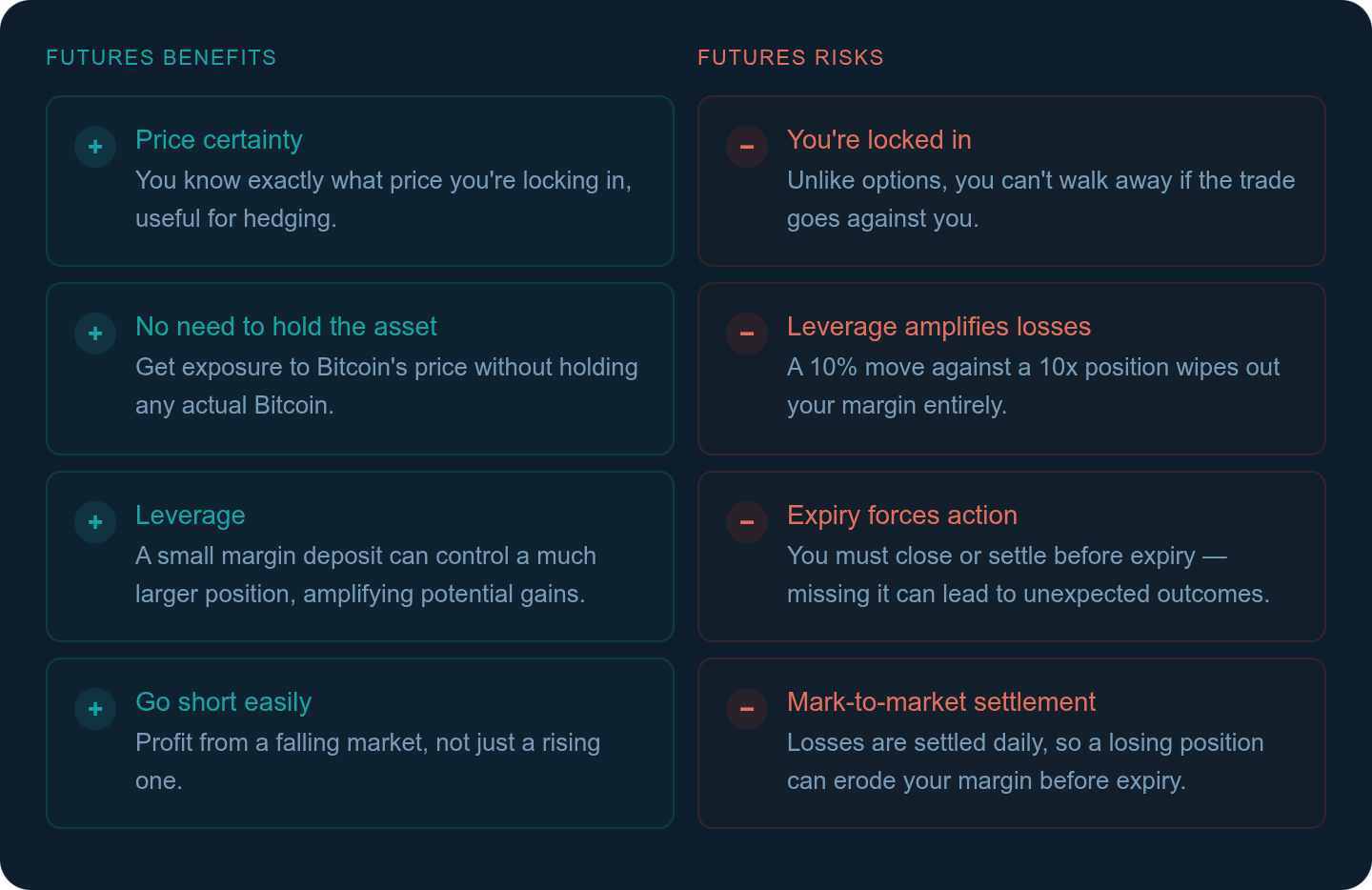
- Hedgers use futures to lock in a price and protect against adverse moves. A miner who knows they'll produce 10 BTC next quarter might sell futures at today's price to guarantee their revenue, regardless of where the market goes.
- Speculators use futures to take a directional bet with leverage, without needing to hold the underlying asset.
- Arbitrageurs exploit price differences between the futures price and the spot price to profit from inefficiencies. This is the mechanism that helps keep the balance between the spot and futures price, more on that below.
Futures vs. Perpetual Futures
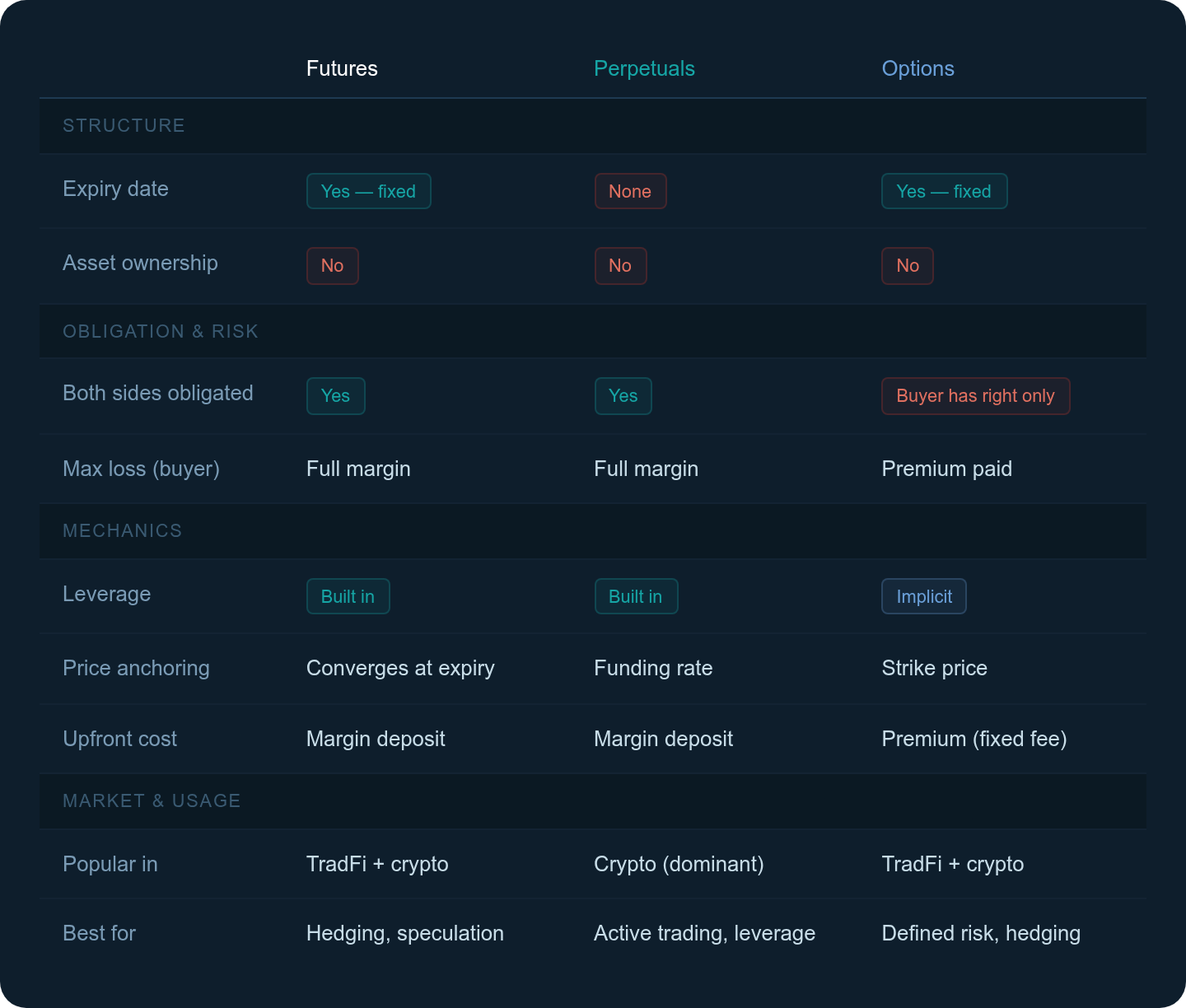
If you've read our article on perpetual futures, you already know that perps are built on the same foundation as regular futures — but with one key difference: no expiry date.
With regular futures, you have a deadline. Your contract closes on a set date whether you like it or not. With perps, you can hold a position indefinitely, as long as you maintain sufficient margin and account for the funding rate — periodic payments between long and short holders that keep the contract price anchored to the spot price.
Regular futures are the older, more institutionally familiar instrument. Perps took the same concept and made it more flexible for crypto's 24/7, non-stop market environment — which is a big part of why they've become so dominant in crypto trading.
Futures vs. Options
Both are derivatives. Both let you gain exposure without owning the underlying asset. But there's a crucial difference in how much commitment is involved.
With a futures contract, both parties are obligated to follow through. You can't change your mind because the price moved against you. The profit or loss is settled at expiry, no matter what.
With an options contract, the buyer has the right — but not the obligation — to buy or sell. If the trade moves against you, you can simply let the contract expire. The most you lose is the premium you paid upfront to enter the contract.
That flexibility has a cost — literally. Options buyers pay a premium; futures traders just post margin. For someone who wants a defined maximum loss, options offer that protection. For someone who's confident in their directional call and wants maximum leverage without paying a premium, futures are often the choice.
You can read more about derivatives as a whole — including how options, futures, and perps fit together — in our Types of Trading Explained article.
From Wheat Fields to Wallets
Futures are one of those financial tools that sound more complex than they are. At their core, they're just agreements. Two parties, one price, one future date. The complexity comes from the leverage, the liquidation mechanics, and the need to actively manage positions — but the underlying concept is genuinely straightforward.
In crypto, understanding futures helps you make sense of a lot of other things: why Bitcoin's price on CME futures sometimes differs from spot prices, what institutions are doing when they hedge exposure, and how the whole derivatives ecosystem — from basic futures to complex perps — connects back to a simple idea that farmers figured out in 1848.
Interactive Futures Simulator
Try our Interactive Futures Simulator yourself:
Thank you for reading our article on futures contracts! Make sure to follow us on X(Twitter) and let us know your thoughts. Subscribe to our newsletter to stay up to date with MEW releases, and check out our weekly podcast Crypto Currents for the latest news in crypto.