Every three months, the financial world holds its breath. Stock prices swing, analysts scramble, and headlines flood the news — all because a company released its earnings report. If you've ever wondered what all the fuss is about, or felt overwhelmed trying to make sense of all those numbers, this guide is for you.
By the end, you'll know exactly what earnings reports are, why they matter, where to find them, how to read them, and how to stay on top of them like a pro.
Disclaimer: This article is for informational and educational purposes only and does not constitute financial or investment advice. Always consult a qualified financial professional before making investment decisions.
Jump to:
- Why Do Companies Release Earnings Reports?
- The Earnings Calendar: When Do Companies Report?
- Where to Find Earnings Reports
- How to Read an Earnings Report: The Key Sections
- How to Stay on Top of Earnings and Corporate Actions
- The Numbers Are Telling a Story
Why Do Companies Release Earnings Reports?
The short answer: because they're required to.
Publicly traded companies — those whose shares are bought and sold on stock exchanges — are legally obligated to report their financial results to the public. In the United States, this requirement comes from the Securities and Exchange Commission (SEC). The rationale is simple: if you're investing your money in a company, you have the right to know how that company is actually performing.
Beyond legal obligation, earnings reports serve a deeper purpose. They are a company's report card to the world — a transparent, standardized snapshot of its financial health. They tell investors whether the business is growing or shrinking, profitable or bleeding money, and whether management's promises are being kept.
Think of it this way: if you lent money to a friend to start a business, you'd want regular updates on how things were going. Earnings reports are that update — just formalized, audited, and made available to everyone equally.
The Earnings Calendar: When Do Companies Report?
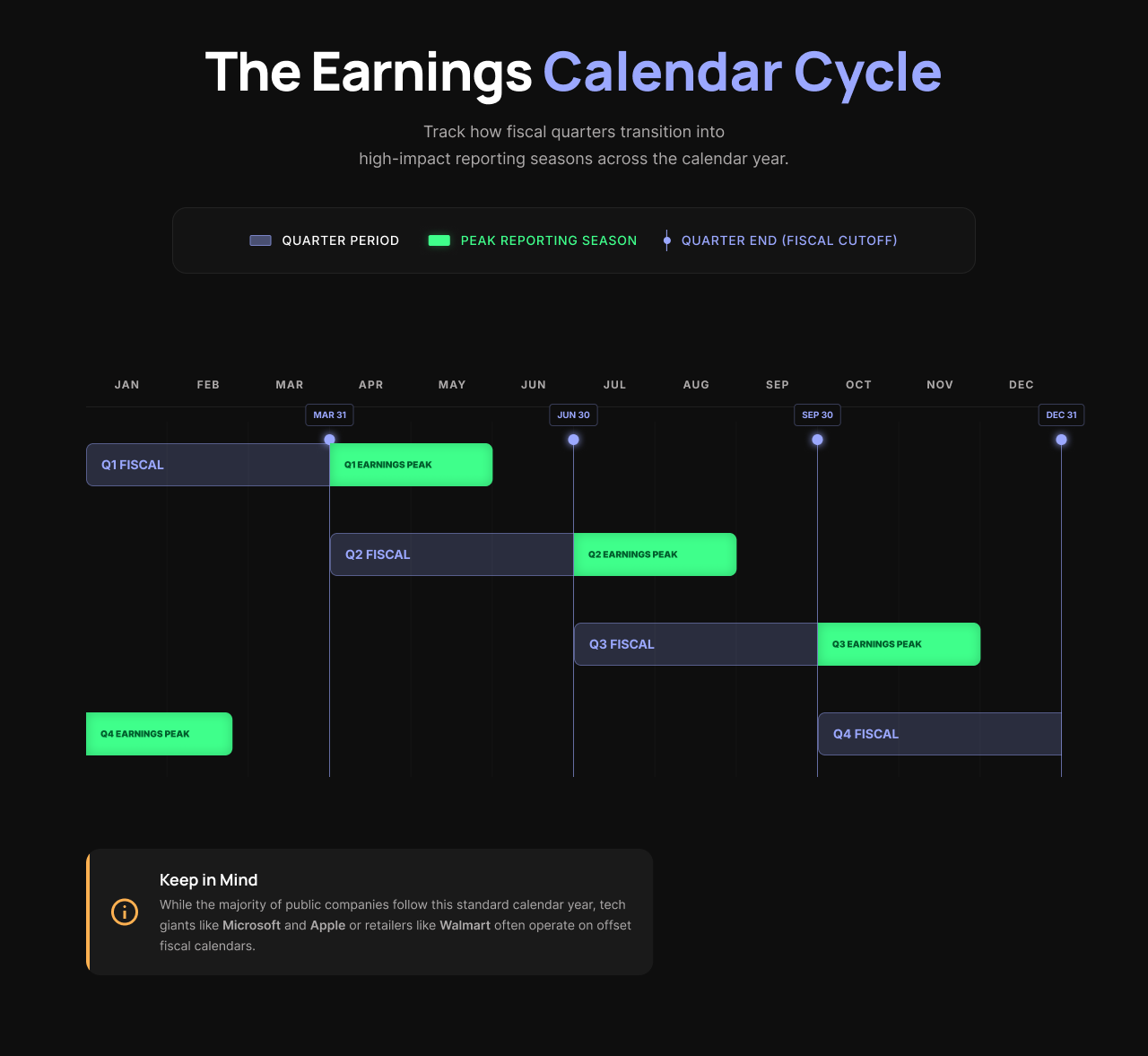
Most publicly traded companies report earnings four times a year, once per quarter. The reporting periods follow the fiscal calendar:
There's typically a lag of two to six weeks after a quarter ends before the report is released — this gives companies time to compile, verify, and file their numbers.
A few things worth knowing:
- Not all companies follow the same fiscal year. Apple's fiscal year, for instance, ends in September, so its quarters are offset from the standard calendar. Always check a company's specific reporting schedule. You can usually find this on the Investor Relations page, more on that below.
- "Earnings season" is the informal term for the concentrated period when most large companies report, typically in the weeks following quarter-end.
- Banks and financials often report first, with technology and consumer companies following close behind.
Where to Find Earnings Reports
1. The Company's Own Investor Relations (IR) Page
Every public company maintains an Investor Relations section on its website. This is the most authoritative source for earnings reports, press releases, and supplemental financial data. Simply search "[Company Name] investor relations" and navigate to their Earnings or Financial Results section.
Examples:
- Apple: investor.apple.com
- Microsoft: microsoft.com/en-us/investor
- Amazon: ir.aboutamazon.com
2. SEC EDGAR (U.S. Companies)
The SEC's EDGAR database (edgar.sec.gov) is the official public repository of all regulatory filings. Every U.S. public company is required to file here. The key documents to look for:
- 10-Q — Quarterly earnings report (filed three times a year)
- 10-K — Annual earnings report (the most comprehensive)
- 8-K — A current report filed for significant events, including earnings releases
3. Financial News & Data Platforms
These platforms aggregate earnings data and make it easy to search and compare:
- Yahoo Finance (finance.yahoo.com) — Free, widely used, includes earnings history and estimates
- Seeking Alpha (seekingalpha.com) — Strong earnings analysis and commentary
- Macrotrends (macrotrends.net) — Historical financial data presented in chart form
- Stockanalysis.com — Clean, easy-to-read financial summaries
4. A Brokerage Platform
Most brokerages — Fidelity, Charles Schwab, TD Ameritrade, Robinhood, and others — have built-in tools that surface earnings reports, analyst estimates, and earnings calendars directly within the platform. If you already have a brokerage account, this is often the most convenient starting point.
How to Read an Earnings Report: The Key Sections
1. The Earnings Press Release
Before the full 10-Q or 10-K is filed, companies almost always issue a press release summarizing key results. This is usually the first document available and the most investor-friendly. It's written in plain language and highlights the numbers management wants you to focus on. To make sure you catch it as soon as it drops, follow the company's official account on X, sign up for email alerts through their Investor Relations page, or set a Google Alert for the company name plus "earnings" — press releases typically hit all three channels within minutes of release.
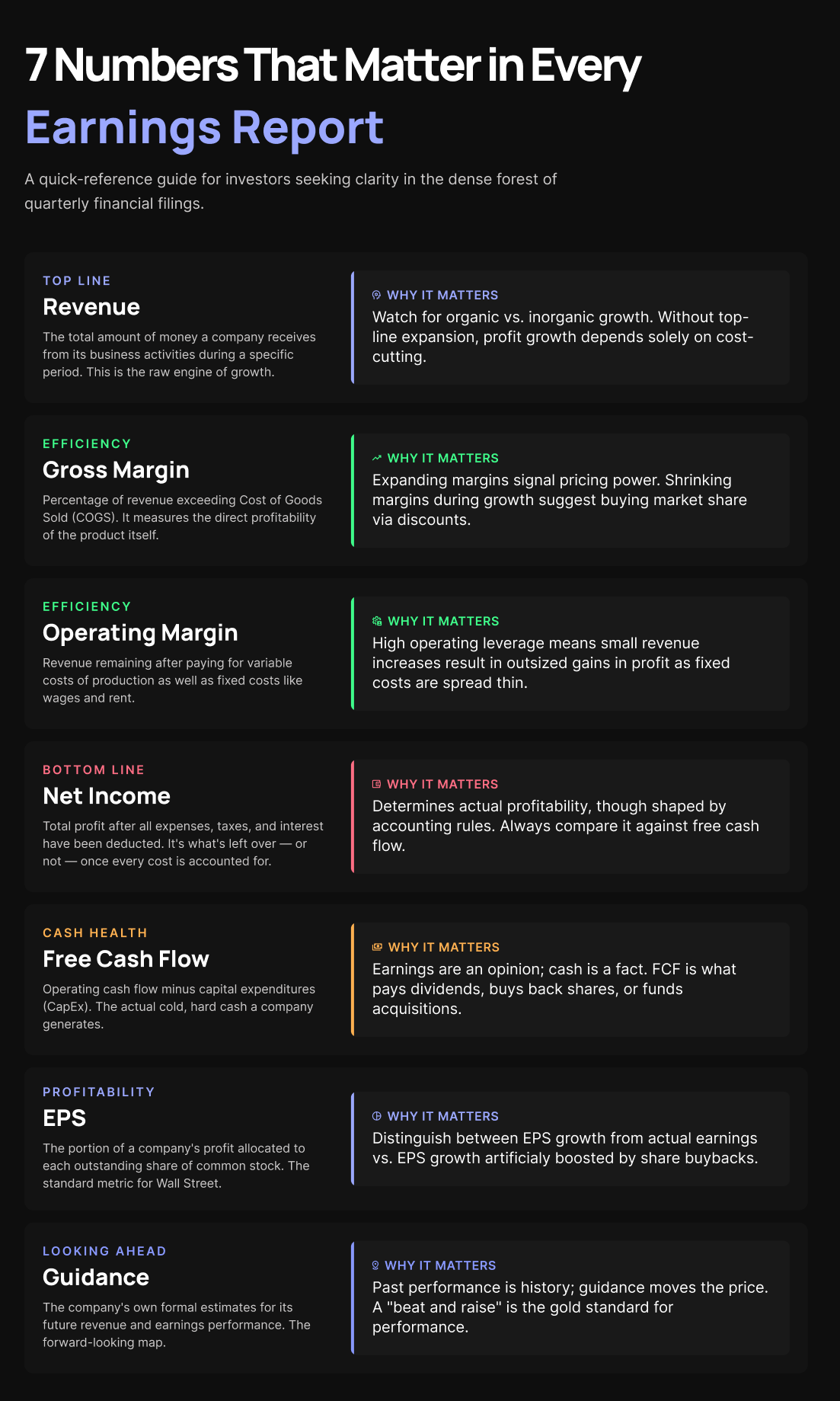
2. Revenue (Top Line)
Revenue — also called net sales or turnover — is the total amount of money the company brought in during the quarter. It's the "top line" because it sits at the top of the income statement.
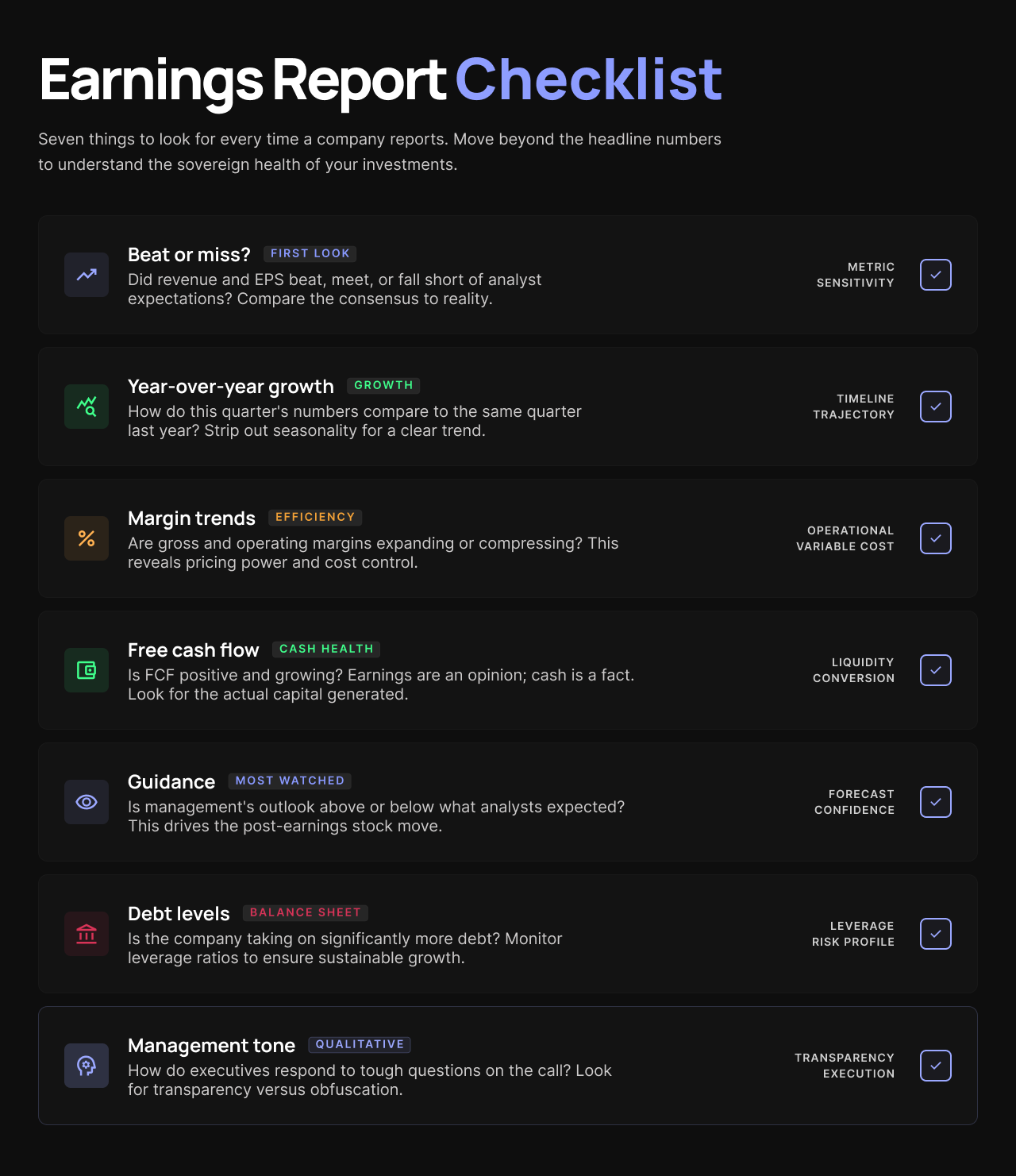
What to ask: Is revenue growing year-over-year? Is it accelerating or slowing down? How does it compare to what analysts expected? Analyst consensus estimates, the average forecast from Wall Street researchers, are freely available before earnings on platforms like Yahoo Finance, Seeking Alpha, and Stockanalysis.com, so you can walk into any earnings report already knowing the bar the company needs to clear.
3. Earnings Per Share (EPS)
EPS is arguably the single most-watched number in any earnings report. It tells you how much profit the company generated for each share of stock outstanding.
You'll often see two versions:
- GAAP EPS — Calculated according to Generally Accepted Accounting Principles, the official standard
- Non-GAAP (Adjusted) EPS — Strips out one-time items like restructuring charges or stock compensation to show "underlying" profitability
Both matter. Companies often highlight Non-GAAP figures because they look better, but GAAP tells the full story.
What to ask: Did EPS beat or miss analyst expectations? Is it growing compared to the same quarter last year?
4. Gross Margin and Operating Margin
Gross margin is what's left of revenue after subtracting the direct cost of producing goods or services. Operating margin goes further, subtracting operating expenses like sales, marketing, and R&D.
Margins reveal efficiency — a company growing revenue but shrinking margins may be spending its way to growth unsustainably.
5. Net Income
This is the "bottom line" — profit after all expenses, taxes, and interest are accounted for. A company can be growing revenue and still be unprofitable, which is common in early-stage or high-growth businesses.
6. Free Cash Flow (FCF)
Many experienced investors argue that free cash flow is more important than reported earnings. FCF is the cash a business generates after paying for capital expenditures (investments in property, equipment, etc.). Unlike net income, cash flow is harder to manipulate with accounting decisions.
What to ask: Is FCF positive and growing? Is the company converting its profits into real cash?
7. Guidance
This is often the most market-moving part of an earnings report. Guidance is management's forward-looking forecast for the next quarter or full year — their expectation for future revenue, margins, and earnings.
A company can beat past expectations convincingly but still see its stock fall if its guidance for the future disappoints. The market is always looking ahead.
How to Stay on Top of Earnings and Corporate Actions
Knowing how to read a report is only half the battle. You also need to know when one is coming — and be aware of other events that can significantly affect your investments.
Track Earnings Dates
Earnings calendars are free and widely available. Here are a few popular ones:
- Earnings Whispers (earningswhispers.com) — Considered the gold standard for earnings calendars; shows dates, times, and market consensus expectations
- Yahoo Finance Earnings Calendar — Simple and reliable
- Nasdaq Earnings Calendar (nasdaq.com/market-activity/earnings) — Includes both upcoming and historical dates
- Your brokerage app — Most allow you to set alerts for earnings releases on stocks you hold or follow
Set Up Alerts
Don't rely on memory. Set up email or push notification alerts on your brokerage platform or through financial apps like:
- Robinhood, Fidelity, or Schwab — Built-in stock alerts for earnings and price movements
- Stockanalysis.com — Free email alerts for earnings releases
- SEC EDGAR alerts — You can subscribe to receive email notifications whenever a specific company files a new document
Track Corporate Actions
Beyond earnings, other corporate actions can materially impact your investments:
- Dividends — When declared, what the ex-dividend date is, and when you'll receive payment
- Stock splits — When a company divides its shares (can affect price and perceived value)
- Share buybacks — Companies repurchasing their own stock, which can boost EPS
- Mergers & acquisitions — Any announcement of a company being bought or merging with another
- Insider trading filings (Form 4) — When executives buy or sell shares, which can be a useful signal
For corporate actions, EDGAR's full-text search and financial news platforms like Bloomberg, Reuters, or The Wall Street Journal are your best resources. Most brokerage platforms also surface dividend and corporate action information in your portfolio dashboard.
Build a Simple Tracking System
Consider maintaining a basic watchlist — even a spreadsheet works — where you log:
- Companies you own or follow
- Their next expected earnings date
- Last quarter's key metrics (revenue, EPS, margins)
- Any upcoming corporate actions
This habit takes minutes to maintain but keeps you far more informed than the average investor.
The Numbers Are Telling a Story
Earnings reports can seem intimidating at first, but once you understand their structure, they become one of the most powerful tools available to any investor. They cut through the noise, the headlines, and the market hype to show you what a business is actually doing.
You don't need to read every line of a 200-page 10-K. Focus on the press release, the key metrics (revenue, EPS, margins, and cash flow), and what management says about the future. Then track these numbers over time. Patterns and trends will tell you far more than any single quarter ever could.
Thank you for checking out our article on How to Find and Read Company Earnings Reports! Make sure to follow us on X(Twitter) and let us know your thoughts. MEW rewards active traders — see our Rewards page for all ongoing campaigns. Subscribe to our newsletter to stay up to date with MEW releases, and check out our weekly podcast Crypto Currents for the latest news in crypto.