
Apple. NVIDIA. Tesla. Microsoft. The US stock market is home to some of the most valuable companies in the world, and for good reason — it's the deepest, most liquid equity market on the planet. But if you're not based in the United States, accessing it can be a challenge.
For most international investors, getting exposure to US equities means navigating a maze of broker eligibility requirements, documentation, country restrictions, and tax obligations. It's doable — but it takes more work than it should. And since 2025, there's a second path that's been quietly gaining ground: tokenized stocks.
This article breaks down both options — what they involve, what they cost, and what kind of investor each one suits best.
This article is for educational purposes only and does not constitute financial advice. Investing in equities, whether through traditional brokerages or tokenized products, involves risk. Always conduct your own research and consult a qualified financial advisor before making investment decisions. Tax obligations vary by jurisdiction — consult a local tax professional for guidance specific to your situation.
Jump To:
- Why Is It Complicated in the First Place?
- Path 1: International Brokerages
- Path 2: Tokenized Stocks
- The Barrier Is Lower Than You Think
Why Is It Complicated in the First Place?
US financial markets are heavily regulated. Brokers operating in the US must comply with SEC and FINRA rules, and many simply choose not to service international clients rather than deal with the compliance overhead. For those that do, the process of onboarding non-US investors involves layers of verification that domestic customers never encounter.
On top of that, there's the tax dimension. Non-US investors in US equities are subject to a 30% withholding tax on dividends (reduced by tax treaty in some countries), and are required to submit a W-8BEN form to declare their foreign status. Get this wrong and you could end up paying more tax than you owe — or face complications during filing.
Then there are country restrictions. Even brokers that service international clients often have country-specific exclusions based on local regulations, sanctions, or simply business decisions. An investor in one country might have full access; someone next door might be shut out entirely.
Path 1: International Brokerages
A number of brokers do cater to international investors and provide access to US-listed stocks. Here's a look at the main options and what each involves (this is not a comprehensive list and investors should do their own research).
Brokers That Offer US Stocks Internationally
- Interactive Brokers - Generally considered the gold standard for international investors. Interactive Brokers services clients in over 200 countries and territories, offers access to US stocks, ETFs, options, and more, and has relatively low fees. The platform is powerful — but it's built for serious investors, and the account opening process reflects that. Expect identity verification, proof of address, and questions about your financial background. Minimum deposit requirements vary by account type, and the interface has a steep learning curve for newcomers.
- Charles Schwab International - Schwab's international account is a legitimate option for investors in select countries, but the eligibility list is more restrictive than Interactive Brokers. It's better suited to investors in developed markets with strong US treaty relationships. The account opening process involves mailing physical documents in some cases — a friction point that feels distinctly out of step with how the rest of financial services has evolved.
- Firstrade - A US-based broker that accepts international clients from a reasonable range of countries. No trading commissions on stocks and ETFs, which is attractive. However, the country coverage isn't as broad as Interactive Brokers, and the platform experience is more basic. Account approval can take several days to weeks depending on your location.
- eToro - More accessible than traditional brokers in terms of onboarding experience, and available in a large number of countries. eToro offers fractional shares and a social trading layer that appeals to newer investors. That said, its fee structure — including conversion fees and withdrawal fees — can add up, and it operates under multiple regulatory jurisdictions depending on where you're based, which affects what products you can actually access.
- Trading 212 - Available across much of Europe and a growing list of other markets. Commission-free trading, fractional shares, and a clean mobile interface make it one of the more accessible brokerage options for international retail investors. Country coverage is still limited compared to Interactive Brokers, and it lacks the depth of instruments that more advanced investors might need.
- DEGIRO - Popular across Europe, with low fees and a straightforward platform. DEGIRO is a solid option for European investors specifically, but its availability doesn't extend much beyond that region. Custody arrangements and investor protections vary by country, so it's worth checking local terms carefully.
The Fine Print Nobody Talks About
Across all of these brokers, a few consistent friction points show up:
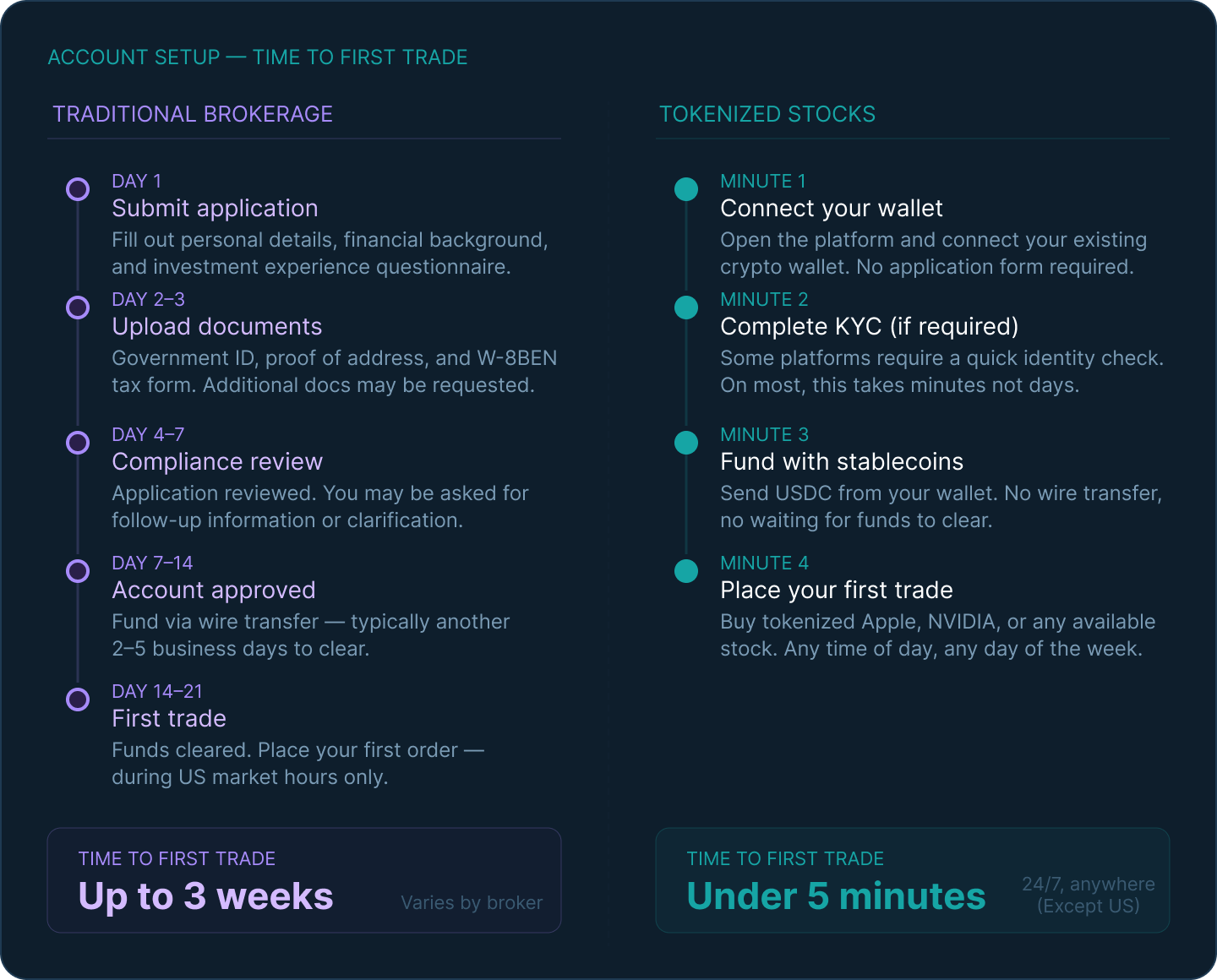
- Account opening typically requires government ID, proof of address, and sometimes additional financial documentation. Processing times range from a few hours to several weeks.
- W-8BEN filing is required to certify your non-US status and potentially reduce dividend withholding tax. It needs to be renewed every three years.
- Country availability is never guaranteed. Broker eligibility lists change, and your access can be affected by local regulations outside your control.
- Trading hours are fixed to US market hours — 9:30am to 4:00pm Eastern Time — which means early mornings, late nights, or missed moves depending on where you live.
- Currency conversion adds a layer of cost if your local currency isn't USD.
Path 2: Tokenized Stocks
Tokenized stocks are blockchain-based tokens that track the price of real underlying equities — think Apple or Tesla, but represented as a token on-chain. The token's value moves with the stock, and depending on the platform, holders may also receive dividend distributions.
This approach has been around in early forms for a few years, but the infrastructure has matured significantly. Today, several regulated platforms issue tokenized stocks with proper legal backing, on-chain settlement, and real underlying assets held in custody (remember to always do your own research when selecting a platform for transacting).
Platforms Offering Tokenized US Stocks
The space is growing, and a few platforms have established themselves as serious players:
- Ondo Stocks — One of the more prominent names in the tokenized real-world asset space, offering products that bring exposure to US equities and treasuries on-chain. Currently one of the highest TVL protocols in the RWA sector, Ondo is also collaborating with the DTCC on a tokenization framework.
- Backed Finance (xStocks) — A Swiss-regulated issuer of tokenized ETFs and stocks, with a focus on regulatory compliance and institutional-grade custody. Currently the leader by tokenized stock trading volume, making it one of the most actively used platforms in the space.
- Swarm Markets — A regulated DeFi platform based in Germany that offers tokenized stocks alongside crypto trading, operating under BaFin oversight.
- Dinari — A US-based platform building tokenized stocks with a compliance-first approach, focused on accessibility for international investors.
Each platform has its own approach to custody, regulation, and which assets are available. As with any investment platform, it's worth understanding how the underlying asset is held and what protections are in place.
What Makes Tokenized Stocks Different
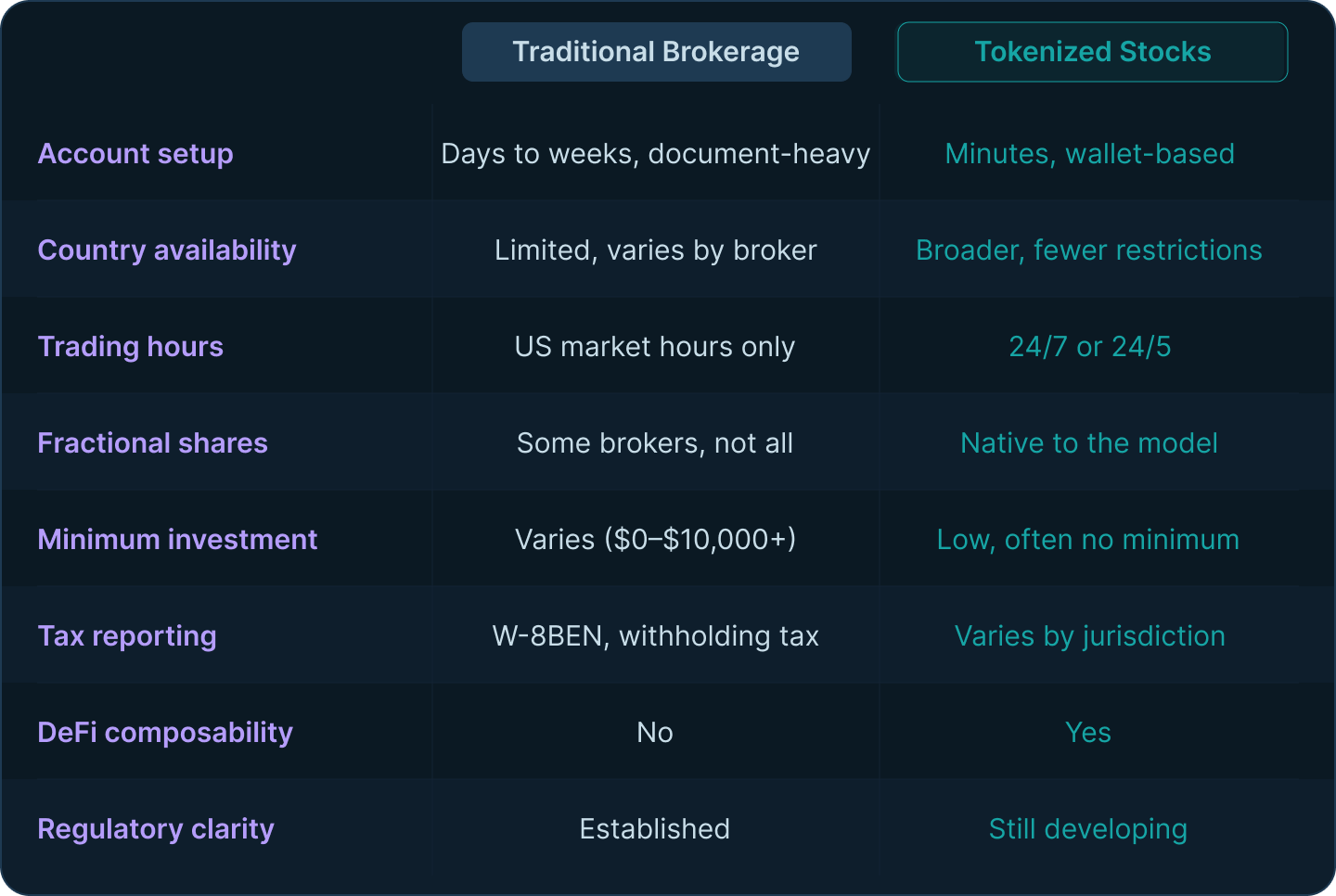
The contrast with traditional brokerages becomes clear quickly:
- No broker account required. You access tokenized stocks through a crypto wallet or a DeFi platform — no lengthy onboarding, no document queues, no approval waiting period. However, some platforms will have an online KYC process.
- 24/7 trading. Crypto markets don't close. Tokenized stocks can be traded at any time, not just during New York market hours. Some platforms support 24/5 trading, which is still significantly more flexible than brokerage hours.
- Fractional by default. Want $50 worth of Amazon? No problem. Tokenization makes fractional ownership native to the experience.
- Accessible from more countries. Many tokenized stock platforms have broader geographic reach than traditional brokers, particularly for investors in regions that are underserved by the brokerage world.
- On-chain composability. Tokenized stocks can interact with the broader DeFi ecosystem — used as collateral, held in yield strategies, or integrated into on-chain portfolios alongside crypto assets.
What to Keep in Mind
Tokenized stocks aren't without their own considerations. Regulatory frameworks are still developing in many jurisdictions, liquidity can be thinner than on traditional exchanges for some assets, and tax treatment of tokenized securities varies by country. It's an evolving space — but one that's evolving quickly, and largely in the right direction.
The Barrier Is Lower Than You Think
For most of financial history, access to US equities as an international investor meant working within a system that wasn't really built for you — navigating broker eligibility lists, paperwork requirements, and market hours set to a timezone that may be inconvenient at best and inaccessible at worst.
Tokenized stocks change that equation. They work on-chain, around the clock, with the same wallet you already use — and increasingly, with regulatory frameworks catching up to make them a genuinely credible alternative to the traditional route.
The infrastructure for a more open, more accessible global equity market already exists. Tokenized stocks are how more and more international investors are choosing to use it.
Thank you for checking out our How to Get US stocks from Outside the US article! Make sure to follow us on X(Twitter) and let us know your thoughts. MEW rewards active traders — see our Rewards page for all ongoing campaigns. Subscribe to our newsletter to stay up to date with MEW releases, and check out our weekly podcast Crypto Currents for the latest news in crypto.