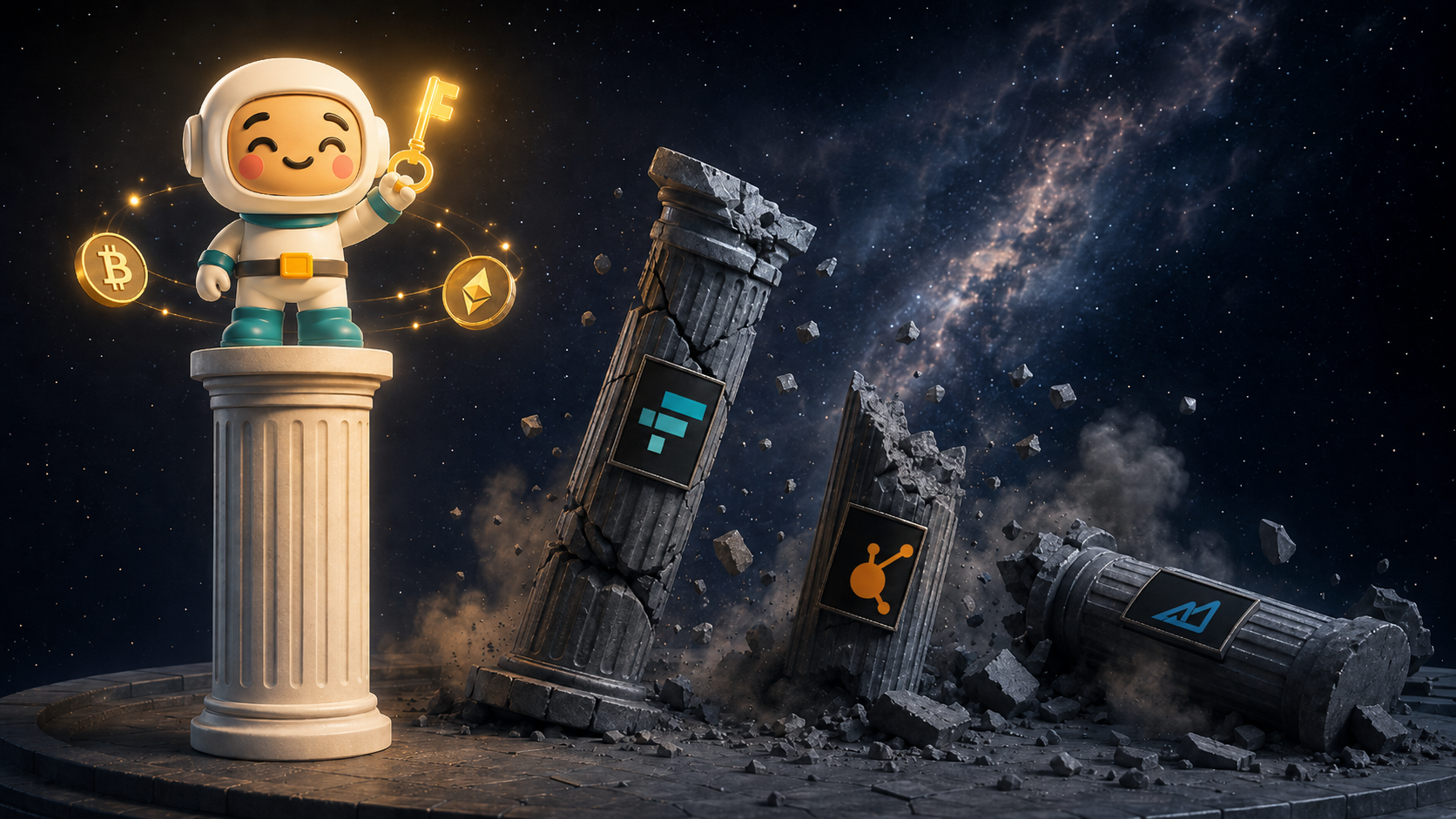
Three centralized crypto exchanges have announced they're shutting down in a matter of weeks. AscendEX. Then BitMEX. Then BitMart. These aren't small, no-name platforms.
BitMEX basically invented perps — currently the most-traded product in all of crypto — and ran for 11 years. It's still closing. BitMart operated for nearly a decade and claimed more than 13 million users across 180 countries. It's closing too. AscendEX, founded by experienced Wall Street veterans in 2018 and boasting 9 million users globally, ceased operations and paused all automated withdrawals on July 1.
Here’s the thing: an exchange doesn’t have to be an FTX-level disaster to fail. It doesn’t have to be newsworthy fraud or negligence or a spectacular hack. It can be an orderly wind-down, a calculated decision to turn off the lights. Or it can be something happening behind the scenes that the public will never know. The main question for anyone holding assets on an exchange: how safe is your crypto when your access can be interrupted or fully taken away at any time?
Your crypto was never yours to begin with
When you keep coins on a centralized exchange, you don't actually own or hold those coins. You hold an IOU. The exchange holds the crypto and promises you can have it back when you ask. That's what “custodial” means — someone else has custody, and you have a promise.
Most of the time, the promise is good. You log in, you withdraw, everything works. It's easy to mistake that convenience for ownership. But the moment the exchange decides otherwise — because of bankruptcy, regulation, or just a strategic review in a boardroom you'll never sit in — that promise is all you have. And a promise is a lot weaker than a key.
You know the old crypto saying: not your keys, not your crypto. It sounds like a slogan until an exchange proves it for you. Self custody doesn’t matter until it really, really does.
What “winding down operations” actually looks like for you
Even when an exchange does not go down in epic flames, but “winds down operations” in an orderly manner, that still means some very uncomfortable moments for the users (to put it mildly).
You get a deadline, not a choice. BitMEX gave users until September 23 to get their funds out. BitMart set a hard stop on all trading and a separate, later date for the platform to close for good. Withdrawing stops being something you do whenever you like and becomes a countdown. If you’re not someone who keeps a very close daily eye on your holdings, you could be in a lot of trouble later on.
The exit door gets narrower as more people rush it. BitMart kept withdrawals open but warned that requests could face extra identity checks, device reviews, and source-of-funds scrutiny — the kind of friction that turns "a few minutes" into "we'll get back to you." When millions of people head for the same door at once, the door does not get wider.
Sometimes the door barely opens at all. AscendEX is the cautionary version of this. When it ceased operations on July 1, it didn't just slow withdrawals down — it switched them off. Automated withdrawals were paused entirely, and every request was routed into manual review for KYC, sanctions, fraud, and balance checks. The exchange later revealed that a strategic deal meant to fund the platform had fallen through, that it was weighing "what options, if any" existed for account holders, and that a formal insolvency process might follow. Same word, "wind-down." Very different outcome for the people waiting on their money.
Leftovers get taxed. BitMEX told users that any assets left on the platform after the deadline would start racking up monthly custody fees — and warned those fees could climb over time. Your own money, quietly billed for the privilege of being stuck.
Open positions get closed for you. If you were trading, the exchange reserves the right to force-close your positions on its own terms and its own timeline, and to take no responsibility for the losses.
Sometimes the people inside find out the same time you do. BitMart's own former global CEO said he learned the exchange was shutting down by reading the public announcement, like everyone else. If the executives don't get a heads-up, you certainly won't.
Exchange shutdowns can follow different scenarios, but the lesson is the same: when the thing holding your money is a company, your access lasts exactly as long as that company decides — or manages — to keep the door open.
How self custody is different
A self custody wallet (also called a non-custodial wallet) is fundamentally different. Instead of an exchange holding your crypto and promising to give it back, you hold it. The keys live with you. There's no IOU, because there's no middleman standing between you and your coins. You are the bank, the exchange, the custodian.
There's no withdrawal window, because you're never waiting on anyone's permission to move your own money. There's no deadline to beat, no queue to stand in, no compliance review to clear before you can access your funds. A regulator can't revoke it. A bankruptcy can't freeze it. A boardroom can't vote it out of existence.
A wallet provider like MEW can't hack into your funds, run off with them, or lock you out because MEW never has access to them in the first place. That’s how non-custodial wallets are built to begin with – it’s not a feature that can be turned on and off. Even if MEW closed down tomorrow and never wrote another line of code, you'd still reach your crypto with your recovery phrase in any compatible wallet. Try getting that guarantee from an exchange.
This is exactly why self custody matters, and it's the reason we keep coming back to it every time another platform makes headlines for the wrong reasons.
The catch: with the keys comes the responsibility
Financial independence is a power, and with power comes… you know what it is. Responsibility. When you hold your own keys, nobody can help you if your lose or compromise them. Your recovery phrase — usually 12 or 24 words — is the master key to everything. Write it down on paper. Keep it somewhere physically safe. Never put it in a cloud document, an email, or a screenshot, and never, ever share it with anyone. No legitimate company will ask for it. If someone does, it's a scam.
For most people, that's the entire learning curve: protect the phrase, and you've protected the wallet. It's a different kind of responsibility than you're used to from banks and apps — but it's the price of actually owning your crypto instead of renting access to it.
An exchange is a tool, not a vault
All this being said, there’s no need to be a decentralization maxi and burn your exchange account. Centralized platforms can still be useful for certain operations, although self custody wallets like MEW are increasingly incorporating all the functions that exchanges traditionally provided: buying crypto with card or bank account, cashing out to fiat, and every imaginable swap and trade.
The point is simpler: keep on the exchange only what you're actively using. Use it to get in, get out, or make a trade you can't make elsewhere — then send your crypto back to a wallet you control. Behind the lull of convenience, the ability to withdraw from an exchange is a privilege the exchange grants you. It can add conditions, deadlines, and fees, or take the privilege away entirely at any time. Self custody replaces that privilege with a right. Your keys, your coins, your call, no countdown attached.
The best time for self custody is now
The best time to move your crypto to a wallet you control is not the day after your exchange announces it's closing. It's now, while the process is calm and entirely on your terms.
If you'd like the practical, step-by-step version of that move, we've written it up a few guides to get you started:
- How to move your crypto off an exchange
- Self custody your Bitcoin
- Move crypto from Gemini to MEW
- Move crypto from Coinbase to MEW
- Move crypto from Crypto.com to MEW
- Move crypto from Binance to MEW
We know self custody can feel intimidating if you're used to the convenience of banks and exchanges. That's exactly why we're here to help. Reach out to support@myetherwallet.com, explore our Help Center, hit us up on X (Twitter) or join our community on Reddit. Let's make crypto better for everyone, together.