
Broadly speaking, ETFs and mutual funds do essentially the same thing: they pool money from many investors and use it to buy a diversified basket of assets. You put money in, you get exposure to a collection of stocks, bonds, or other securities, and you don't have to pick individual investments yourself.
So why do two products that sound so similar often get discussed in terms of their differences? Because the way they're structured — how you buy them, how they're priced, how they're taxed, and how much they cost — varies in ways that matter quite a bit in practice.
This article is for educational purposes only and does not constitute financial advice. All investments carry risk. Always conduct your own research before making any financial decisions.
Jump to:
- What Is a Mutual Fund?
- What Is an ETF?
- The Key Differences Between ETFs and Mutual Funds
- Different Tools for Different Situations
- The Tokenized Angle
- The Bottom Line on ETFs vs Mutual Funds
What Is a Mutual Fund?
A mutual fund is an investment fund managed by a professional asset manager. Investors pool their money together, and the manager uses those combined assets to buy a portfolio of securities on their behalf.
When you buy into a mutual fund, you're purchasing shares directly from the fund itself — not from another investor on an exchange. The price you pay is determined once per day, after the market closes, based on the fund's net asset value (NAV): the total value of all its holdings divided by the number of shares outstanding. It doesn't matter whether you placed your order at 10am or 3pm — everyone who buys or sells that day gets the same end-of-day price.
Mutual funds come in two broad flavours:
Actively managed funds employ a professional portfolio manager who makes decisions about what to buy and sell, aiming to outperform a benchmark index. Fidelity Contrafund (FCNTX) is a well-known example — its manager actively selects US growth stocks in an attempt to beat the market. Active management comes with higher fees, and the evidence that it consistently outperforms passive strategies over the long run is mixed at best.
Passive (index) mutual funds simply track an index, buying the same securities in the same proportions as the benchmark. Vanguard's 500 Index Fund (VFIAX) tracks the S&P 500, for example. These carry much lower fees than active funds and have gained enormous popularity over the past two decades. When John Bogle launched the world's first index mutual fund at Vanguard in 1976, it was the only way for retail investors to invest in a market index — and for nearly 17 years, it stayed that way.
What Is an ETF?
An ETF (Exchange-Traded Fund) is an investment fund that holds a collection of assets and trades on a stock exchange throughout the day, just like an individual stock. The ETF was itself an innovation born out of indexing — when the first ETF, the SPDR S&P 500 Trust (SPY), launched in 1993, it offered a new way to track the same S&P 500 index that Vanguard's mutual fund had been following since 1976, but with the added ability to trade it throughout the day like a stock. You buy and sell ETF shares through a brokerage account, at whatever price the market is offering at that moment — not once per day, but continuously during market hours.
Like mutual funds, ETFs can be either actively managed or passive — though the vast majority of ETFs track an index passively. The largest and most widely held ETFs — SPDR S&P 500 ETF Trust (SPY), Vanguard Total Stock Market ETF (VTI), Invesco QQQ Trust (QQQ) — are all passive index trackers.
For a more detailed look at how ETFs work and the different types available, see our article on What Are ETFs? and our guide to the many different types of ETFs.
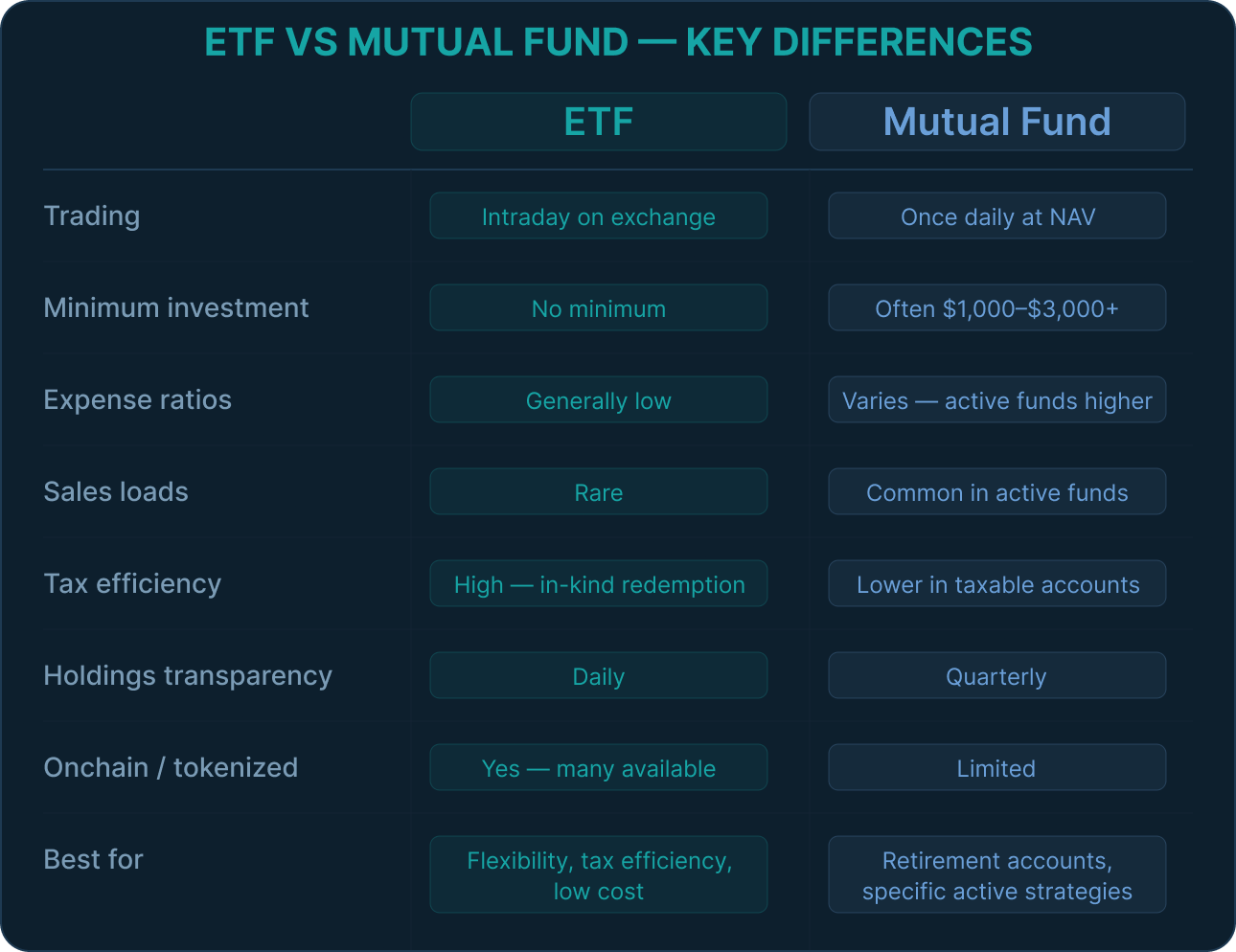
The Key Differences Between ETFs and Mutual Funds
Trading
The most fundamental difference between ETFs and mutual funds is how and when you can trade them.
ETFs trade on an exchange throughout the day — you can buy or sell at any point during market hours, and the price fluctuates in real time based on supply and demand. This gives you flexibility: if news breaks at 11am and you want to react immediately, you can.
Mutual funds price once per day, after the market closes. Whatever you order during the day, you get the NAV calculated at the end of that trading session. For long-term investors who aren't trying to time the market, this distinction rarely matters. For traders or anyone who wants intraday flexibility, it matters a great deal.
Minimum Investment
Many mutual funds have minimum investment requirements — often $1,000 to $3,000 for initial purchases, sometimes higher for certain institutional share classes. This can be a barrier for newer or smaller investors.
ETFs have no fund-level minimum. You can buy as little as one share — and with fractional share investing now widely available, you can often buy a fraction of a single ETF share for as little as $1. This makes ETFs significantly more accessible for investors starting out with smaller amounts.
Fees
Both ETFs and mutual funds charge an expense ratio — an annual fee expressed as a percentage of your investment that covers the fund's operating costs.
For passive funds tracking the same index, expense ratios are broadly comparable. Vanguard's S&P 500 ETF (VOO) charges 0.03% annually. Its mutual fund equivalent (VFIAX) charges 0.04%. The difference is negligible.
Where fees diverge significantly is in actively managed mutual funds, which can charge 0.5% to 1%+ annually — sometimes more. Some mutual funds also charge sales loads — upfront or deferred commissions paid to brokers — which can add 3% to 5.75% to the cost of entering or exiting the fund. Most ETFs have no sales loads.
Over long time horizons, seemingly small fee differences compound into meaningful gaps in final returns. A 1% annual fee difference on a $50,000 investment over 30 years can amount to tens of thousands of dollars in lost returns.
Tax Efficiency
This is one of the most practically important differences for taxable (non-retirement) accounts, and one of the least understood.
When investors sell shares in a mutual fund, the fund may need to sell some of its holdings to raise the cash to pay them out. If those sales generate capital gains, those gains are distributed to all shareholders — even those who didn't sell anything. You could hold a mutual fund all year, never touch it, and still receive a capital gains distribution that creates a tax bill.
ETFs largely avoid this through a mechanism called in-kind creation and redemption. When large institutional investors create or redeem ETF shares, they exchange a basket of the underlying securities rather than cash — allowing the ETF to offload low-cost-basis securities without triggering a taxable event for the fund. As a result, most ETFs distribute little to no capital gains throughout the year.
For investors holding funds in taxable accounts, ETFs' structural tax advantage can be meaningful over time.
Transparency
ETFs are required to disclose their full holdings on a daily basis — you can see exactly what's inside an ETF at any given moment.
Most mutual funds disclose their holdings only quarterly, with a lag. This means that with an actively managed mutual fund, you may not know exactly what the manager has been buying and selling until weeks or months after the fact.
Different Tools for Different Situations
ETFs and mutual funds each have characteristics that make them better suited to certain contexts — and many investors end up using both depending on what they're trying to accomplish.
Retirement accounts and 401(k)s. Most workplace retirement plans offer mutual funds rather than ETFs. For investors contributing through an employer-sponsored plan, mutual funds are often the primary option available — and low-cost index mutual funds within these plans can be highly effective long-term vehicles.
Active management strategies. Some active strategies — particularly in fixed income, alternatives, and certain niche markets — are structured primarily as mutual funds. Investors seeking exposure to a specific active approach may find it available only in mutual fund form.
Investing exact dollar amounts. Mutual funds allow investors to put in a precise dollar amount — say $500 — since shares are bought at NAV and fractional amounts are handled automatically. ETFs trade at market prices, which can make investing exact amounts less straightforward without fractional share support.
Intraday flexibility. Investors who want to buy or sell at a specific price during the trading day, or who want to react to market events in real time, can do so with ETFs but not with mutual funds, which settle at end-of-day NAV only.
The Tokenized Angle
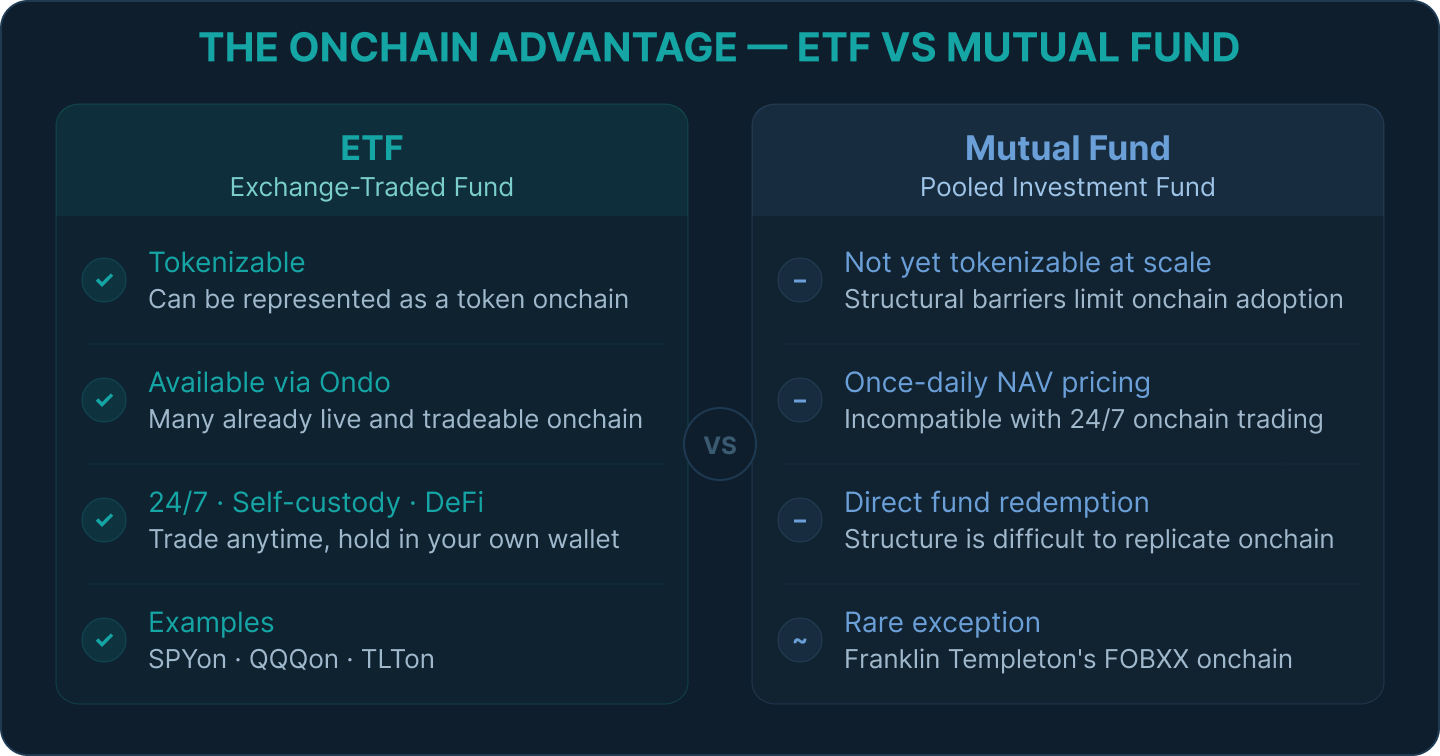
One development worth noting for investors thinking about the longer-term trajectory of these two structures: tokenized ETFs are now available onchain.
Through platforms like Ondo Stocks and xStocks, many of the most widely held ETFs — including SPY, QQQ, TLT, and dozens of others — can be held as tokens in a self-custodial crypto wallet, traded 24/7, and used within the broader DeFi ecosystem. The ETF structure — with its daily transparency and exchange-traded flexibility — translates well to onchain rails.
Mutual funds face more structural challenges in this area. Their once-daily NAV pricing, direct redemption structure, and reliance on centralized fund administrators make onchain representation more complex. Franklin Templeton has made progress with its onchain money market fund (FOBXX), but broad tokenization of mutual funds remains limited at this stage. How this evolves as the tokenized asset space matures remains to be seen.
The Bottom Line on ETFs vs Mutual Funds
ETFs and mutual funds are more alike than they are different — both offer diversification, professional management options, and access to a wide range of asset classes. The differences come down to structure: how they trade, how they're taxed, how much they cost, and how transparent they are.
For most investors building a long-term portfolio in a taxable account, ETFs have structural advantages that are hard to ignore — lower costs on average, greater tax efficiency, intraday flexibility, and daily transparency. For investors contributing to a workplace retirement plan, or those who want access to specific active strategies, mutual funds remain entirely valid.
The two structures aren't mutually exclusive. Many investors hold both, using ETFs for taxable accounts and mutual funds within retirement plans — getting the best of both structures depending on the context.
Thank you for checking out our article on ETFs vs Mutual Funds! Make sure to follow us on X(Twitter) and let us know your thoughts. Sign up for our newsletter to stay up to date with MEW releases, and check out our weekly podcast Crypto Currents for the latest news in crypto. For more on ETFs and how they're evolving onchain, check out our article on What Are ETFs? and The Many Different Types of ETFs.