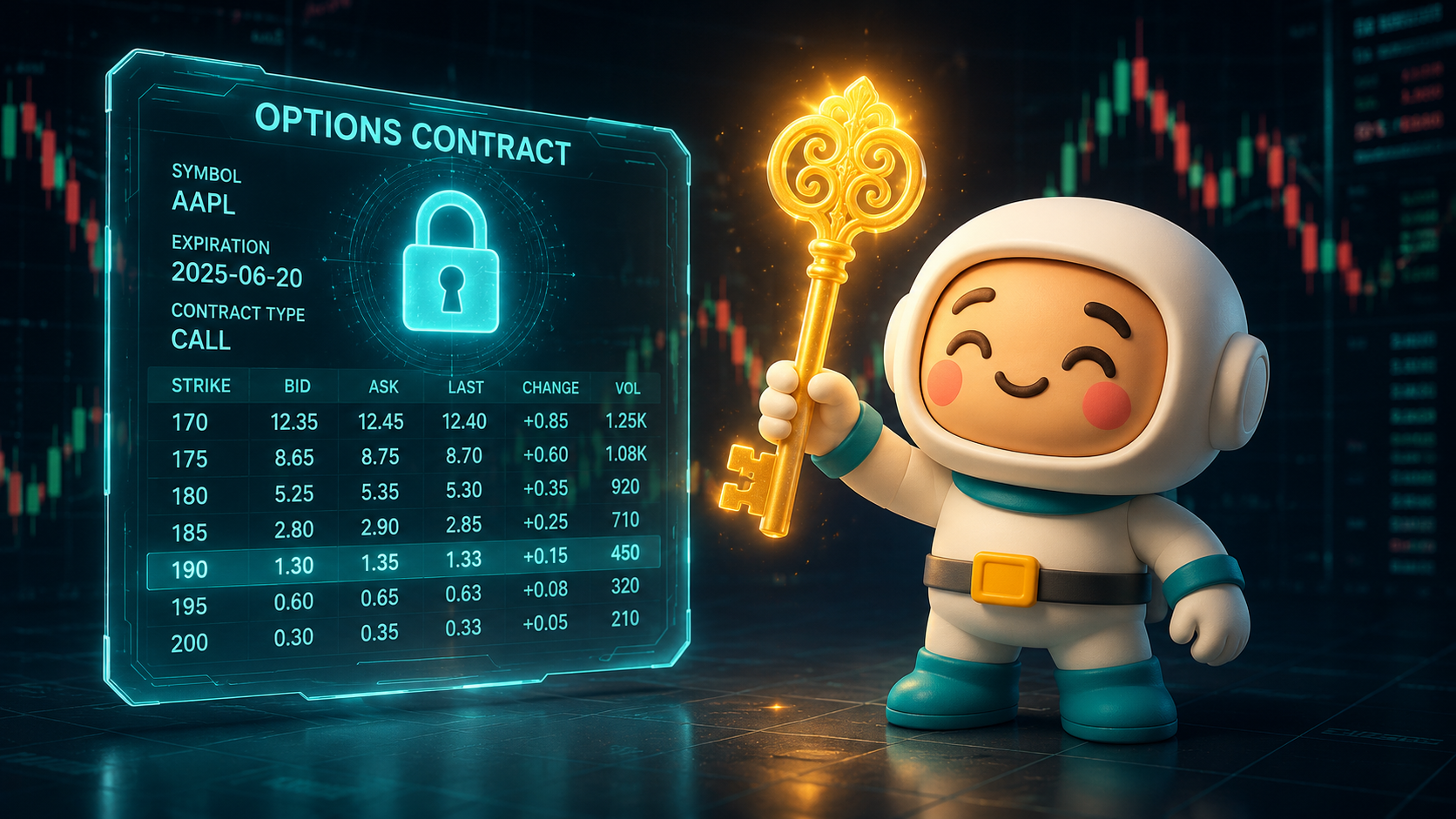
There's one thing that makes options different from every other derivative — and it's right there in the name. An option gives you the right to do something. Not the obligation.
With a futures contract, both parties are locked in. The trade happens at expiry whether the market moved in your favor or not. With an options contract, the option buyer gets to choose. If the trade makes sense, you exercise it. If it doesn't, you walk away. The most you lose is the premium you paid to enter.
It’s worth noting that the option seller has no such choice. In exchange for collecting the premium upfront — which they keep regardless of the outcome — they take on the obligation to fulfill the contract if the buyer decides to exercise. It's a trade-off: guaranteed income now, potential obligation later.
Still, that single difference — right versus obligation for the buyer — shapes everything about how options work, why people use them, and what makes them one of the most flexible instruments in both traditional and crypto markets.
This article is for educational purposes only and does not constitute financial advice. Trading derivatives involves significant risk. Always do your own research before participating.
Jump To:
- Terms To Know
- A Brief Origin Story
- The Two Types: Calls and Puts
- Example: Three Scenarios
- How Options Premiums Work
- Options vs Futures vs Perpetuals
- Options in Crypto
- Interactive Profits and Losses Calculator for Options
- Options Benefits and Risks
Terms To Know
A Brief Origin Story
Options are older than most people realise. The ancient Greek philosopher Thales of Miletus is often cited as the first recorded options trader. Anticipating a strong olive harvest, he secured the right to use olive presses at a fixed price months in advance. When the harvest came in and demand for presses surged, he exercised his right and profited from the difference.
The concept formalised slowly over centuries, eventually landing in 17th century Amsterdam's tulip markets, then in commodity trading, and finally in 1973 when the Chicago Board Options Exchange (CBOE) standardised equity options and gave them a permanent home in financial markets.
Crypto options arrived much later — Deribit launched Bitcoin options in 2016 — but the underlying mechanics are identical to what Thales figured out in ancient Greece.
The Two Types: Calls and Puts
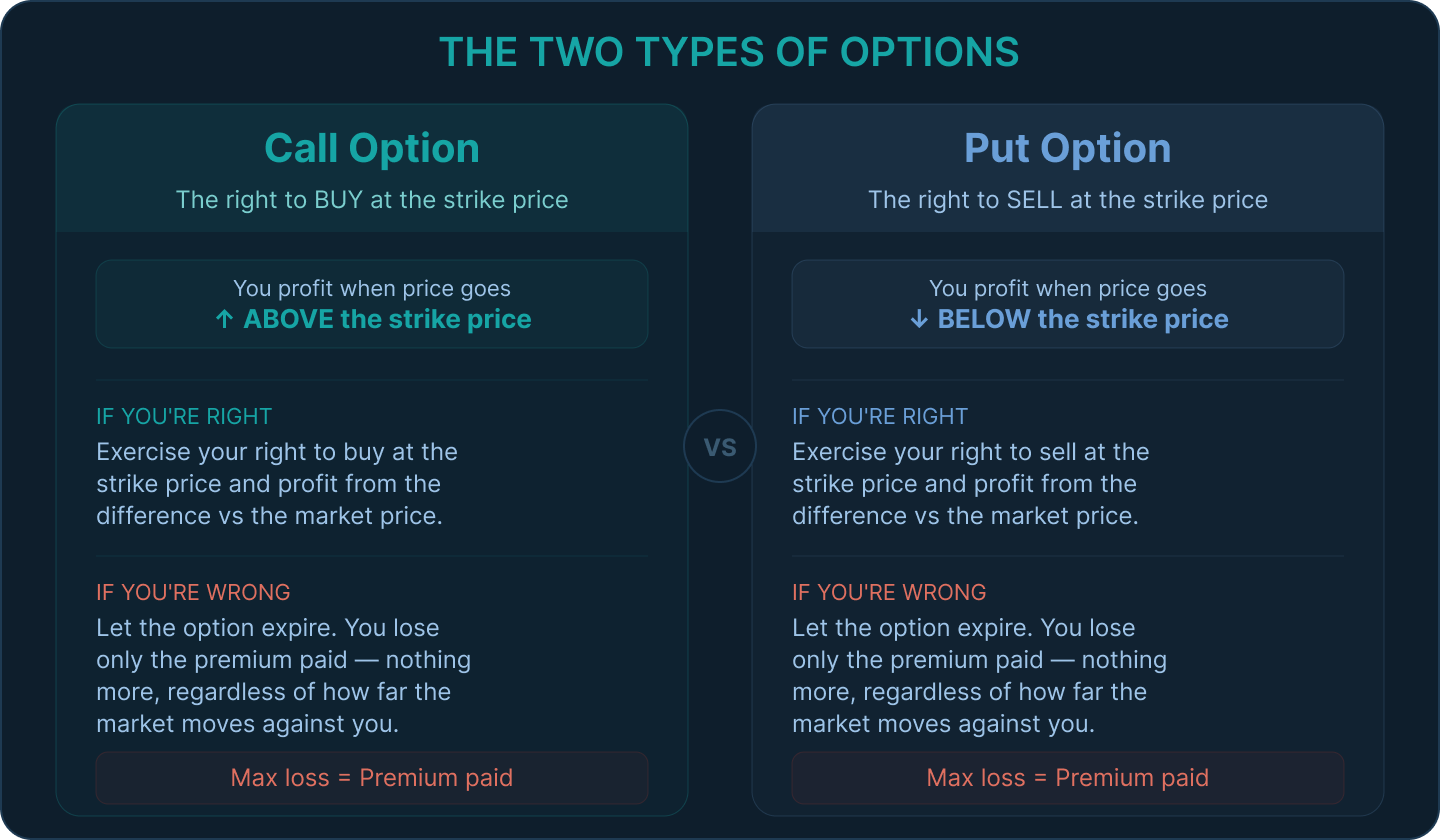
Every options contract is either a call or a put. That's it. Everything else — the strategies, the combinations, the complexity — is built on top of these two basic instruments.
Call Options — The Right to Buy
A call option gives you the right to buy an asset at a predetermined price before or on a specific date.
You buy a call when you think the price is going up. If you're right and the price rises above your predetermined price, you can buy at the lower agreed price and profit from the difference. If you're wrong and the price stays flat or falls, you simply don't exercise the option. You lose only what you paid to enter.
Real example: Bitcoin is trading at $80,000. You buy a call option with a strike price of $85,000, expiring in 30 days. You pay a $500 premium.
- If Bitcoin rises to $95,000, you have the right to buy at $85,000. That's a $10,000 gain per coin, minus the $500 premium — net profit of $9,500.
- If Bitcoin stays at $80,000 or falls, you don't exercise. You lose $500 — nothing more.
Put Options — The Right to Sell
A put option gives you the right to sell an asset at a predetermined price before or on a specific date.
You buy a put when you think the price is going down. If the price falls below your strike price, you can sell at the higher agreed price and profit from the decline. If the price rises instead, you let the option expire. Again, your maximum loss is the premium paid.
Real example: Bitcoin is at $80,000. You buy a put option with a strike price of $75,000, expiring in 30 days. You pay a $400 premium.
- If Bitcoin drops to $60,000, you have the right to sell at $75,000 — a $15,000 gain per coin, minus the $400 premium.
- If Bitcoin rises to $90,000, you don't exercise. You lose $400.
Example: Three Scenarios
How Options Premiums Work
The premium is the price of flexibility. It's what you pay for the right to walk away. But premiums aren’t necessarily cheap. They're priced to reflect:
- Time value — The longer until expiry, the more time the market has to move in your favour, so premiums are higher. As expiry approaches, time value decays — a concept called theta decay — and out-of-the-money options lose value rapidly in their final days.
- Volatility — The more volatile the underlying asset, the higher the premium. In crypto, where daily swings of 5–10% are common, options premiums tend to be significantly higher than their traditional finance equivalents.
- Distance from strike — Options with strike prices close to the current market price (at-the-money) cost more than those with strikes far away (deep out-of-the-money), which have a lower probability of ever being exercised.
As an options buyer, the premium represents your total downside. You know exactly how much you can lose before you enter the trade — making options one of the few instruments where risk is genuinely capped on the buy side.
From the seller's perspective, the premium works differently. The seller receives it immediately when the contract is opened — not at expiry, not if certain conditions are met, but upfront and unconditionally. This is why selling options is sometimes used as an income strategy: collect the premium now, hope the buyer never exercises, repeat. The trade-off is that while the buyer's loss is capped, the seller's is not — if the market moves sharply against them, the obligation to fulfil the contract can result in losses that far exceed what they collected.
There is only one premium per contract — the buyer pays it, the seller receives it. Its size fluctuates with market conditions: higher volatility, more time until expiry, and a strike price closer to the current market price all push the premium higher. Whether it feels "high" or "low" depends entirely on which side of the trade you're on.
When a buyer exercises, the seller is assigned and must fulfil the trade at the agreed strike price. That asymmetry — guaranteed income for the seller, uncapped obligation — is worth understanding before you consider selling options yourself.
Options vs Futures vs Perpetuals
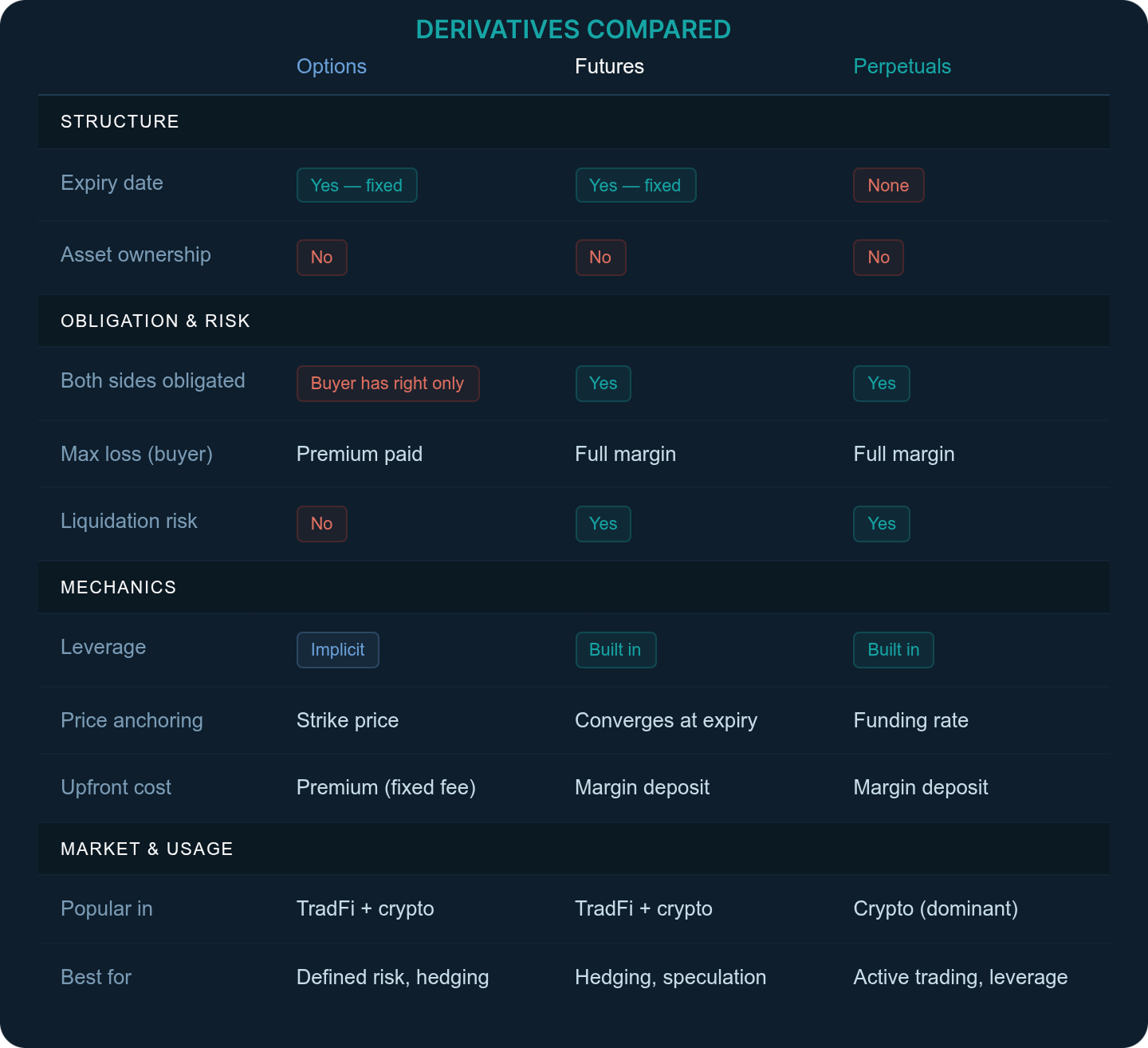
All three are derivatives. All three let you gain exposure to an asset without owning it. But they behave very differently.
The core trade-off is flexibility versus cost. Options give the buyer the ability to walk away — but that flexibility has a price. Futures and perps are cheaper to enter (no premium) but lock both sides in, which means losses can exceed your initial deposit.
For more on how futures and perps work, see our articles on Futures Contracts and Perpetual Futures.
Options in Crypto
Crypto options are structurally identical to traditional options, but a few things are different in practice.
Where they trade: The dominant venue for crypto options is Deribit, which handles the large majority of Bitcoin and Ethereum options volume. On-chain alternatives include Lyra Finance and Hegic, which offer options directly in DeFi without a centralized intermediary. For those who prefer to stay within the traditional finance ecosystem, options on spot Bitcoin ETFs — such as BlackRock's iShares Bitcoin Trust (IBIT) — are also available through standard brokerage accounts, offering Bitcoin price exposure via a familiar instrument without needing a crypto exchange account.
Cash settlement: Most crypto options are cash-settled — no actual Bitcoin or Ethereum changes hands. The profit or loss is paid out in the underlying crypto or in stablecoins.
Higher premiums: Because crypto assets are more volatile than traditional stocks or commodities, options premiums are generally higher. More volatility means more potential movement, which makes the right to buy or sell more valuable.
24/7 markets: Unlike traditional options which trade during exchange hours, crypto options markets never close. Positions can move significantly overnight, on weekends, or during major macro events at any hour.
Common use cases in crypto:
- Hedging a long position — If you hold Bitcoin and are worried about a short-term drop, buying a put option locks in a floor price without forcing you to sell.
- Speculating with defined risk — Instead of buying Bitcoin outright, buying a call option gives you upside exposure with a capped downside.
- Generating yield — Selling covered calls against an asset you already hold allows you to collect premium income, a strategy popular among longer-term holders.
Interactive Profits and Losses Calculator for Options
Try our Interactive Profits and Losses Calculator yourself:
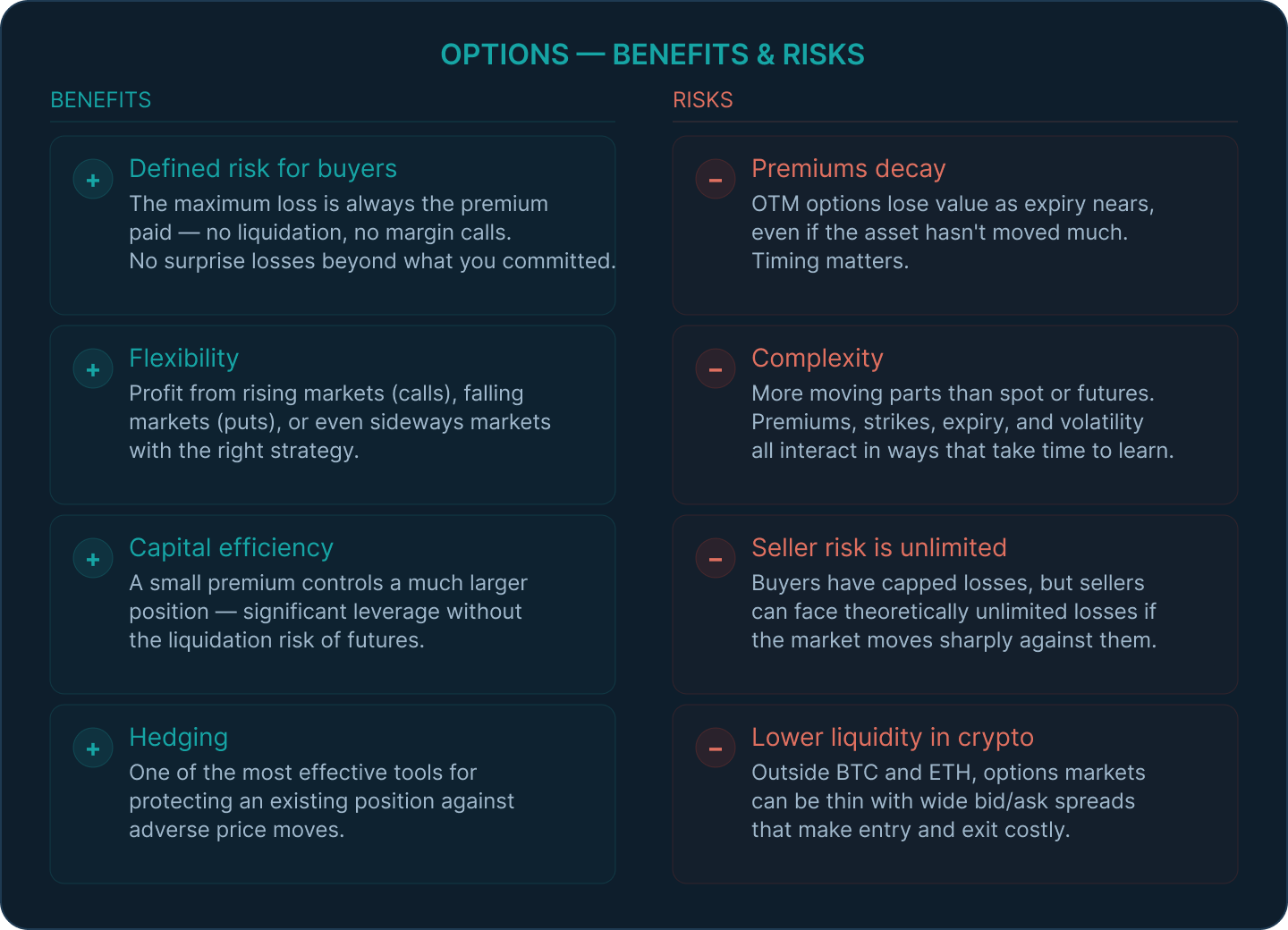
Options Benefits and Risks
Thank you for checking out our What are Options Contracts? Rights without Obligation article! Make sure to follow us on X(Twitter) and let us know your thoughts. MEW rewards active traders — see our Rewards page for all ongoing campaigns. Subscribe to our newsletter to stay up to date with MEW releases, and check out our weekly podcast Crypto Currents for the latest news in crypto. To complete your derivatives knowledge, check out our articles on Futures Contracts and Perpetual Futures.