
For years, the relationship between traditional finance and crypto was defined by skepticism. Banks issued warnings. Asset managers called it speculative. Regulators dragged their feet. Things were barely changing gradually. And then, they changed all at once.
The same institutions that spent the better part of a decade dismissing crypto are now racing to put their own products onchain. BlackRock, Franklin Templeton, Goldman Sachs, Fidelity. They're not experimenting anymore — they're building infrastructure, launching products, and competing for position in a market they once ignored.
Tokenized stocks are at the center of that shift. And understanding why is increasingly important for anyone investing today, whether they are doing it through Fidelity, Robinhood, or onchain.
This article is for educational purposes only and does not constitute financial advice. Always conduct your own research before making any investment decisions.
Terms to Know
Institutional context
- SEC — The U.S. Securities and Exchange Commission — the regulator that oversees securities markets in the United States. Whether a tokenized stock qualifies as a security under SEC rules has major implications for how it can be offered and to whom.
- DTCC — The Depository Trust & Clearing Corporation — the centralised clearing and settlement infrastructure behind most U.S. equity trades. Tokenized stocks on public blockchains represent a direct alternative to the DTCC's T+2 settlement model.
- MiCA — The EU's Markets in Crypto-Assets regulation, which created a unified licensing framework for crypto service providers.
- BUIDL — BlackRock's tokenized money market fund launched on Ethereum in 2024, widely seen as the institutional turning point for onchain finance.
What Tokenized Stocks Actually Do Differently
A tokenized stock isn't just a stock with a different label. It's a fundamentally different way of representing and transferring equity exposure — one that trades the constraints of traditional market infrastructure for the properties of blockchain.
Here's what that means in practice.
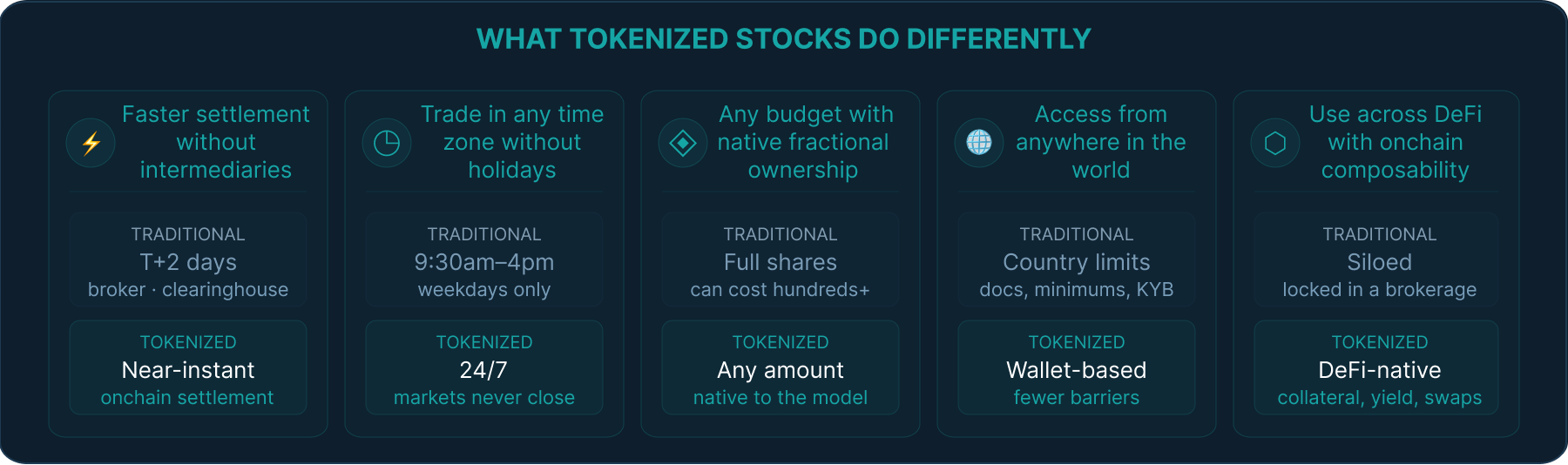
Settlement speed. Traditional stock trades settle on a T+2 basis — two business days after the transaction. Tokenized stocks settle onchain, which means near-instant finality. For individual investors this is a convenience; for institutions managing large portfolios, it's a meaningful reduction in counterparty risk and capital tied up in the settlement pipeline.
Trading hours. Stock markets close. Crypto markets don't. Tokenized stocks can be traded 24 hours a day, seven days a week — not just during the nine-and-a-half hours that the New York Stock Exchange is open. For investors outside the US, this removes the inconvenience of trading across time zones. For active traders, it removes the gap risk that builds up overnight.
Fractional ownership. A single share of some companies costs hundreds or thousands of dollars. Tokenization makes fractional ownership native — you can hold $10 worth of a company rather than being priced out entirely. This isn't a workaround; it's built into how the token works.
Global accessibility. Most countries outside the US have limited choices - or no options at all - when it comes to getting US equities through traditional brokerages. Tokenized stocks can be accessed from a crypto wallet with far fewer barriers — particularly meaningful for investors in markets that are underserved by the traditional brokerage system.
Onchain composability. This is the property that is most exciting to crypto-native users and platforms. Tokenized stocks can interact with the broader DeFi ecosystem — used as collateral in lending protocols, held in onchain portfolios alongside crypto assets, integrated into yield strategies. They behave like crypto assets, but they track the economics of real equities. That combination didn't exist before.
Why TradFi Is Moving Now
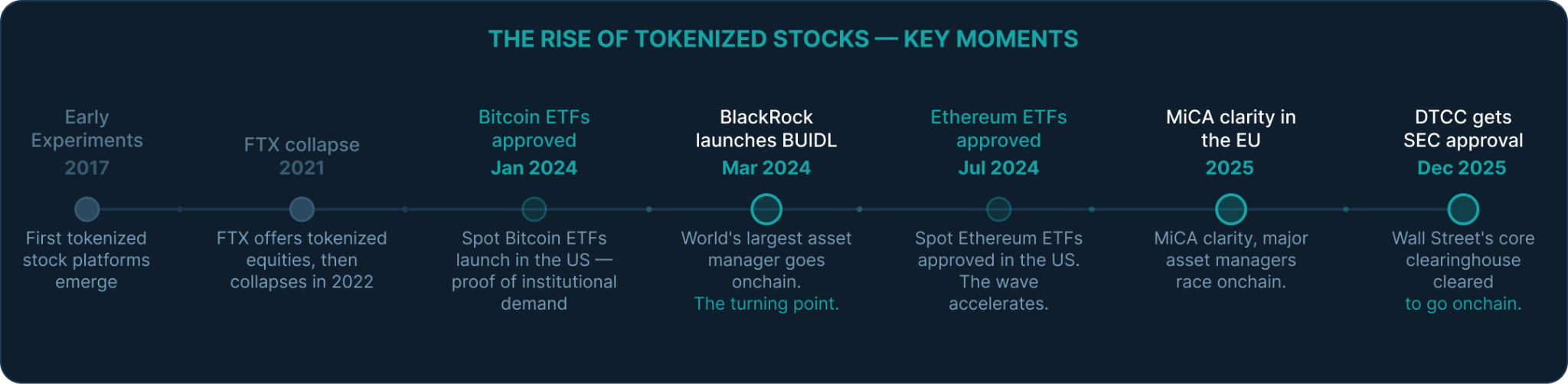
Tokenized stocks aren't new. Early versions appeared as far back as 2017, and platforms like FTX briefly offered tokenized equities before their collapse. But those early experiments were fragile, lightly regulated, and structurally limited. They didn't go mainstream because the infrastructure wasn't there and the regulatory framework wasn't clear.
Starting in 2024, several key moments turned it all around.
Regulatory clarity arrived. In early 2025, a change in US administration brought a significant shift in the SEC's posture toward crypto. Under new leadership, the commission signalled that compliant tokenization could proceed — removing the regulatory uncertainty that had kept many institutional players on the sidelines for years. Around the same time, MiCA in the EU created a unified licensing framework for crypto-asset service providers across all 27 member states for the first time. Together, the two largest financial markets in the world had moved from ambiguity to a workable legal framework — and for institutions that had been waiting on that certainty, this was the green light.
Spot Bitcoin ETFs changed the conversation. The approval of spot Bitcoin ETFs in the US in January 2024 — and the $50+ billion that flowed into them in the months that followed — demonstrated something important: retail and institutional demand for regulated, accessible crypto exposure sizeable. Tokenized funds and stocks are the logical next step in that same direction of travel.
BlackRock moved first — and it mattered. When the world's largest asset manager launched BUIDL, its tokenized money market fund on Ethereum, in early 2024, it was a signal. BlackRock doesn't run experiments — it deploys capital at scale. The message to the rest of the industry was clear: onchain distribution of traditional financial products is real, and the race is on.
The competitive pressure intensified. Once BlackRock moved, others followed. Franklin Templeton expanded its onchain money market fund. Goldman Sachs deepened its digital assets infrastructure. Fidelity launched tokenized treasury products. The race to capture onchain distribution is now a strategic priority for major asset managers — not a side project.
The infrastructure itself started moving. In December 2025, the Depository Trust & Clearing Corporation, the DTCC, received a no-action letter from the SEC clearing it to tokenize securities on blockchain. The DTCC is not an asset manager or a startup. It is the central clearinghouse that processes virtually all US stock and bond trades — $4.7 quadrillion in transactions in 2025 alone. When the institution that settles Wall Street starts building onchain infrastructure, tokenization stops being a trend and starts being the new standard. The DTCC's full tokenization service is targeted for launch in October 2026, with more than 50 firms already onboarded.
Today, the tokenized real-world asset market has grown to tens of billions of dollars and is projected to reach trillions over the next decade as more asset classes move onchain. Tokenized equities — stocks, ETFs, and equity indices — are expected to be among the largest categories.
What It Means for Retail Investors
There are two ways to look at the institutional adoption of tokenized stocks, depending on which side of the TradFi/crypto divide you're coming from.
For TradFi investors, tokenization offers a new way to access familiar assets. If you already hold equities through a traditional brokerage, tokenized stocks represent the same underlying exposure delivered on better rails — faster settlement, longer trading hours, fractional access, and the ability to hold alongside other digital assets in a single wallet. The stocks are the same. The infrastructure is different, and in many ways better. And for investors who don't hold those stocks yet — because their country isn't serviced by major brokerages, because the documentation requirements are too burdensome, or because minimum deposits put certain markets out of reach — tokenized stocks remove those barriers entirely. The same Apple, NVIDIA, or S&P 500 exposure that was previously inaccessible becomes available through a crypto wallet, with no broker account required.
For crypto-native investors, tokenized stocks offer something that wasn't previously available inside the onchain ecosystem: genuine exposure to traditional market cycles. Crypto assets are highly correlated with each other. Adding tokenized equities — stocks that respond to earnings reports, interest rate decisions, and macroeconomic data rather than crypto-specific sentiment — introduces a layer of diversification that purely crypto portfolios lack. And it does so without requiring a brokerage account, without leaving your wallet, and without giving up self-custody.
The convergence is happening in both directions. TradFi is coming onchain. Crypto-native investors are gaining access to traditional markets. And for brand new investors just getting started, the options have never been broader — you can begin with a brokerage account, a crypto wallet, or a platform that bridges both. The infrastructure that makes both possible is being built right now.
But Not All Tokenized Stocks Are the Same
Institutional adoption is a meaningful signal that tokenized stocks are maturing. Major asset managers don't launch products without legal infrastructure, custody arrangements, and compliance frameworks. The presence of names like BlackRock and Franklin Templeton in this space raises the overall credibility of tokenized assets as a category.
But institutional endorsement of the category is not the same as every product in the category being equally well-structured. Tokenized stocks vary significantly in how they're built — and those differences can matter enormously for the investor holding them.
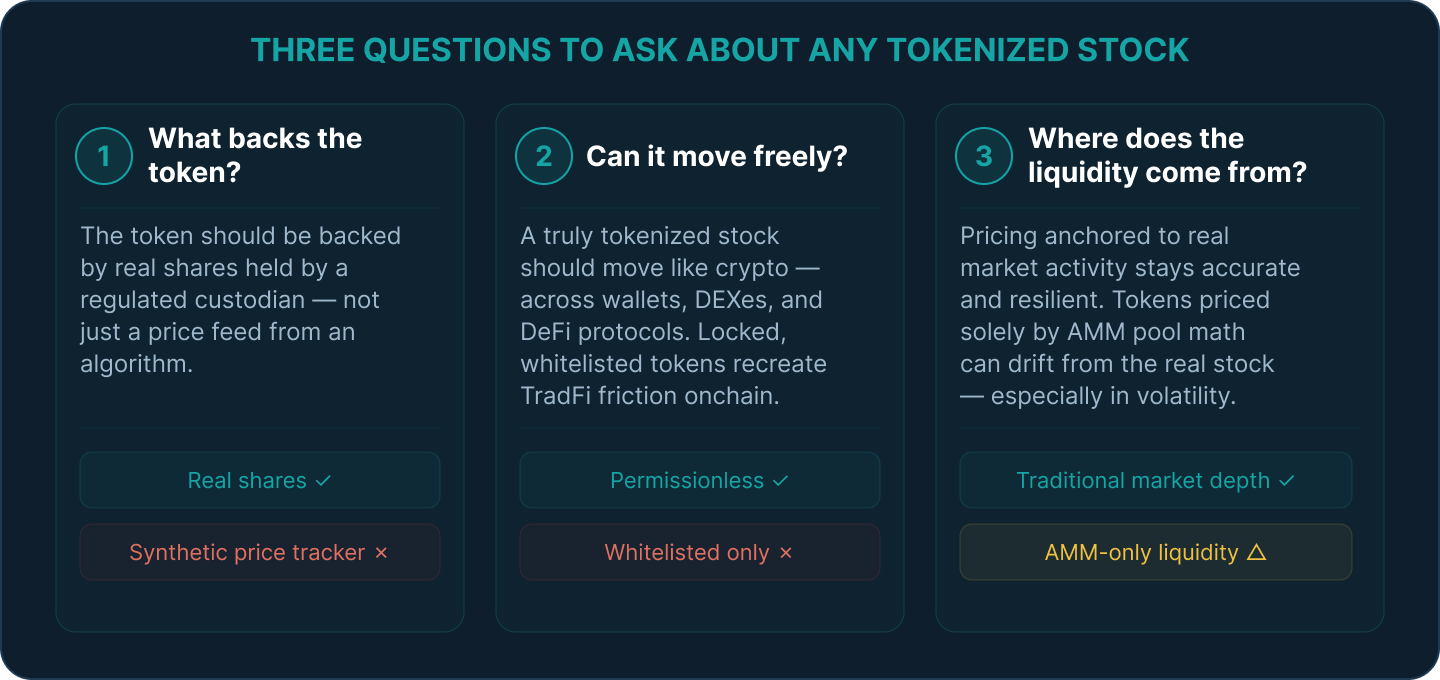
Some platforms back their tokens with real shares held by a regulated custodian. Others issue synthetic tokens that simply mirror the price via an algorithm, with no real equity behind them. Some tokens move freely across wallets, DeFi protocols, and smart contracts. Others are locked to whitelisted addresses, recreating the walled-garden experience of a centralised platform in a supposedly decentralised wrapper. Some source their liquidity and pricing directly from traditional equity markets, maintaining tight spreads and accurate pricing even in volatile conditions. Others rely on AMM pools with shallow depth, where large trades cause significant slippage and prices can drift meaningfully from the real stock.
As more capital flows into tokenized stocks — from both retail and institutional investors — understanding these structural differences becomes more important, not less. The growth of the market means more products, more issuers, and more variation in quality. Knowing what sits behind a token, how it moves, and where its liquidity comes from is the foundation of making an informed decision.
For a full breakdown of how tokenized stock platforms differ across backing, permissionlessness, and liquidity source, see our article: Are All Tokenized Stocks the Same?
Thank you for checking out our article on Why TradFi Is Rushing Into Tokenized Stocks! Make sure to follow us on X(Twitter) and let us know your thoughts. MEW rewards active traders — see our Rewards page for all ongoing campaigns. Sign up for our newsletter to stay up to date with MEW releases, and check out our weekly podcast Crypto Currents for the latest news in crypto. For more on tokenized stocks and real-world assets, check out our articles on What Are Tokenized Stocks, Are All Tokenized Stocks the Same? and How to Get US Stocks from Outside the US.