Exchange-traded funds (ETFs) are some of the most popular tools and most searched-for terms in investing — and for good reason. They're simple, diversified, low-fee, and low maintenance. But "how do I actually buy one" turns out to have a different answer depending on where you're asking from.
If you're in the US, buying an ETF is about as straightforward as online investing gets. If you're anywhere else, the picture gets more complicated — and increasingly, there's a third path that didn't exist a few years ago. This article walks through all three.
This article is for educational purposes only and does not constitute financial advice. All investments carry risk. Always conduct your own research before making any financial decisions.
Jump To:
- Terms to Know
- A Quick Recap: What Is an ETF
- Path 1: Buying ETFs From the US
- Path 2: Buying ETFs From Outside the US via International Brokers
- Path 3: Buying Tokenized ETFs From Anywhere
- What to Consider Before You Buy Any ETF
- Access Has Never Looked More Different
Terms to Know
A Quick Recap: What Is an ETF
An ETF (Exchange-Traded Fund) is an investment fund that holds a collection of assets and trades on a stock exchange throughout the day, just like an individual stock. Buying a share gives you exposure to everything the fund holds, without needing to buy each underlying asset separately.
For a fuller introduction, see our guide to What Are ETFs? — and if you want to understand the full landscape of ETF categories before deciding what to buy, check out The Many Different Types of ETFs.
Path 1: Buying ETFs From the US
If you're a US resident, this is the simplest of the three paths. Here's how it works.
1. Choose a brokerage. Traditional platforms like Fidelity, Schwab, and Vanguard offer full research tools and retirement accounts. App-based platforms like Robinhood, Public, and Webull offer a simpler, mobile-first experience. Most brokers now offer commission-free trading, so the real differences come down to research tools, account types, and fractional share support.
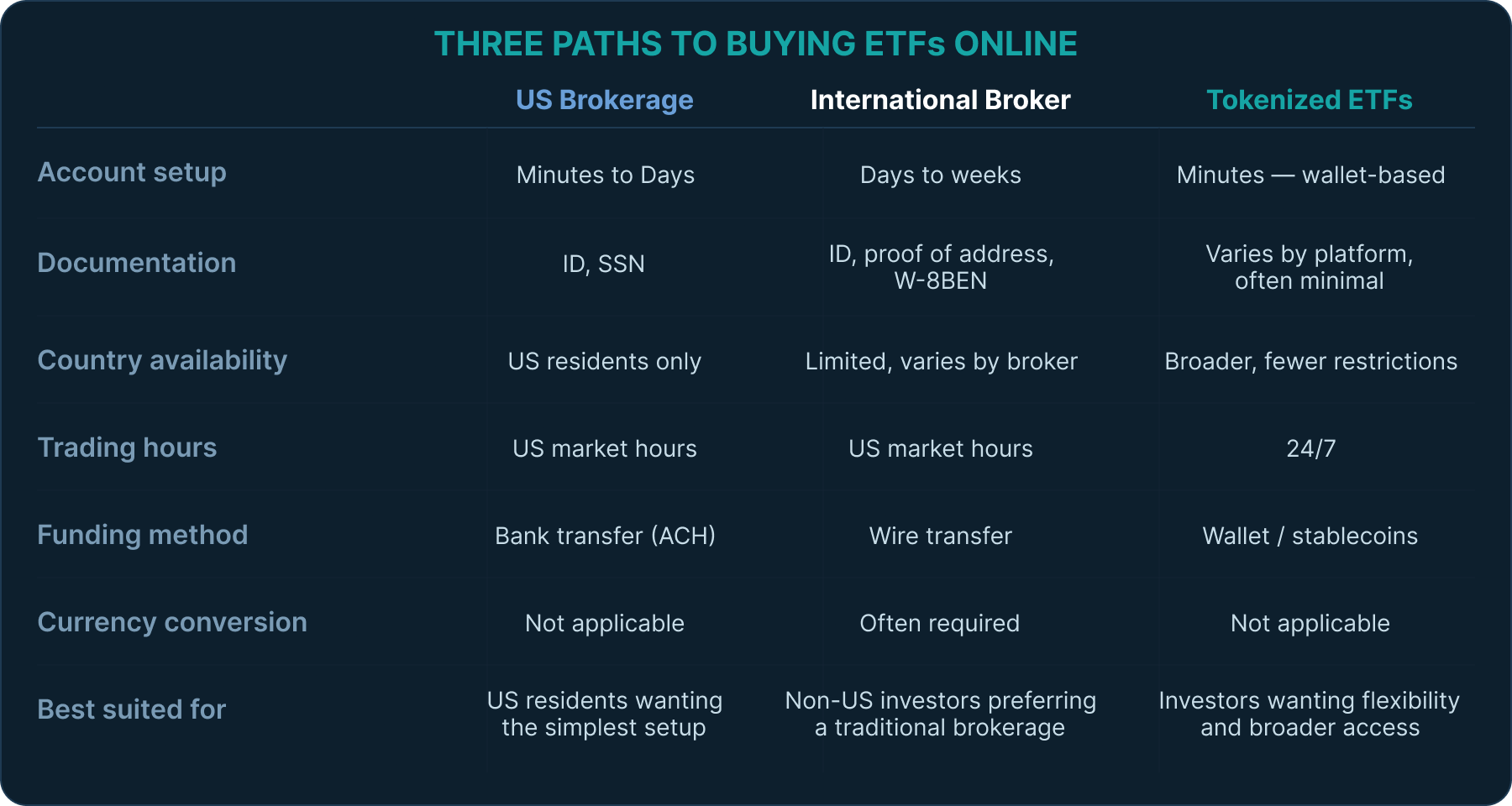
2. Open and fund your account. This usually takes 10–15 minutes online, requiring ID and basic financial details. Funding via a linked bank account (ACH) typically clears in one to three business days.
3. Search and buy. Search the ETF by its ticker — SPY, QQQ, VTI — and place a market or limit order. Fractional shares let you invest a specific dollar amount rather than buying a whole share.
4. Monitor your position. Once purchased, track performance and reinvest dividends automatically if your platform supports it.
For US investors, this entire process can take anywhere from a couple of days — if it's your first time funding a new account — to just a few minutes if your bank account was already linked.
Path 2: Buying ETFs From Outside the US via International Brokers
If you're outside the US, the process is considerably more involved. A number of international brokers — including Interactive Brokers, Charles Schwab International, Trading 212, eToro, and DEGIRO — offer access to US-listed ETFs for non-US residents, but with meaningfully more friction than the US-based path above.
Expect account opening to take days rather than minutes, documentation requirements including proof of identity and address, a W-8BEN form to certify your non-US status for tax purposes, and country eligibility that varies significantly by broker.
ETFs can face an extra hurdle here too — since 2018, EU regulation has generally blocked EU and UK retail investors from buying US-domiciled ETFs like SPY or QQQ through EU brokers, pushing many toward European-listed equivalents instead. Trading hours are also fixed to US market hours, and currency conversion adds a cost if your local currency isn't USD.
We've covered the US ETF and stock purchase path for non-US residents in full detail — including a breakdown of each broker, the specific friction points, and step-by-step guidance — in our article How to Get US Equities From Outside the US: Brokerage vs Tokenized Stocks.
Path 3: Buying Tokenized ETFs From Anywhere
The third path didn't exist a decade ago: buying ETFs as tokens, held in a self-custodial crypto wallet, accessible from virtually anywhere in the world.
Tokenized ETFs are blockchain-based tokens that track the price and economic exposure of a real underlying ETF. Through tokenization platforms like Ondo Stocks (integrated in MEW Mobile and MEW Portfolio), many widely held ETFs — including SPY, QQQ, TLT, and dozens of others — are available as tokens that can be held, traded 24/7, and used within the broader DeFi ecosystem, all without a traditional brokerage account.
This path removes many of the friction points of Path 2 — no lengthy account opening, no country eligibility lists, no fixed market hours — but it comes with its own considerations, including the need to understand how a given tokenized ETF is backed and where its liquidity comes from.
For the full breakdown of how to acquire tokenized assets, see our How to Get US Equities From Outside the US article, which covers the tokenized path in detail. And for a look at the variety of ETFs currently available in tokenized form, see The Many Different Types of ETFs.
What to Consider Before You Buy Any ETF
Regardless of which path you take, a few things are worth checking before buying any specific ETF.
Expense ratio. Fees vary enormously — from 0.03% for broad market index ETFs to 0.75%+ for actively managed or niche thematic funds. Over long holding periods, this difference compounds meaningfully.
Liquidity. The largest ETFs trade with tight spreads and deep volume. Smaller or niche ETFs can have wide bid/ask spreads and thinner trading, which affects the price you actually get when buying or selling.
What's actually inside it. Not every ETF works the way its name suggests — some use derivatives, futures contracts, or leverage rather than holding the underlying assets directly. Understanding the structure matters as much as understanding the exposure. Our guides The Many Different Types of ETFs and Are All Tokenized Stocks the Same help break down the different categories and what to watch for in each.
Access Has Never Looked More Different
The route to owning an ETF today depends entirely on where you're starting from — a US resident can be invested within minutes, while an investor elsewhere may navigate weeks of paperwork through a traditional broker, or increasingly, sidestep that process altogether through a tokenized alternative. The destination — a diversified basket of assets in a single investment — is the same. How you get there is not.
Thank you for checking out our guide on How to Buy ETFs Online from the US or Anywhere Else! Make sure to follow us on X(Twitter) and let us know your thoughts. MEW rewards active traders — see our Rewards page for all ongoing campaigns. Sign up for our newsletter to stay up to date with MEW releases, and check out our weekly podcast Crypto Currents for the latest news in crypto. For more on ETFs and how they're evolving onchain, check out our article on What Are ETFs?, The Many Different Types of ETFs and How to Get US Equities From Outside the US.