
A new category of onchain product has started to appear that looks, at first glance, a lot like a tokenized ETF. You deposit funds, receive a single onchain token in return, and that token represents a diversified basket of underlying assets. Sounds familiar, but the machinery running underneath it is entirely different.
An ETF gives you a basket of assets in a single share (which can then be tokenized onchain), but it still relies on a professional management company, a listed exchange, and a fund structure built for a pre-internet world.
Tokenized portfolios take the same core idea and rebuild it natively onchain. Instead of a fund administrator, a smart contract handles everything — keeping track of the assets, issuing your share, and in some cases rebalancing the portfolio automatically, all visible in real time and accessible directly from your wallet. Understanding how that mechanism generally works is the key to understanding what you're holding when you buy into one.
It's worth noting that several traditional brokerages already offer automated, algorithm-managed portfolio products built entirely on conventional brokerage infrastructure with no blockchain involved. This article is specifically about the onchain version of this concept, where the portfolio logic and asset custody are handled by a smart contract rather than a brokerage's internal systems.
Different platforms use different names for their version of this idea — token baskets, synthetic baskets, index baskets, model portfolios, curated investment portfolios, automated token portfolios, and intelligent portfolios are all terms that have appeared across the space.
The most recent examples include Bitwise's Automated Token Portfolios (ATPs), which let eligible investors hold rules-based baskets of tokenized US stocks, and Ondo’s Intelligent Portfolios (OIPs), initially launching with three BlackRock model portfolios that are tradeable as single digital tokens onchain.
The naming varies, but the underlying mechanism tends to follow the same basic pattern – let’s take a closer look at how it works.
This article is for educational purposes only and does not constitute financial advice. Smart contract-based products carry risks distinct from traditional regulated funds, including smart contract vulnerabilities and evolving regulatory treatment. Always conduct your own research before participating in any onchain financial product.
Jump To:
- Terms to Know
- Two Main Types of Tokenized Portfolios
- How the Different Models Work Under the Hood
- How This Differs From Regular and Tokenized ETFs
- Benefits of Tokenized Portfolios
- Risks and Open Questions
- Where Token Baskets and Tokenized Portfolios Are Headed
Terms to Know
Two Main Types of Tokenized Portfolios
At the core of a tokenized portfolio is a basket of underlying assets — which can include tokenized stocks, tokenized treasuries, stablecoins, or other digital assets. Two main structures have emerged for how this actually works.
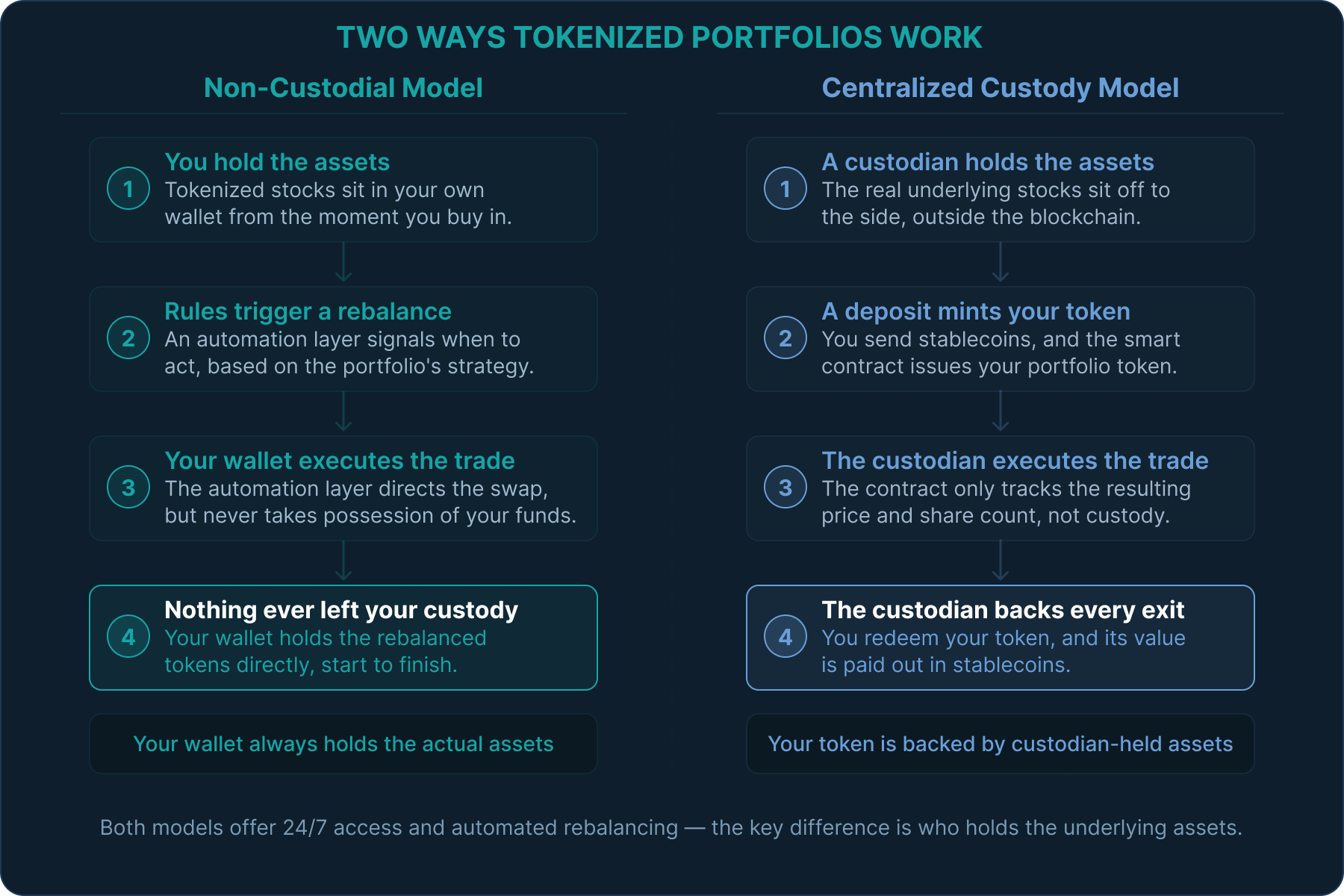
In a non-custodial, wallet-native model, the underlying tokenized assets stay directly in your own wallet the entire time. An automation layer directs the rebalancing — buying and selling on your behalf according to a published strategy — but never takes possession of your assets. There's no shared pool; every investor's holdings are individually theirs, sitting in their own wallet the whole time.
In a centralized custody, onchain accounting model, the actual underlying assets — real shares of stock, for example — are held by a custodian or platform. The smart contract's role here is closer to a ledger: it tracks the price of each holding and the number of shares the portfolio has in each, and lets you mint or redeem your portfolio position for stablecoins. You're not directly holding the underlying stock tokens in this model — you're holding a claim that the smart contract accounts for.
The baskets themselves take different forms depending on the platform and structure. There are thematic baskets — bundling together tokenized stocks tied to a single trend, like AI, robotics, or a specific sector. Some replicate familiar groupings from traditional markets, such as an equal-weighted basket of mega-cap technology names. Others focus on asset type rather than theme, combining tokenized treasuries and stablecoins into a lower-volatility basket built for yield rather than growth.
How the Different Models Work Under the Hood
The mechanics are worth walking through in more detail, because they explain both the appeal and the risk of this category.
Custody depends on the structure
In the non-custodial model, the underlying tokens remain in your own wallet throughout, and the automation layer only directs trades — it never takes possession of your assets. In the centralized custody model, the actual assets sit with a custodian off-chain or off to the side, and the smart contract tracks pricing and share accounting rather than holding anything itself.
For baskets involving offchain assets like real-world stocks, either structure typically relies on custodians and price oracles that report the value of those holdings back onchain, since a blockchain has no native way of directly observing something like a bond coupon payment or a stock dividend.
Value moves with the underlying assets
Whether you're holding the underlying tokens directly or a claim tracked by the smart contract, the value of your position moves in line with the basket's holdings. As those holdings change in price, or generate income like dividends, your position's value adjusts accordingly.
Rebalancing can be automatic or governed
Some products are built with hard-coded rules: for example, always holding the ten largest tokens by market capitalization, automatically buying and selling to maintain that composition as market caps shift. Others are directed by a designated manager — a person or entity with the authority to adjust the basket's holdings over time, publishing a model that the automation layer or smart contract then executes. In both cases, every trade is recorded transparently onchain.
Visibility varies by structure
In the non-custodial model, every deposit, withdrawal, and rebalancing action is recorded on a public ledger the moment it happens, and the current composition can be checked by anyone at any time. In the centralized custody model, the smart contract's onchain accounting still offers more frequent visibility into holdings and pricing than a traditional fund's periodic disclosures, though the underlying custody arrangement itself sits with a private custodian rather than being independently verifiable onchain.
The underlying position can be usable elsewhere
In the non-custodial model, because the tokenized assets sit in your own wallet, they can often be deposited into other DeFi protocols — used as collateral for a loan, or layered into another yield strategy. In the centralized custody model, the portfolio token you hold can also often be used the same way, since it functions as a standard onchain asset even though the underlying stocks sit with a custodian.
In some implementations, your position can continue accruing dividends and retaining other economic benefits from the underlying assets even while it's simultaneously deployed in a secondary yield strategy — something a traditional fund share cannot do.
How This Differs From Regular and Tokenized ETFs
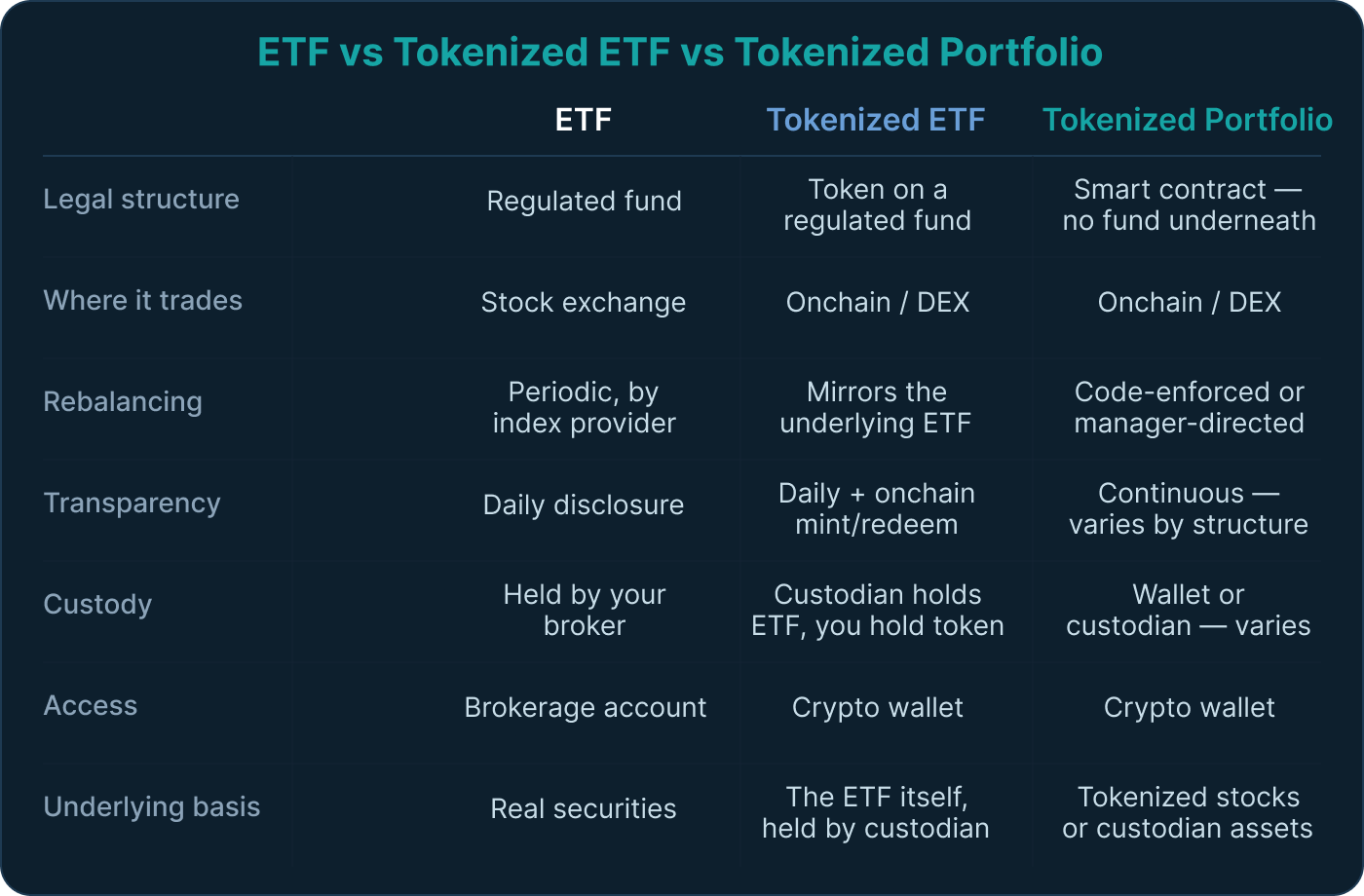
The surface-level similarity of tokenized portfolios to traditional and tokenized ETFs — a basket of assets represented by a single tradeable unit — masks some fundamental structural differences.
Legal structure
A traditional ETF is a regulated investment company, registered with securities regulators, operating under a specific legal framework designed for pooled investment vehicles. A tokenized ETF doesn't change this — it's simply a token representing a claim on those same regulated ETF shares, held by a custodian on the investor's behalf.
A tokenized portfolio is different: it's built on a smart contract, code deployed on a blockchain, governed by whatever rules were written into it and, in many cases, whatever multisig or governance process controls it. It may or may not have an actual fund registration underneath it.
Where it trades
ETF shares are listed and traded on a stock exchange, matched between buyers and sellers through market makers. A tokenized ETF reflects the underlying ETF, but moves the trading venue onchain: minted or redeemed directly, and tradeable peer-to-peer or on decentralized exchanges, without needing a traditional brokerage account.
A tokenized portfolio works similarly in mechanics — acquired and exited through direct interaction with a smart contract, with the resulting tokens often tradeable peer-to-peer or on decentralized exchanges too — but there's no underlying ETF listed on a stock exchange.
Rebalancing
An ETF's rebalancing follows a published methodology, executed periodically by the fund's index provider or manager, with the resulting holdings disclosed afterward. A tokenized ETF simply reflects whatever rebalancing happens in the underlying ETF — it doesn't introduce its own separate process.
A tokenized portfolio is different: there's no underlying fund manager rebalancing on a periodic schedule. Its rebalancing is either enforced automatically by its code or executed directly by a designated manager, with the action itself and the resulting composition visible onchain as it happens, rather than reported after the fact.
Transparency
ETFs disclose their holdings daily; mutual funds, quarterly. A tokenized ETF inherits the same daily disclosure as its underlying ETF, with the added visibility of onchain mint and redeem activity.
An tokenized portfolio has no underlying fund disclosure to inherit — its transparency comes entirely from what's visible onchain, and how much depends on the structure: the non-custodial model exposes every wallet-level transaction publicly, while the centralized custody model's onchain accounting still depends on the custodian's own reporting being accurate.
Custody
ETF shares are held by your broker, in an account structure where the broker or a central depository maintains the official record of ownership. Tokenized ETFs sit somewhere in between — the underlying ETF shares are typically held by a custodian, while the token representing them can be held directly in your own self-custodial wallet.
Tokenized portfolios have no underlying ETF or broker at all — custody depends entirely on their structure. In the non-custodial model, the underlying tokens sit directly in your own self-custodial wallet the entire time; in the centralized custody model, the actual assets are held by a custodian off to the side, similar to how many individual tokenized stocks are backed.
Access
ETFs require a brokerage account. Tokenized ETFs are accessed through a crypto wallet instead, without that account-opening process.
Tokenized portfolios work the same way in this respect — accessed through a wallet, not a brokerage — but again, with no underlying listed ETF behind them.
For more on how buying tokenized ETFs and other onchain assets compares to buying ETFs through traditional routes, see our guide on How to Buy ETFs Online.
Benefits of Tokenized Portfolios
Composability
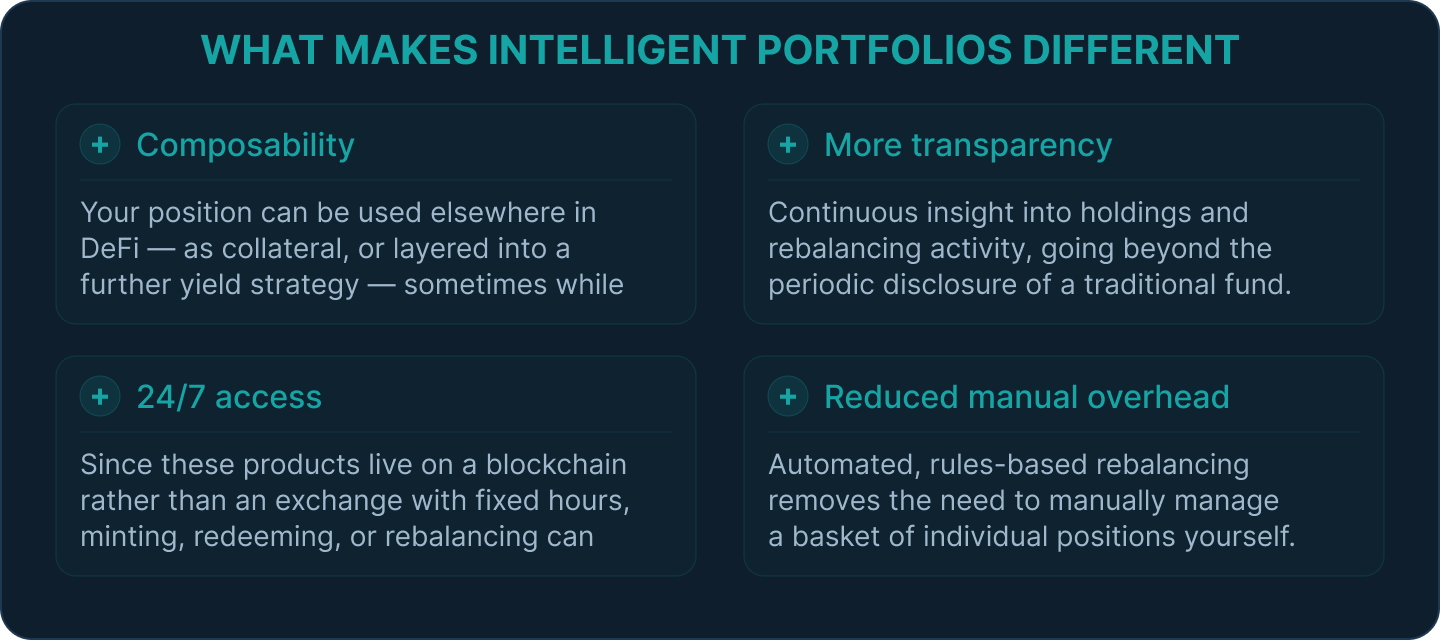
Whether you're holding the underlying tokenized assets directly or a portfolio token backed by a custodian, the position is generally usable elsewhere in DeFi — as collateral, or layered into a further yield strategy. This is something a traditional fund share cannot offer. Some implementations even let a position keep earning dividends and other economic benefits from the underlying assets while it's simultaneously deployed elsewhere.
More transparency
Both structures generally offer more frequent insight into holdings and pricing than a traditional fund's periodic disclosures, though the depth of that visibility depends on the platform’s specific structure.
24/7 access (with some models)
Since these products live on a blockchain rather than an exchange with fixed hours, minting, redeeming, or rebalancing can happen at any time.
Reduced manual overhead
Automated, rules-based rebalancing removes the need for investors to manually manage a basket of individual positions themselves.
Risks and Open Questions
Smart contract risk
The entire structure of a tokenized portfolio depends on the underlying code functioning as intended. A bug or exploit in the contract can put the pooled assets at risk in a way that has no direct parallel in a traditional, legally regulated fund structure.
Custodian and counterparty risk
In the centralized custody model, the security of your position depends on the custodian actually holding the assets it claims to hold, and honoring redemptions as expected. This is a similar trust assumption to the one behind any individual custodial tokenized stock, and it means the "onchain" part of the product is really the accounting and share tracking layer, not a guarantee that the underlying assets are held in a trustless way.
Oracle and pricing dependency
For baskets involving offchain assets, the accuracy of the onchain valuation depends entirely on the price feeds and reporting mechanisms connecting the offchain world to the blockchain. If that reporting is delayed, manipulated, or incorrect, the token's price can diverge from the true value of what it represents.
Governance risk
Where rebalancing is managed by a designated party rather than fully automated by code, that party's decisions — and the trust required in them — become a meaningful factor in the product's reliability.
A less mature regulatory framework
ETFs operate within decades of established securities law. Tokenized portfolios and similar products are a newer category, and the regulatory treatment of these products is still developing in most jurisdictions.
Early-stage category
This is a genuinely new structure, still being refined. Best practices for how these smart contracts should be built and secured are still forming, and the space lacks the multi-decade track record that gives investors confidence in how traditional ETFs behave across different market conditions.
Where Token Baskets and Tokenized Portfolios Are Headed
The broader pattern here is one that's playing out across the tokenized asset space more generally: infrastructure that once required a regulated intermediary is increasingly being represented directly in code. Tokenized stocks, tokenized treasuries, and now tokenized portfolios built from those assets are all part of the same underlying shift — moving financial products onto rails that are transparent, composable, and accessible from a self-custodial wallet.
Whether these products end up complementing ETFs, competing with them, or evolving into something distinct will likely depend on how the regulatory and technical infrastructure around them matures over the coming years. For now, they represent a genuinely new tool — one worth understanding on its own terms rather than assuming it behaves exactly like the fund structures that came before it.
For more on the broader tokenized asset landscape, see our articles on What Are RWAs and Are All Tokenized Stocks the Same?
Thank you for checking out our article on Tokenized Portfolios: How They Differ From an ETF! Make sure to follow us on X(Twitter) and let us know your thoughts. MEW rewards active traders — see our Rewards page for all ongoing campaigns. Sign up for our newsletter to stay up to date with MEW releases, and check out our weekly podcast Crypto Currents for the latest news in crypto. For more on ETFs and how they're evolving onchain, check out our article on What Are RWAs?, Are All Tokenized Stocks the Same? and What Are ETFs?.