
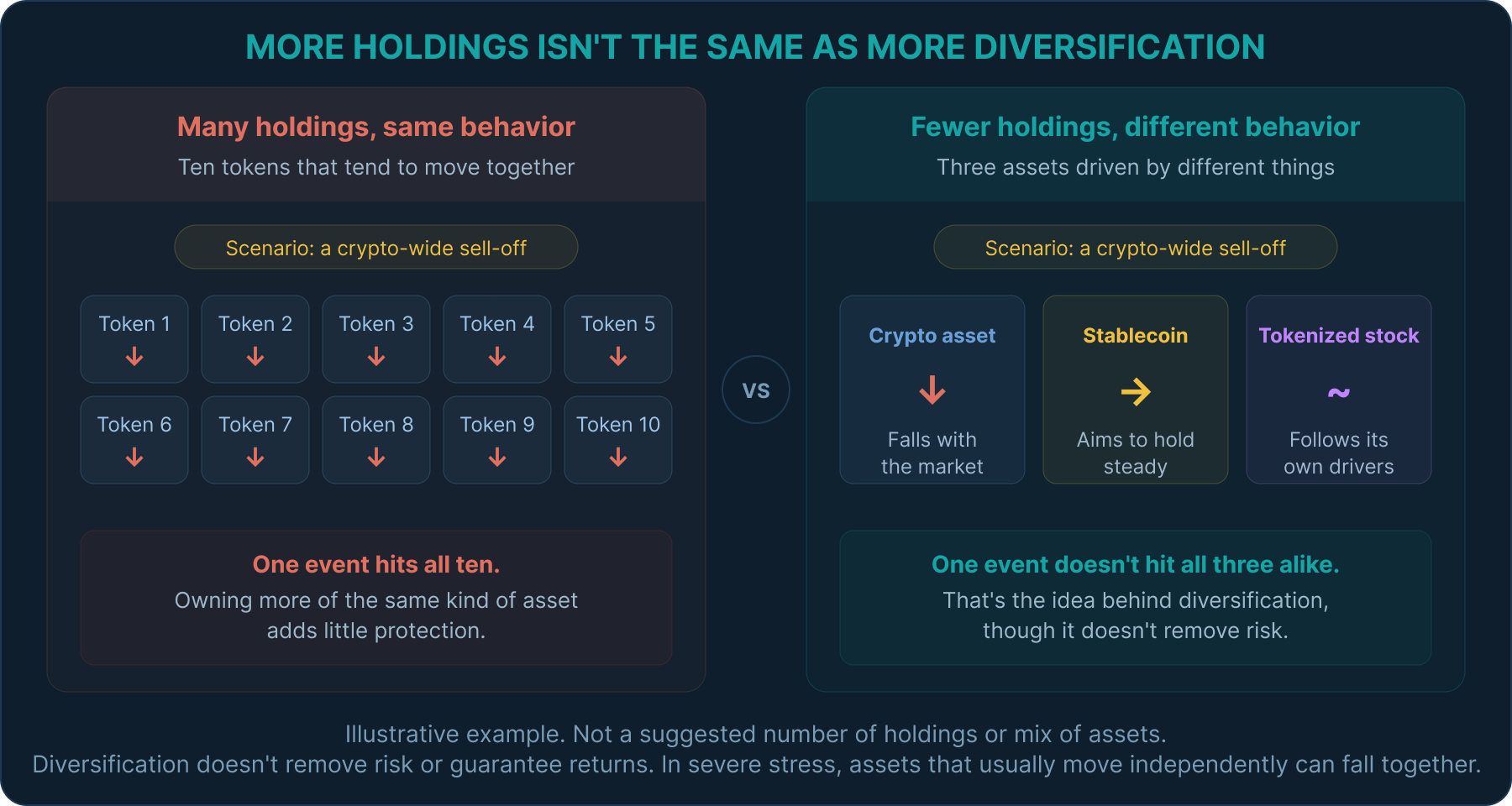
Ask a few investors how they diversify and you'll tend to hear one of two answers. Some hold a couple of assets and hope for the best. Others hold a dozen or more and assume that's enough to diversify, without noticing that most of those holdings rise and fall together.
Both approaches miss what diversification is really about. It isn't a headcount. It’s about owning assets that react differently to the same events, so no single outcome determines how your entire portfolio performs. That’s why it’s not necessarily about the number of different assets, but about a thoughtful approach to their selection. This article covers what that means in practice, what research says about how many holdings it takes, where the idea breaks down, and how ETFs, tokenized ETFs, and onchain baskets fit in.
This article is for educational purposes only and does not constitute financial advice. Diversification does not guarantee a profit or protect against loss. All investments carry risk. Always conduct your own research before making any financial decisions.
Jump To:
- Terms to Know
- What Diversification Actually Means
- Does Adding More Always Help?
- Diversifying Across Asset Types, Not Just Counts
- The Cost of Overdoing It
- Three Ways to Get Broad Exposure
- Themes Inside a Portfolio
- One Wallet, Multiple Asset Types
- How to Think About Portfolio Diversification
Terms to Know
- Diversification: Spreading a portfolio across assets that don't all react the same way to the same events, to reduce reliance on any single outcome. See our guide to asset allocation and portfolio rebalancing for how this applies to a crypto wallet.
- Correlation: A measure of how closely two assets' prices move together. Highly correlated assets tend to rise and fall at the same time; low-correlation assets tend to move more independently.
- Idiosyncratic risk: Risk tied to a single asset, such as one company missing earnings or one protocol being exploited. Holding several assets can reduce it.
- Systematic risk: Risk shared across an entire market, such as a broad downturn. It can't be diversified away within a single market.
- Concentration risk: The risk that comes from a large share of a portfolio depending on one asset, sector, or theme.
- Overlap: When different holdings contain the same underlying assets, therefore owning both increases exposure to those assets instead of spreading it.
- Thematic exposure: Exposure to a trend or idea, such as AI or clean energy, rather than to a traditional industry. See Beyond the S&P 500 for more on thematic funds.
- Rebalancing: Adjusting a portfolio back to its intended allocation after market movements cause it to drift.
- ETF (Exchange-Traded Fund): A fund that holds a collection of assets and trades on an exchange like a single stock. What Are ETFs? →
- Tokenized ETF: A blockchain-based token that represents economic exposure to a real underlying ETF, which can be held in a wallet. Are All Tokenized Stocks the Same? →
- Tokenized portfolio (onchain basket): A product that bundles several tokenized assets into a single token or managed position, following a set of automated rules. Structure varies by platform. Tokenized Portfolios: What They Are and How They Differ From ETFs →
- Self-custodial wallet: A crypto wallet where you hold your own private keys and have full control over your assets. Why self-custody matters →
What Diversification Actually Means
The old advice about not putting all your eggs in one basket is a fair start, but it hides the important part: it only helps if the baskets don't all fall off the same shelf.
Diversification works through correlation, meaning how closely two assets move together. Two assets with low correlation tend to react differently to the same news, so when one falls, the other might hold steady or even rise. Two highly correlated assets move in lockstep, so owning both adds little beyond owning one.
It also helps to separate two kinds of risk. Asset-specific (idiosyncratic) risk belongs to a single holding: a company misses earnings, a protocol gets exploited, a token loses its community. Spreading across several holdings can reduce it. Market (systematic) risk is shared by everything in a market. A broad stock downturn hits most stocks, and a crypto-wide sell-off hits most tokens. Diversifying within one market can't remove that risk, and only spreading across different kinds of assets may soften it.
Diversification doesn't eliminate risk or guarantee returns. In severe market stress, assets that normally move independently can fall together.
Does Adding More Always Help?
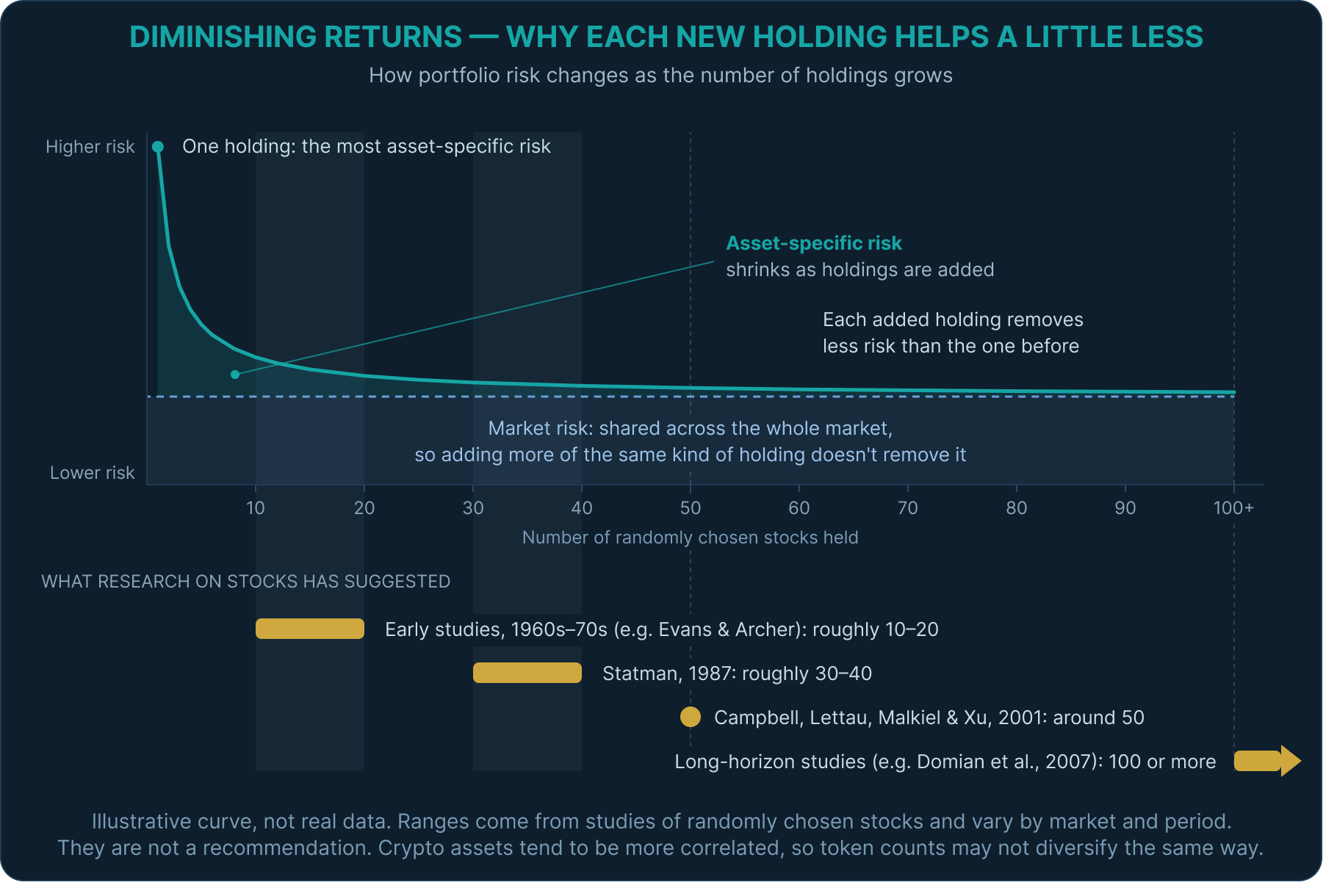
Adding a second holding to a one-asset portfolio makes a big difference. Adding the fiftieth makes much less. That's diminishing returns: the first few additions remove the most asset-specific risk, and each one after that removes a little less.
Researchers have tried to pinpoint where this flattens out for stocks, and the answers have shifted over the decades:
- Early studies from the late 1960s and 1970s, including the often-cited work by Evans and Archer, suggested that roughly 10 to 20 randomly chosen stocks captured most of the benefit.
- Statman (1987) argued the figure was closer to 30 to 40.
- Campbell, Lettau, Malkiel, and Xu (2001) found that individual stocks had become more volatile over time, and estimated that around 50 were needed to get the result that far fewer had achieved decades earlier.
- Studies that focused on long holding periods and the risk of missing long-term goals have argued for 100 or more.
There's no agreed answer, and the spread of answers is the point. The count that matters depends on the market being studied, the time period, how the holdings are weighted, and what kind of risk you're trying to reduce. This article doesn't offer a target number, because the research doesn't support a single one.
Two caveats matter for anyone holding crypto:
These studies look at stocks. Crypto assets tend to be highly correlated with one another, especially during downturns, so a count of tokens says little about how diversified a crypto portfolio really is. Ten tokens that all fall together are less diversified than three that don't.
The studies measure randomly chosen holdings. Real portfolios aren't random. They're built on purpose, often around the same popular themes, which makes overlap more likely.
Diversifying Across Asset Types, Not Just Counts
Since counting holdings only goes so far, many investors think in categories instead. In our asset allocation guide, we covered four broad buckets for a self-custodial crypto wallet:
- Blue chip crypto: Bitcoin and Ethereum
- Altcoins and higher-risk assets
- Stablecoins
- Tokenized real-world assets: stocks, bonds, and treasuries held onchain
The value of a framework like this is that the buckets behave differently. Stablecoins aim to hold a steady value. Tokenized equities follow company earnings and macroeconomic conditions. Blue chip and altcoin holdings tend to respond to crypto-specific sentiment. How much goes into each bucket is a personal decision that depends on goals, time horizon, and risk tolerance.
For more on how the buckets work and why portfolios drift over time, see our guide to asset allocation and portfolio rebalancing.
The Cost of Overdoing It
More isn't automatically better. Investor Peter Lynch popularized the term "diworsification" for what happens when adding holdings makes a portfolio more complicated without making it meaningfully safer. It tends to show up in a few ways:
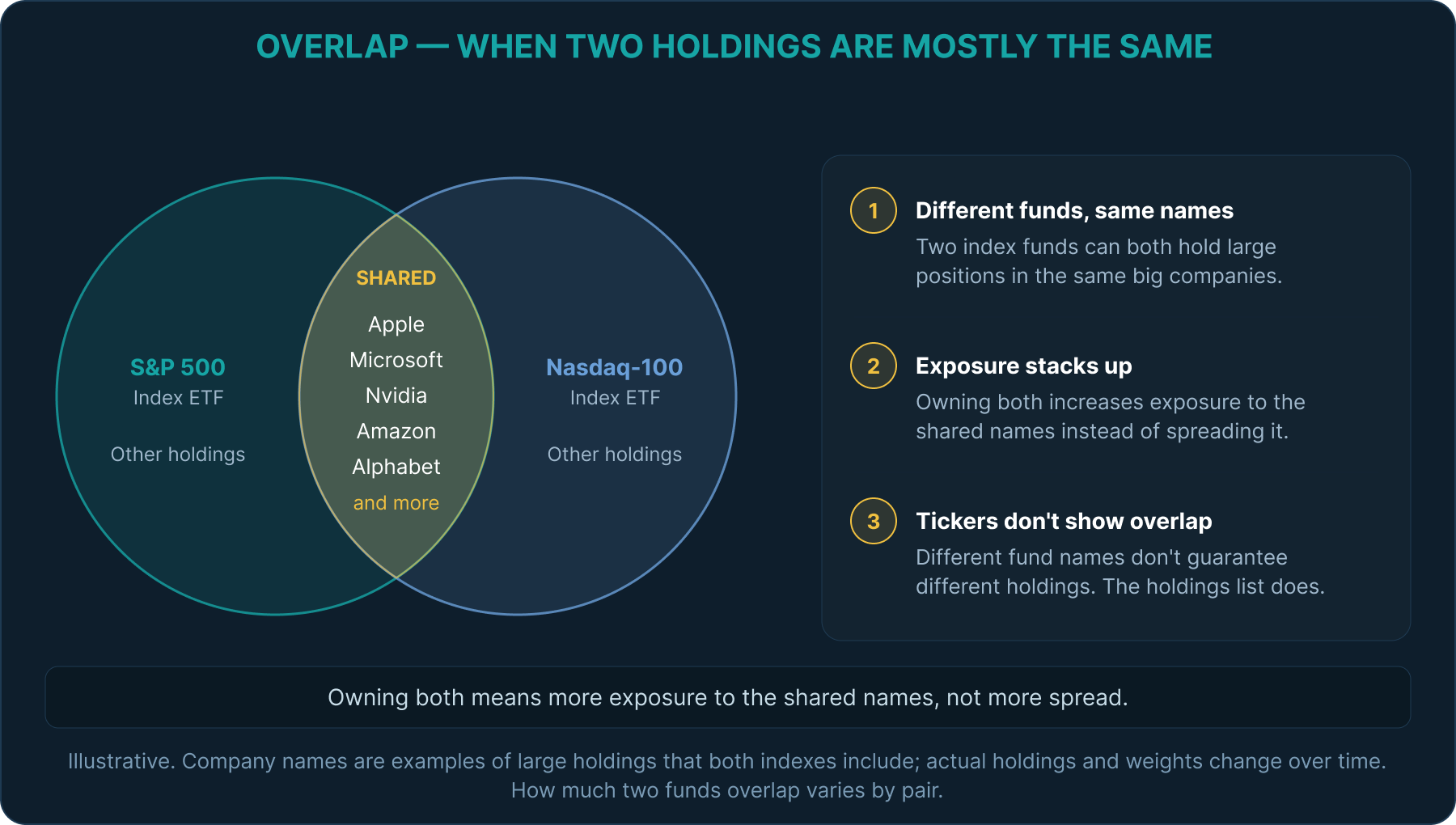
- Overlap. Different holdings can contain the same underlying assets. Two popular index ETFs, for example, can both hold large positions in the same handful of mega-cap technology companies, so owning both increases exposure to those names instead of spreading it.
- Complexity. Every added holding is something to track, research, and understand. The more positions there are, the harder it is to know what you actually own.
- Rebalancing burden. More positions means more to adjust when allocations drift, and each trade can carry fees or tax consequences.
- Cost. Funds and platforms charge their own fees, and holding several overlapping products can mean paying for the same exposure more than once.
Three Ways to Get Broad Exposure
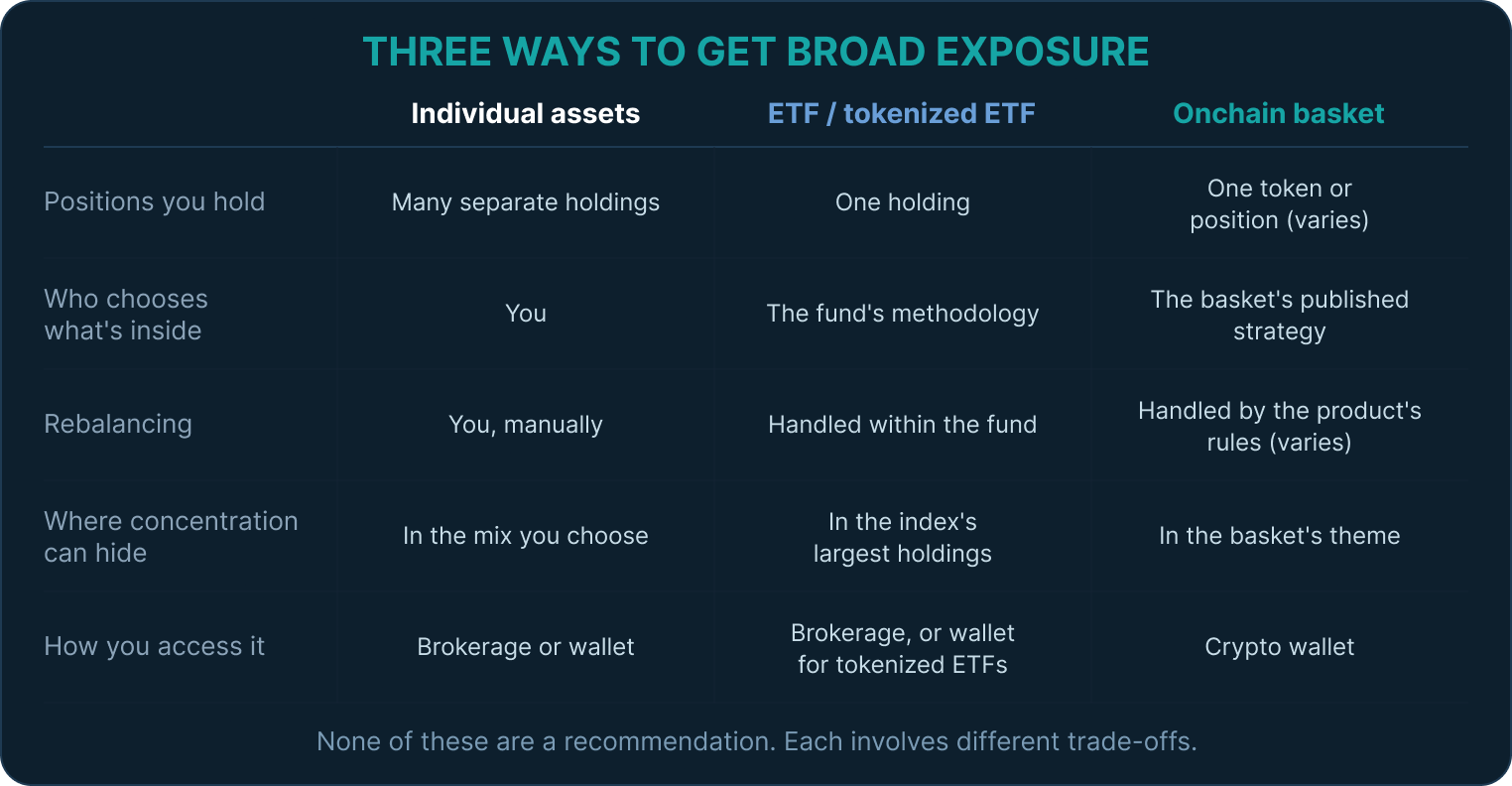
There's more than one way to hold a wide set of assets. Here's how three common approaches compare. None of them is a recommendation, and each involves different trade-offs.
Individual assets. You buy each holding yourself. You choose exactly what's in the portfolio and control the weights, and you're responsible for selecting, tracking, and rebalancing every position.
ETFs and tokenized ETFs. An ETF packages many holdings into a single tradeable share, and the fund handles selection and rebalancing according to its published methodology. A tokenized ETF is a blockchain token that reflects the same underlying fund, so it can sit in a self-custodial wallet next to your crypto. One ETF can hold dozens or hundreds of underlying assets, though how diversified it is depends on what it tracks. Our guide to What Are ETFs? covers the basics.
Onchain baskets (tokenized portfolios). A newer category bundles several tokenized assets into a single token or managed position. You might hold one token that gives exposure to a set of stocks tied to a theme, for example. The details vary by platform, including who holds the underlying assets and how rebalancing happens, so it's worth understanding the specific structure of any product before using it.
Themes Inside a Portfolio
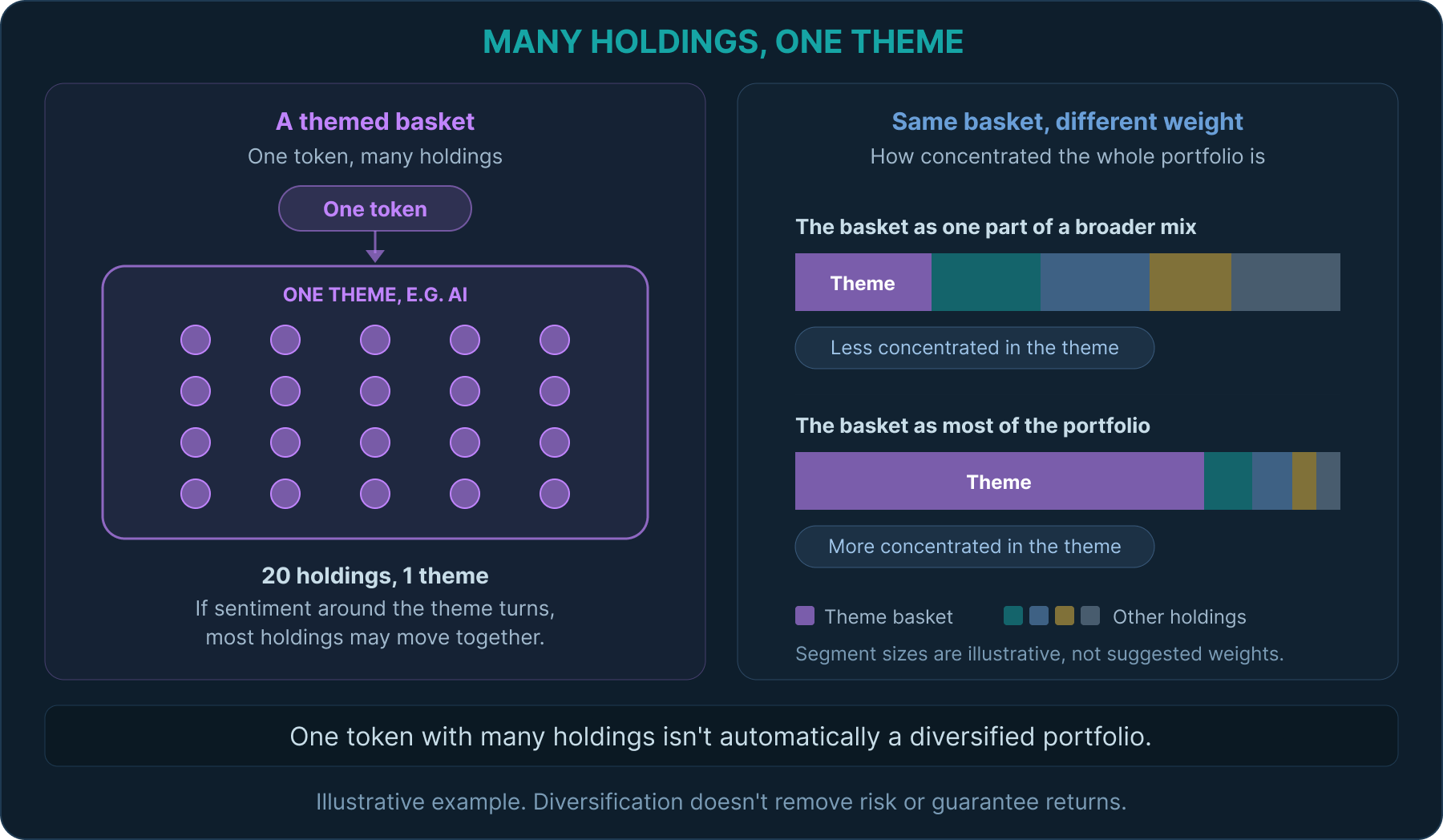
A themed fund or basket can feel diversified because it holds many names. However, it's still concentrated in its theme. A basket of twenty AI-related stocks gives you twenty companies and one theme. If sentiment around that theme turns, most of them are likely to move together. Our guide to the many types of ETFs covers the same pattern in thematic funds.
One token with many holdings isn't automatically a diversified portfolio. A themed basket is a way to express a view on multiple companies at once, and whether that viewpoint sits alongside other holdings or makes up the majority of a portfolio affects how concentrated the overall picture is.
One Wallet, Multiple Asset Types
One of the biggest differences of investment onchain is that asset types that once lived in separate places can now sit together. In a self-custodial wallet, a person can hold crypto, stablecoins, tokenized stocks, and tokenized ETFs in one place, see them side by side, and move between them with swaps, without juggling separate brokerage and exchange accounts.
That makes it easier to see how holdings are distributed across categories, which is the first step in noticing whether a portfolio is concentrated or diversified. Tokenized assets can also widen access for investors in places that traditional brokerages don't serve. For more, see How to Get US Equities From Outside the US and our overview of real-world assets.
How to Think About Portfolio Diversification
Diversification comes down to a few ideas that hold regardless of what's in a portfolio. It's about how holdings behave relative to each other, not how many there are. Research on the right number of holdings has produced a wide range of answers and no single target. More holdings reduce asset-specific risk with diminishing returns, but they can't remove risk that's shared across a market, and they can introduce overlap, complexity, and cost.
Funds, tokenized ETFs, and onchain baskets can bundle many holdings into one, which makes it easier to hold a broad set of assets, but also makes it important to look at what's inside.
Whichever route an investor takes, the useful question is less "how many do I hold?" and more "what happens to this portfolio if one thing goes wrong, and what else goes wrong with it?"
Thank you for checking out our article on Diversification Explained: How Many Assets Does a Portfolio Actually Need?! Make sure to follow us on X(Twitter) and let us know your thoughts. MEW rewards active traders — see our Rewards page for all ongoing campaigns. Sign up for our newsletter to stay up to date with MEW releases, and check out our weekly podcast Crypto Currents for the latest news in crypto. For more on building and understanding portfolios, check out our articles on Asset Allocation & Portfolio Rebalancing, What are ETFs? and Beyond the S&P 500.