
You open a trade, see a price, confirm, and receive slightly more or less than you expected. That gap is called slippage. It is a normal part of trading in both crypto and traditional markets, but understanding why it happens helps you set realistic expectations and avoid surprises.
This article explains what slippage is, what causes it, how slippage tolerance works, how to reduce it, and why a trade can expire before it completes.
Disclaimer: This article is for educational purposes only and is not financial, legal or tax advice. Trading involves risk, including the possible loss of your full investment. Always do your own research.
Jump To:
- Terms to Know
- What Is Slippage?
- Why Does Slippage Happen?
- Positive and Negative Slippage
- How Slippage Tolerance Works
- How to Reduce Slippage
- Why Trades Can Expire
- Managing Slippage: What to Check Before You Trade
Terms to Know
- Slippage: The difference between the price you expect when you place a trade and the price you actually get when it executes.
- Slippage tolerance: The maximum price difference you are willing to accept. If the price moves beyond it, the trade does not go through.
- Minimum received: The lowest amount you will accept to receive, based on your quote and your slippage tolerance.
- Price impact: The change in price caused by your own trade. It grows as your trade gets larger relative to the available liquidity.
- Liquidity: The supply of assets and active buyers and sellers in a market. Deeper liquidity generally means larger trades move the price less.
- Quote: The price a trading venue offers for a trade, usually valid for only a short time.
What Is Slippage?
The price you see before you confirm a swap or a trade is an estimate. The final price is only set when the transaction actually executes, and the two can differ.
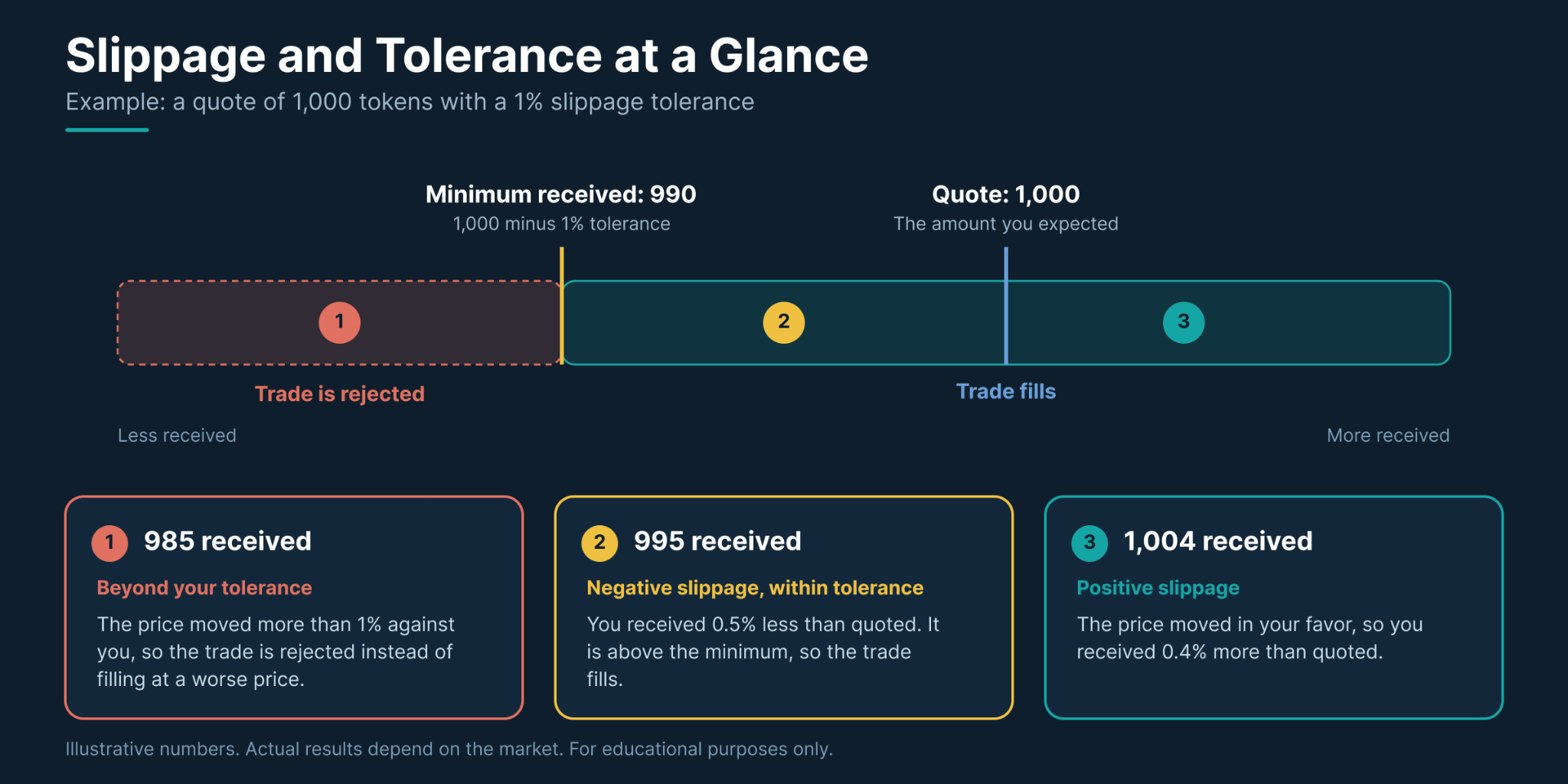
For example, say your quote shows you receiving 1,000 tokens. By the time the trade executes, you receive 990. The 10-token difference is 1% slippage.
Why Does Slippage Happen?
A few things can move the price between the moment you see a quote and the moment your trade executes:
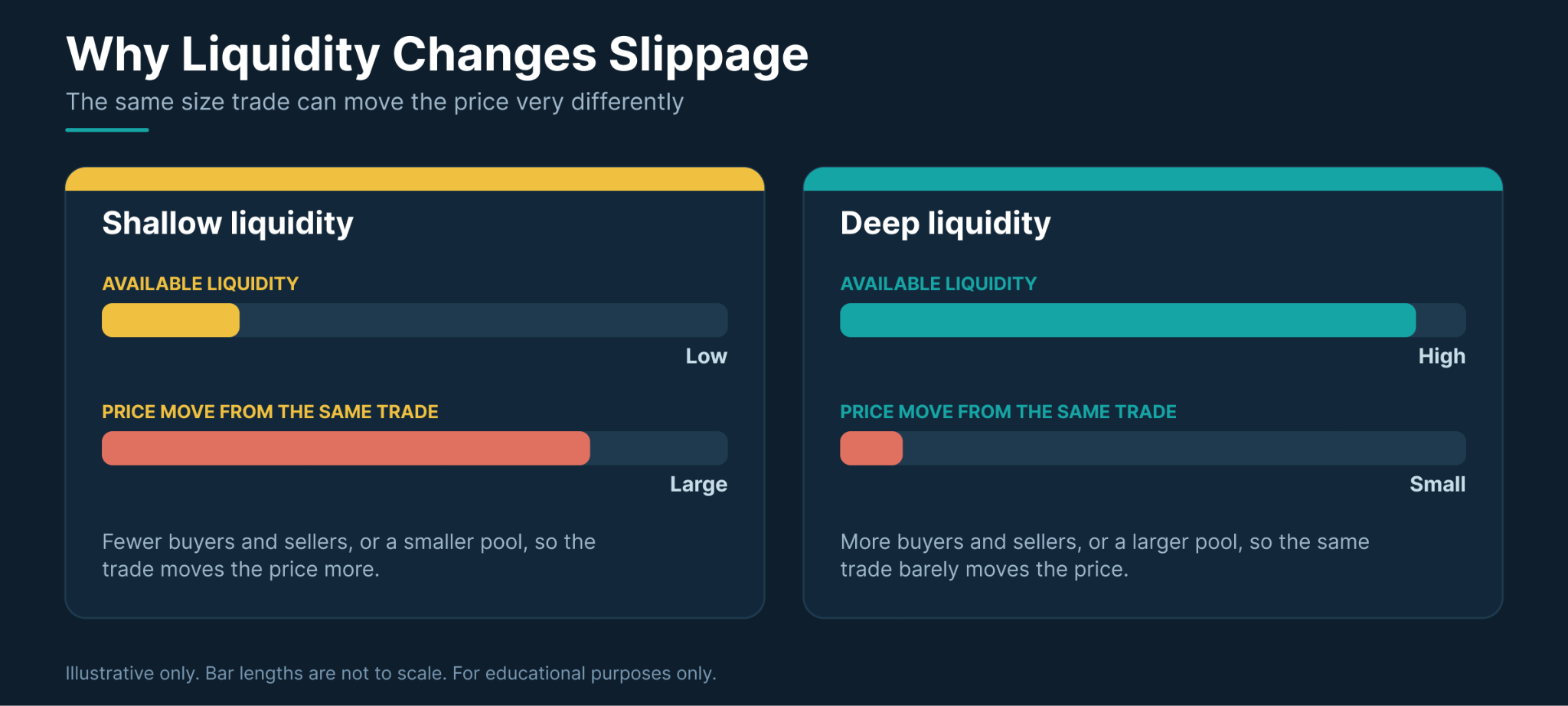
- Low liquidity: When a market has fewer buyers and sellers, or a pool holds fewer tokens, each trade moves the price more.
- Large trade size: A big trade relative to the available liquidity moves the price as it fills. This part is price impact, and it is usually reflected in the quote you see.
- Volatility: In fast-moving markets, prices can change within seconds.
- Delays: Onchain, your transaction waits to be included in a block. A busy network can make that wait longer, which gives the price more time to move.
Positive and Negative Slippage
Slippage works in both directions. Negative slippage means you receive less, or pay more, than expected. Positive slippage means the price moved in your favor and you got a better result than the quote showed. Negative slippage is the one most people worry about, since it is the one that costs you.
How Slippage Tolerance Works
Many trading tools let you set a slippage tolerance, usually as a percentage. It turns your quote into a minimum received amount. If the final price would leave you below that amount, the trade either does not go through or the interface warns you that it could be a bad trade.
Using the earlier example, a quote of 1,000 tokens with a 1% slippage tolerance gives a minimum received amount of 990 tokens. Anything above that fills, and anything below it is rejected or flagged with a warning.
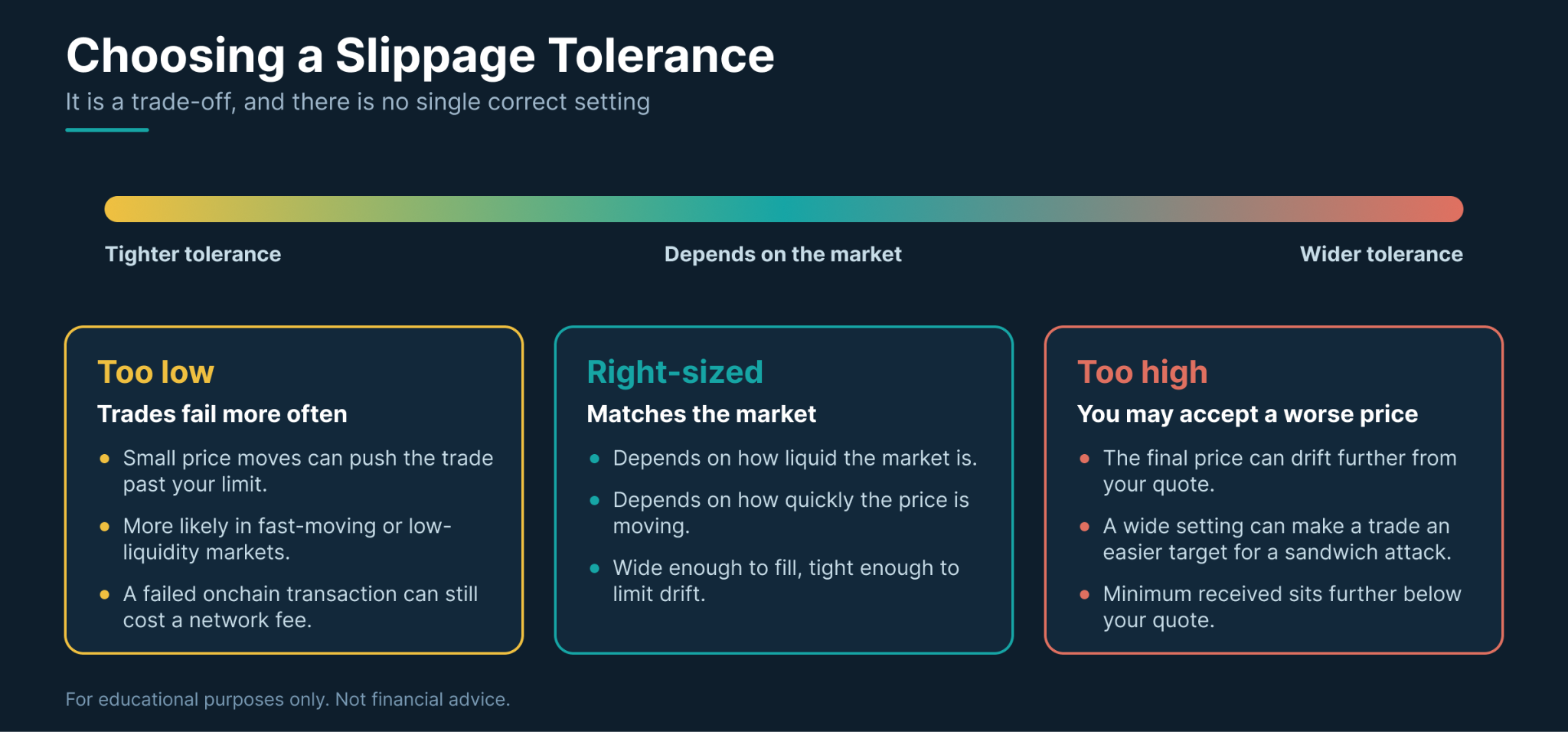
The setting involves a trade-off:
- Too low: Trades may fail more often, especially in fast-moving or low-liquidity markets. A failed onchain transaction can still cost a network fee.
- Too high: You may accept a worse price than you intended. A wide tolerance can also make a trade an easier target for a sandwich attack, where someone places trades just before and after yours to profit from the price move your trade causes.
There is no single correct setting. The right level depends on how liquid the market is and how quickly its price is moving.
How to Reduce Slippage
You cannot remove slippage entirely, but a few habits can limit it:
- Check liquidity first: Deeper liquidity generally means less slippage, and very new or lesser-known tokens usually have less liquidity. Our article on liquidity pools explains how it works.
- Size your trade to the market: Smaller trades move the price less. Splitting a large trade into several smaller ones can help, and some tools do this for you by routing across multiple pools.
- Avoid volatile or congested moments: Slippage tends to rise when prices are moving fast or the network is busy.
- Keep the gap short: The less time between seeing a quote and confirming it, the less room the price has to move.
- Consider limit orders: Where available, a limit order fills at your chosen price or not at all.
- Keep tolerance only as wide as needed: A tighter setting limits how far the final price can drift.
Why Trades Can Expire
Slippage is about the price moving while your trade is pending. Expiration is about how long it is allowed to wait. A quote is a price a market maker or other liquidity source commits to, so it can only hold that price for a short time before the market moves.
As one example, a widely used request-for-quote system describes its quotes as valid for roughly 60 seconds on Ethereum mainnet, with apps typically refreshing them about every 30 seconds. Many trades also carry a deadline, and if the trade is still pending when it passes, it is canceled instead of going through at a different price. This can happen if you take too long to confirm or if the network is busy and your transaction waits too long. If your trade expires, you can usually request a fresh quote and try again, though a failed onchain transaction can still cost a network fee.
Managing Slippage: What to Check Before You Trade
Slippage is a normal part of trading, and a little preparation goes a long way. Before you confirm a trade, it helps to ask:
- How deep is the liquidity for this market?
- How large is my trade compared with that liquidity?
- What are my slippage tolerance and minimum received amount?
- Is my quote still fresh?
Finally, double and triple check everything before you confirm. Make sure you understand what you are receiving, because transactions on the blockchain are final, and never click through a warning without reading it first.
Thank you for checking out our article on What Is Slippage in Crypto? Why It Happens and How to Manage It! Make sure to follow us on X(Twitter) and let us know your thoughts. MEW rewards active traders — see our Rewards page for all ongoing campaigns. Sign up for our newsletter to stay up to date with MEW releases, and check out our weekly podcast Crypto Currents for the latest news in crypto. For more on liquidity and the market makers behind your quotes, check out our articles on Liquidity in Crypto and What Are Market Makers?.