
Tokenized stocks are onchain tokens that give you exposure to the price of a company's stock, and you can trade them straight from a self-custody crypto wallet. That is a big part of their appeal, but a tokenized stock is not always the same thing as the stock itself, and trading one does not work exactly like trading shares through a broker.
This article covers the key things to know before you trade: how tokenized stocks are backed, what you actually own, why trades can expire, how rules differ around the world, and when trading can be unavailable. For a deeper look at how tokenized products differ, see Are All Tokenized Stocks The Same?
Disclaimer: This article is for educational purposes only and is not financial, legal or tax advice. Tokenized stocks involve risk, including the possible loss of your full investment. Rules and availability vary by product and region, so always do your own research.
Terms to Know
- Tokenized stock: A blockchain token designed to track the price of a company's stock. Depending on how it is built, it may or may not be backed by real shares.
- Backing: The assets, if any, that support a token's value, such as real shares held by a custodian.
- Custodian: A regulated company that holds assets on behalf of someone else.
- Synthetic token: A token that tracks a stock's price without any shares behind it.
- Redemption: Exchanging a token with its issuer for the underlying value, usually limited to eligible, verified users.
- Quote: The price a trading venue offers for a swap, usually valid for only a short time.
- Slippage: The difference between the price you expect and the price you actually get when a trade executes.
- Spread: The gap between the highest price buyers will pay and the lowest price sellers will accept.
- Liquidity: The supply of assets and active buyers and sellers in a market. Deeper liquidity generally means larger trades move the price less.
- Trading halt: A temporary pause in trading for a single stock or an entire market.
- Corporate action: An event that changes a stock, such as a dividend, split or merger.
What Backs a Tokenized Stock?
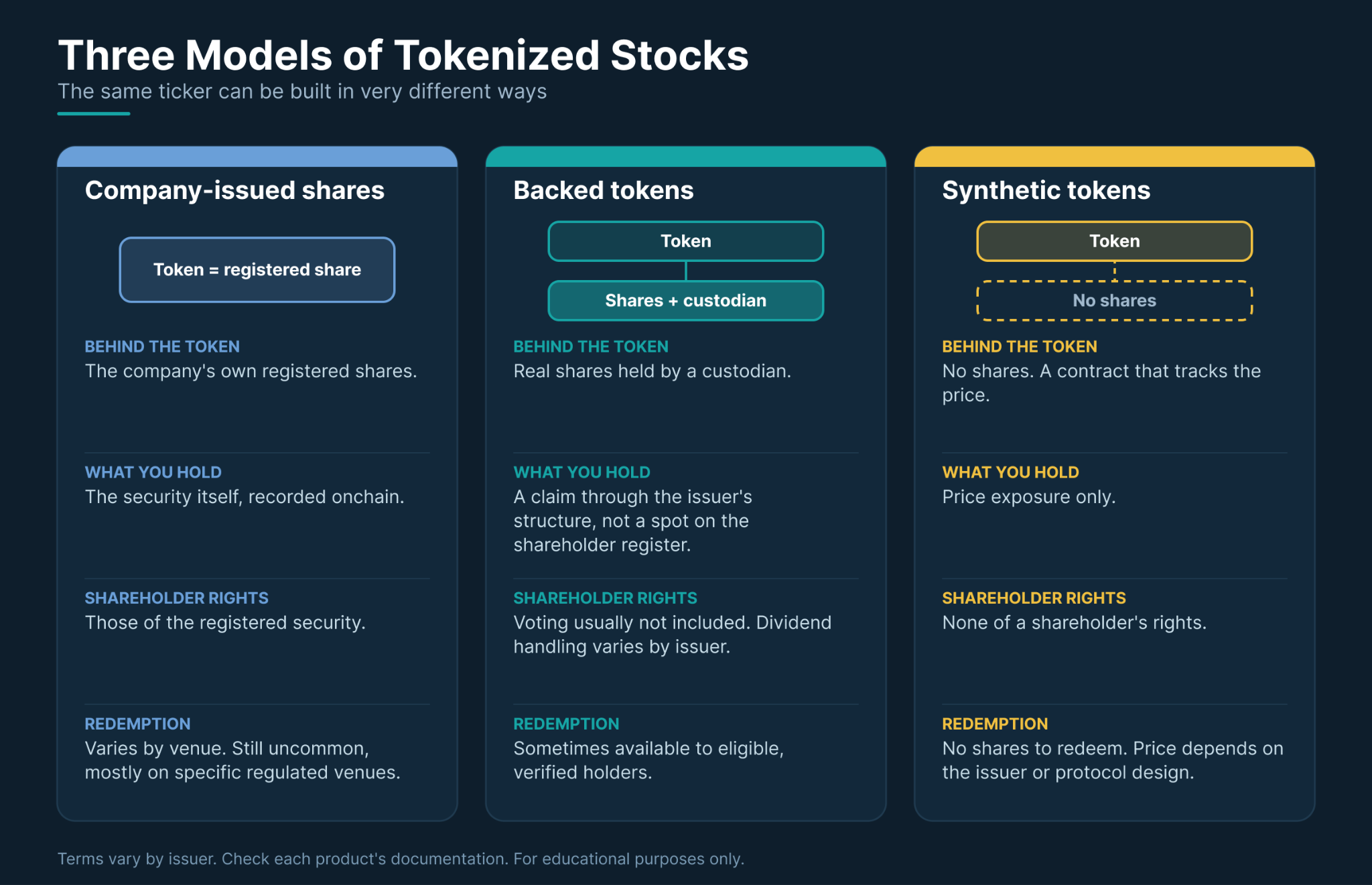
The same ticker can be built in very different ways. Most tokenized stocks fall into one of three models:
- Company-issued shares: The company itself issues its shares as digital tokens, so the token is the registered security. This is still uncommon and is mostly limited to specific regulated venues and jurisdictions.
- Backed tokens: A third party holds real shares with a custodian and issues tokens that represent them, often one token per share. You hold a claim through the issuer's structure rather than appearing on the company's shareholder register.
- Synthetic tokens: The token tracks the stock's price only, with no shares behind it. It works more like a contract with the issuer or protocol than like ownership of a share.
The token itself does not tell you which model you are holding, so check the issuer's documentation. It is also worth knowing whether a token is permissioned or permissionless, since that affects where it can be sent and used.
What Do You Actually Own?
The model behind a token decides which rights come with it:
- Dividends: Some tokens add to your balance when the company pays a dividend, while others handle it in a different way. The method varies by issuer.
- Voting: Most tokenized stocks do not come with shareholder voting rights, and EU regulator ESMA has noted that they typically do not confer them.
- Redemption: Some issuers let eligible, verified holders redeem tokens for the underlying value. If redemption is paused or restricted, the token's price can drift away from the stock's price.
In short, a tokenized stock gives you price exposure, but not always the full rights of a shareholder.
Rules Differ Around the World
Tokenized stocks sit between traditional finance and crypto, and regulators are still working out how to treat them. As traditional finance moves into tokenization, approaches vary by region. A few examples:
- United States: In January 2026, SEC staff said tokenized securities are still securities and follow the same federal securities laws, and that how a token is built affects the rights its holders receive. The SEC has also been working on an "innovation exemption" for tokenized stocks, but has not achieved clarity in regulation by end of 2026. Many tokenized stock products are not offered to people in the US.
- European Union: Tokens that represent stocks are generally treated under existing financial rules such as MiFID II rather than the crypto-asset rules of MiCA. ESMA, the EU markets regulator, has also warned that synthetic products can be misunderstood by investors.
- Elsewhere: Rules differ widely. Some places, such as Switzerland, have created laws specifically for blockchain-based securities.
For you, this means availability depends on where you live, and the protections can differ from those that come with buying shares through a traditional broker. Always check whether a product is offered in your region and what rules apply to it.
When Trading Can Be Unavailable
Even a token that lives onchain 24/7 can become unavailable to trade. Common reasons include:
- Market closures: Some venues only offer quotes during set windows tied to US market sessions, such as Sunday evening to Friday evening Eastern Time, and pause on weekends.
- US market holidays: Some pause trading when US exchanges are closed for a holiday.
- Trading halts: If a stock or an entire market is halted, quotes may be paused until trading resumes.
- Corporate actions: Trading can be paused briefly while an event such as a dividend or split is processed.
- Low liquidity or missing prices: A token can be temporarily unavailable if there is not enough liquidity or no reliable price reference.
- Region or eligibility limits: Some products are only offered in certain countries or to verified users.
- Redemption pauses: If an issuer pauses redemptions, the token's price can drift from the stock's price.
Not every venue follows the same rules. Some keep trading around the clock, usually with thinner liquidity, so it is worth checking how a specific product handles closures. Our article on trading tokenized stocks outside market hours explains this in more detail.
Why Trades Can Expire
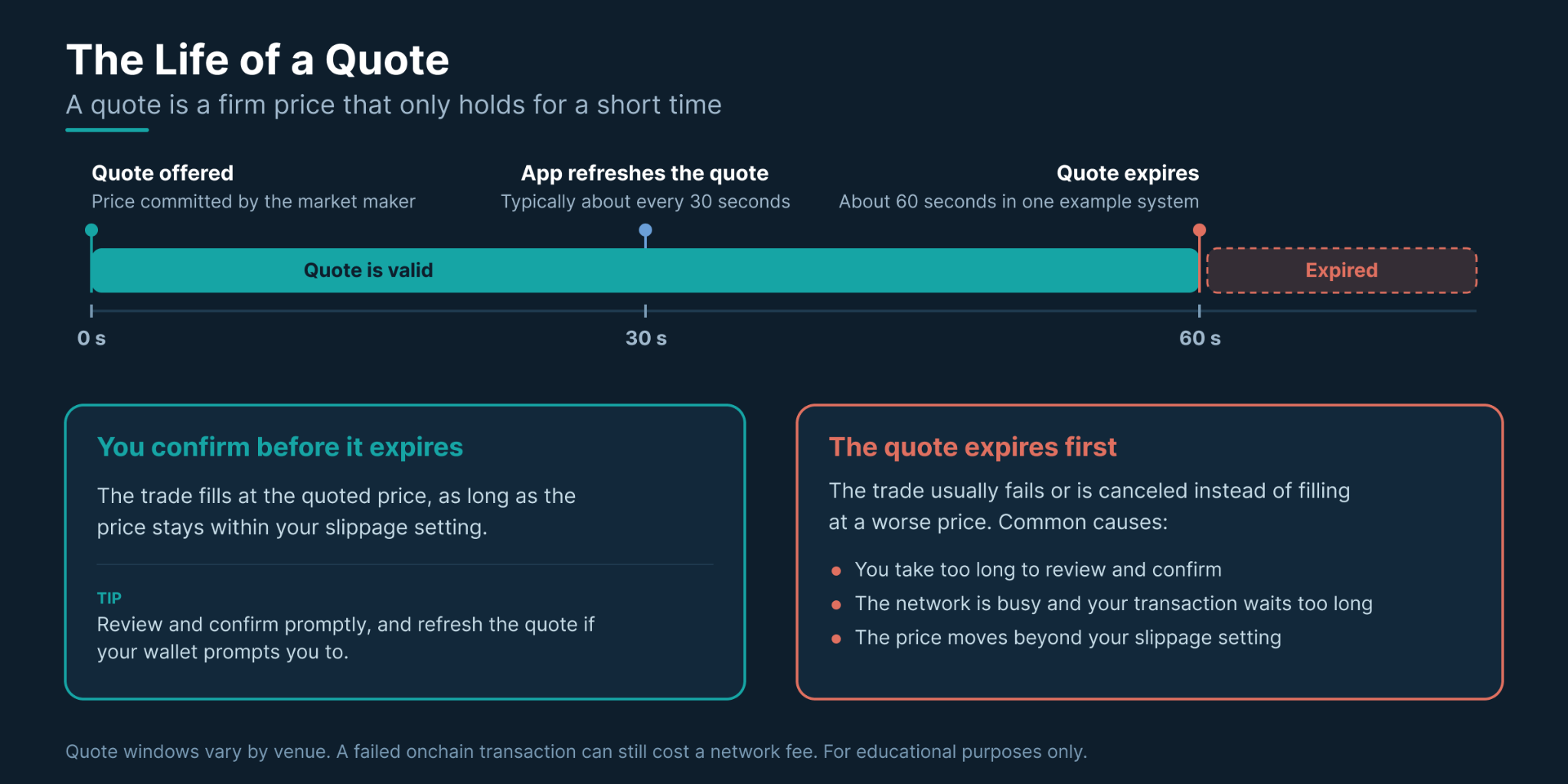
When you trade into or out of a tokenized stock, the price you see is a quote, and quotes do not last. A market maker or other liquidity source that offers you a price is committing to it, so it can only hold that price for a short time before the market moves. As one example, a widely used request-for-quote system describes its quotes as valid for roughly 60 seconds on Ethereum mainnet, and apps typically refresh them about every 30 seconds.
For tokenized stocks, the price may also follow the underlying stock, which can move quickly near the open and close or become unavailable when that market is shut. Older quotes may stop being honored when that happens.
In practice, a quote can expire if:
- You take too long to review and confirm the trade.
- The network is busy and your transaction waits too long to be included in a block.
- The price moves further than your slippage setting allows before the trade goes through.
When this happens, the trade usually fails or is canceled instead of filling at a worse price. A failed onchain transaction can still cost a network fee, so it helps to confirm promptly, refresh the quote if your wallet prompts you to, and check the minimum amount you will receive. Orders with a time limit, such as those open only until the end of the trading day, can also expire if they are not filled in time.
A Few More Things Worth Knowing
- Price differences: A token's price can differ from the stock's price, especially when the stock market is closed or liquidity is thin.
- Fees: Costs can include network fees, the spread between buy and sell prices, and, on some products, currency conversion or issuer fees.
- Taxes: Tax treatment varies by country and by product, so consider speaking with a tax professional.
- Wallet security: With a self-custody wallet, you are responsible for your own keys. Verify the token contract address before trading, since lookalike tokens exist.
Trading Tokenized Stocks: Questions to Ask Before You Trade
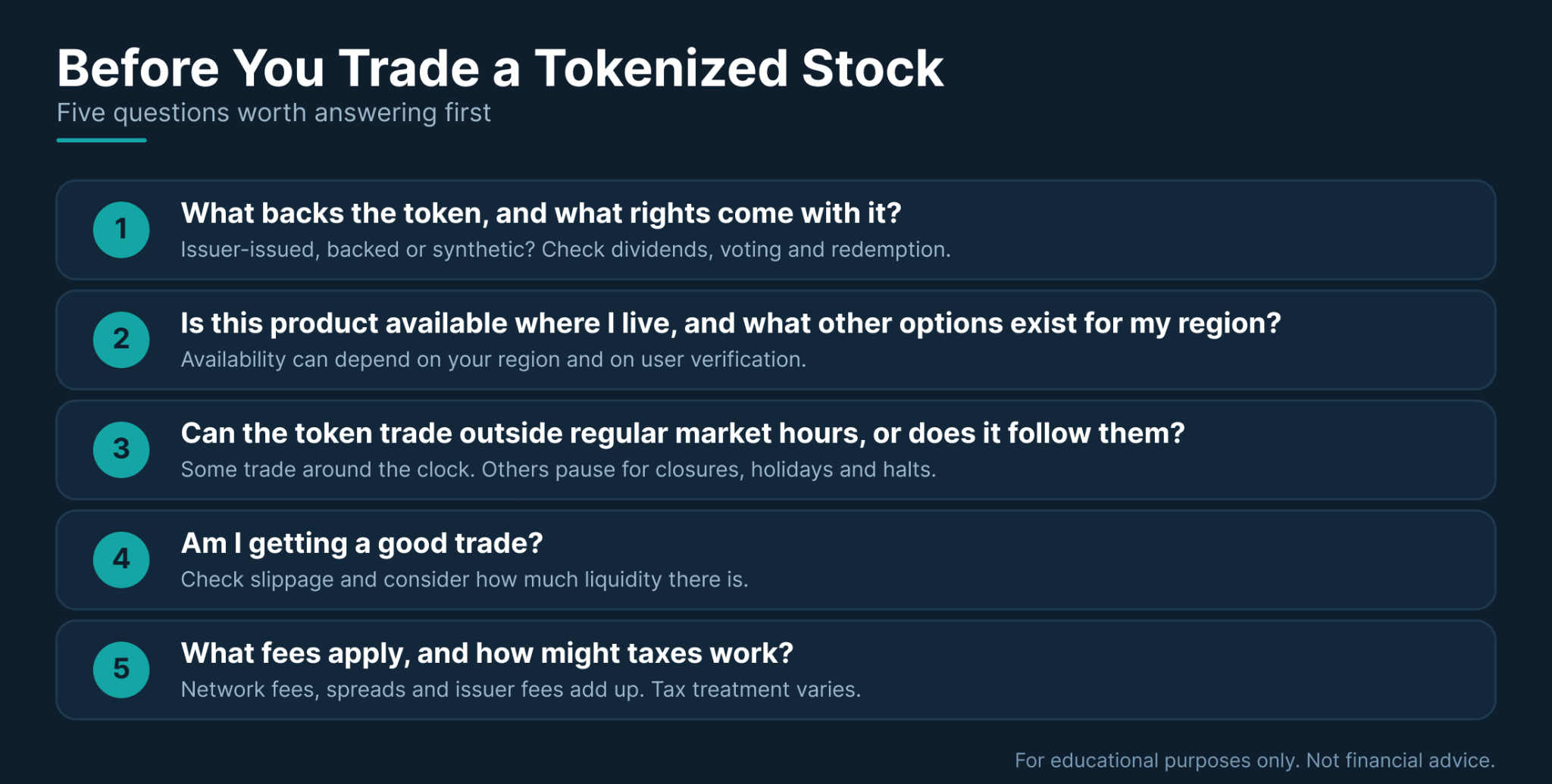
Tokenized stocks make it possible to trade company exposure from a wallet, but the details behind each product matter. Before you trade, it helps to ask:
Thank you for checking out our article on Trading Tokenized Stocks: What You Need to Know! Make sure to follow us on X(Twitter) and let us know your thoughts. MEW rewards active traders — see our Rewards page for all ongoing campaigns. Sign up for our newsletter to stay up to date with MEW releases, and check out our weekly podcast Crypto Currents for the latest news in crypto. For more on tokenized stocks and how they work onchain, check out our articles on What Are RWAs?, Are All Tokenized Stocks the Same? and What Are Corporate Actions?.