US Treasuries and money market funds are staples of traditional finance: a way for governments to borrow, and a way for investors to hold cash-like assets while earning a return. Now both are showing up onchain as tokens.
Tokenized treasuries and money market funds are among the largest categories of tokenized real-world assets (RWAs). This article explains what they are, how they work, and what to know before using them.
Disclaimer: This article is for educational purposes only and is not financial, legal or tax advice. Tokenized products involve risk, including the possible loss of your full investment, and availability and eligibility vary by product and region. Always do your own research.
Jump To:
- Terms to Know
- Treasuries and Money Market Funds: The Basics
- What Does Tokenizing Them Change?
- How Tokenized Treasury and Money Market Fund Products Work
- How Do They Differ From Stablecoins and From Each Other?
- Why Do People Use Them?
- Risks and Things to Know
- Tokenized Treasuries and Money Market Funds: Questions to Ask Before You Use One
Terms to Know
- Treasury: Debt issued by the US government to borrow money. Short-term Treasuries are called Treasury bills, or T-bills.
- Money market fund: A fund that invests in short-term, high-quality debt, such as government securities, and aims to keep its value stable while paying income.
- Net asset value (NAV): The per-share value of a fund, based on the value of what it holds.
- Yield: The income an investment pays, usually shown as a yearly percentage. It is not guaranteed.
- Tokenized fund share: A share of a fund represented as a token on a blockchain.
- Custodian: A regulated company that holds assets on behalf of someone else.
- Redemption: Exchanging fund shares or tokens back for cash or stablecoins through the issuer.
- Permissioned token: A token that can only be held or sent by approved addresses.
Treasuries and Money Market Funds: The Basics
A Treasury is a loan to the US government. You lend money for a set period and get it back with interest. Treasury bills are the shortest kind and mature in a year or less.
A money market fund pools money from many investors and puts it into short-term, high-quality debt, such as government securities and repurchase agreements, which are short-term loans secured by collateral. Investors own shares of the fund, and the income it earns is either paid out or reinvested.
Both are often called "cash-like" assets. The debt is short-term and issued or backed by the US government or other high-quality borrowers, so prices tend to stay steady. A stock or ETF can swing sharply in a single day as company news and market sentiment change, but a Treasury bill matures within a year, which leaves little time for its price to drift far. Money market funds also aim to hold a stable share price, often $1. Cash-like does not mean risk-free, though. Prices can still move a little when interest rates change, money market funds are not insured like bank deposits, and yields rise and fall over time.
Here are a few well-known examples and whether each one has been tokenized:
These are examples, not recommendations. Many tokenized products are permissioned. For example, USDY is limited to non-US persons when first issued, and OUSG and USTB are for accredited or qualified investors. Availability, eligibility and structure vary by product and region, so check each product's terms.
What Does Tokenizing Change?
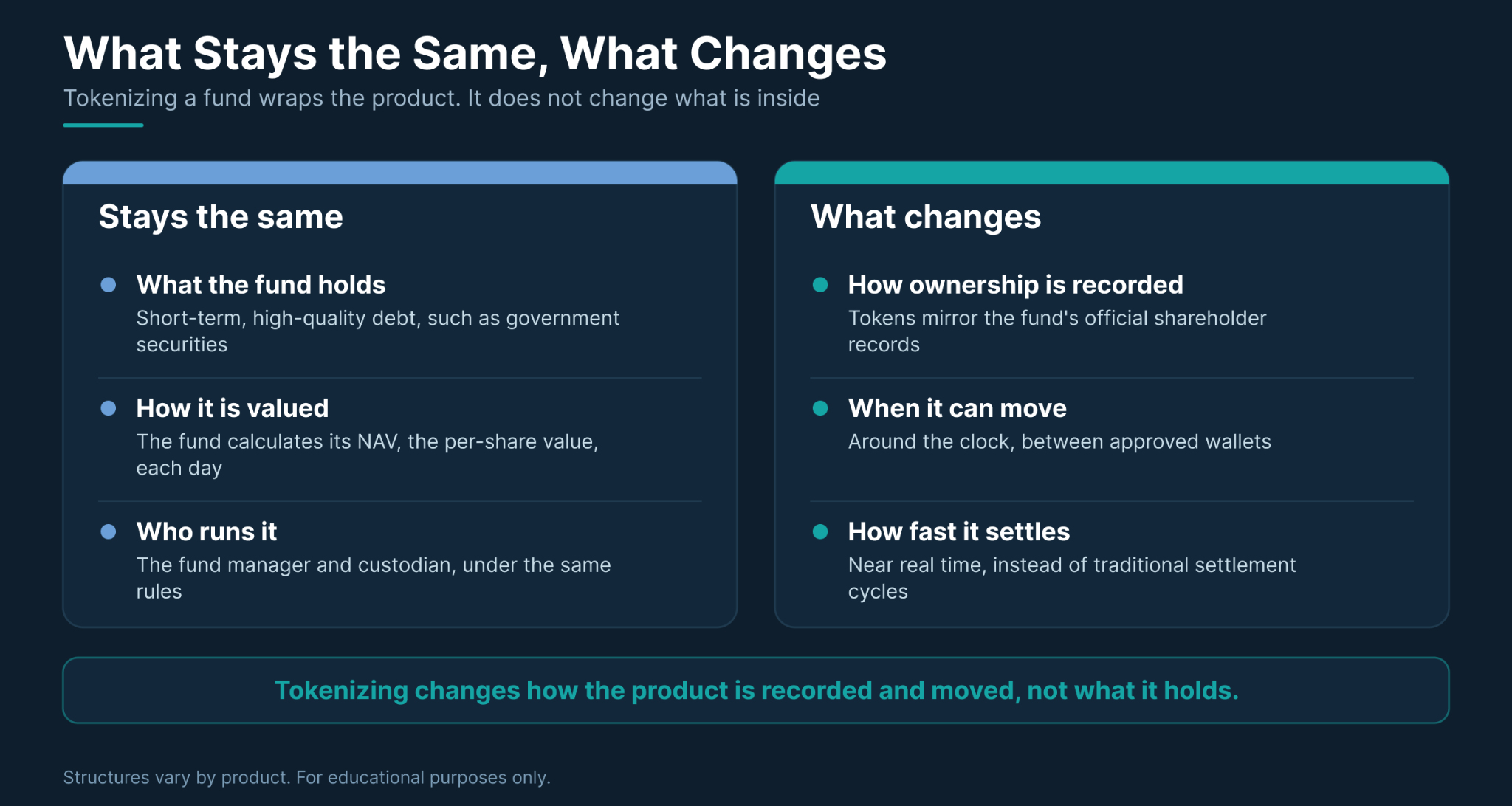
Tokenizing a fund usually changes very little about what the product holds. The fund still invests in the same kinds of short-term securities, with the same valuation and management. What changes is how ownership is recorded and moved. Tokens mirror the fund's official shareholder records and can be transferred between approved wallets in near real time, around the clock.
Commonly cited benefits include:
- Round-the-clock transfers: Including weekends and holidays.
- Faster settlement: Between approved wallets, without waiting for traditional settlement cycles.
- Collateral use: Tokens can be moved as collateral without first redeeming to cash.
- Automation: Smart contracts can handle tasks such as income distribution.
How Tokenized Treasury and Money Market Fund Products Work
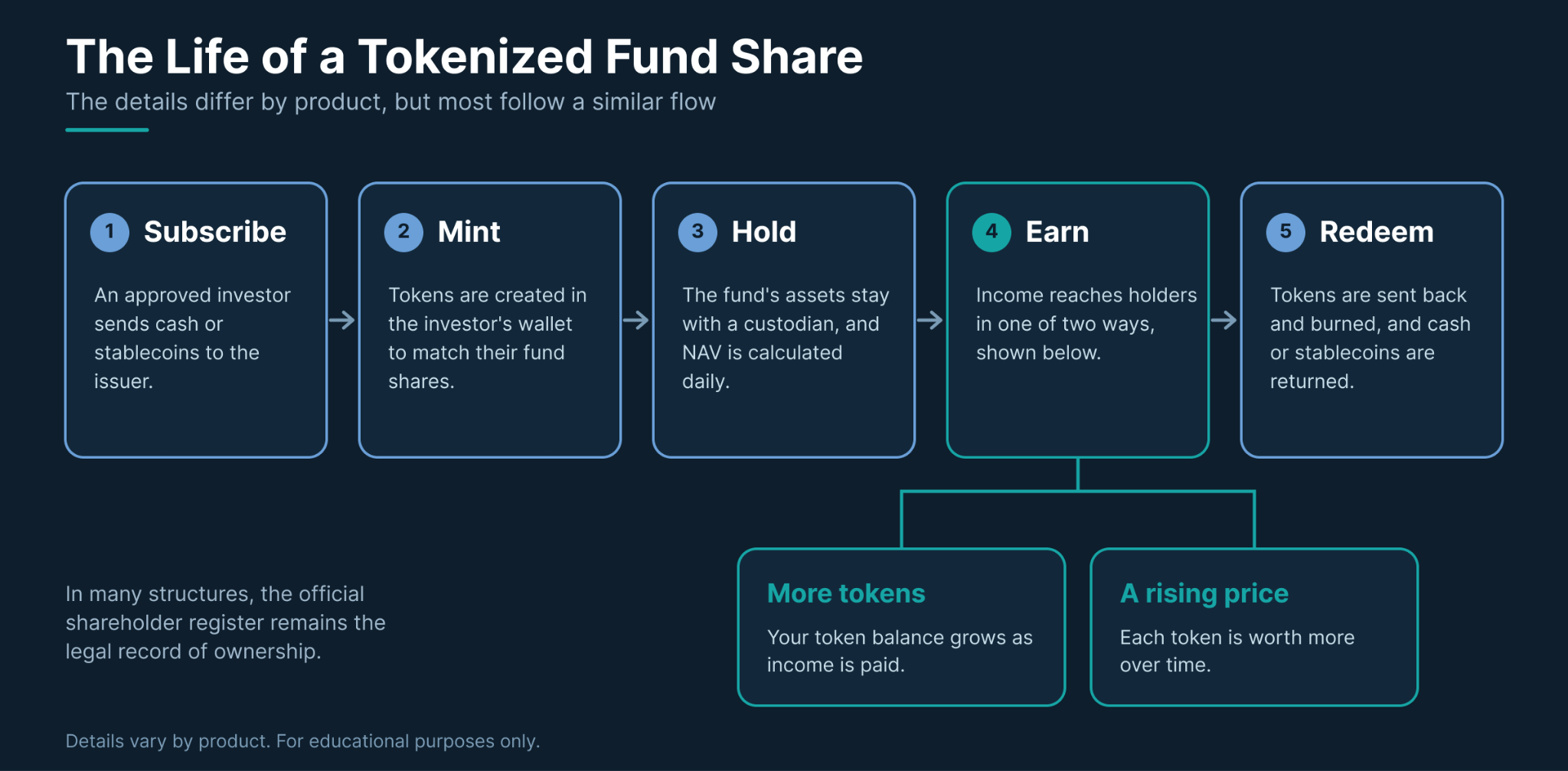
The details differ by product, but most follow a similar flow:
- Subscribe: An approved investor sends cash or stablecoins to the issuer.
- Mint: The issuer creates tokens in the investor's wallet to match their fund shares.
- Hold: The fund's assets stay with a custodian, and the fund calculates its NAV each day. In many structures, the official shareholder register remains the legal record of ownership.
- Earn: Income reaches holders in one of two ways. Some products add more tokens to your balance, and others let the token's price rise over time.
- Redeem: The holder sends tokens back, the issuer burns them, and cash or stablecoins are returned.
Because the value follows the fund's NAV, a token's price reflects the value of what the fund holds, and it is not set by trading activity alone.
How Do They Differ From Stablecoins and From Each Other?
Because tokenized treasuries and money market funds are cash-like, they are often compared with stablecoins, which many people use as digital cash, and with each other.
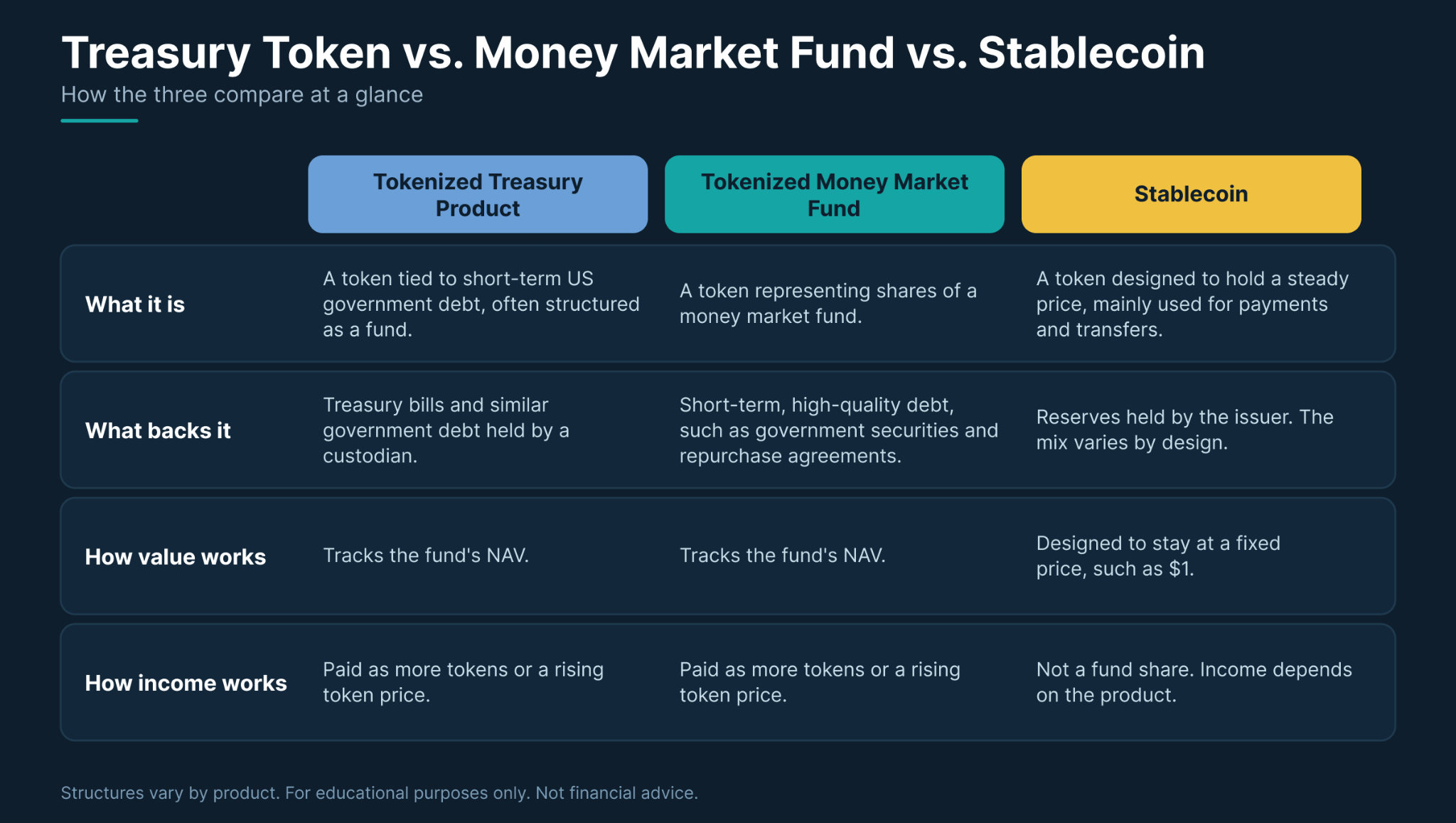
- Tokenized treasuries vs. money market funds: Tokenized treasury products focus on short-term US government debt, while money market funds can hold a wider mix of short-term instruments, such as repurchase agreements. The labels overlap, and many products described as tokenized treasuries are structured as funds.
- Tokenized funds vs. stablecoins: A stablecoin is designed to hold a steady price and is mainly used for payments and transfers. A tokenized treasury or money market fund product is a share of a fund, so its value tracks NAV and it earns income from what the fund holds.
The two can also work together. Many tokenized funds accept stablecoins for subscriptions and redemptions.
Why Do People Use Them?
People and institutions use tokenized treasury and money market fund products for a few reasons:
- Holding a cash-like asset onchain that earns income from short-term government debt.
- Using tokens as collateral or for settlement without moving back to traditional bank rails.
- Moving value at any hour, including weekends and holidays.
Interest has grown quickly. RWA.xyz showed about $14 billion in tokenized US Treasury funds across more than 86,000 holders on November 12, 2026, while Allium counted $17.3 billion in tokenized Treasuries and money market funds as of early September. Figures vary by source and by how each tracker counts.
Risks and Things to Know
Tokenizing a fund does not remove the risks of the fund itself, and it adds a few new ones:
- Eligibility: Many products are limited to approved or qualified investors, sometimes with high minimums, and your wallet may need to be on an approved list. Some registered funds are open to a broader group. This is where permissioned tokens come in.
- No guarantees: These products are not bank deposits. Yield changes with interest rates and fees, and investors may not get back what they put in.
- Redemption timing: Tokens can move in near real time, but redeeming into cash follows the fund's own process and timelines. If transfers are restricted, the pool of possible buyers may also be small.
- Custody and keys: The underlying assets sit with a custodian, but you are responsible for securing your own wallet. Losing access to your keys can mean losing access to your tokens.
- Smart contract and operational risk: Token contracts and the data feeds that publish NAV can have bugs or outages.
- Fees: Besides fund fees, transfers and redemptions can carry network fees.
- Rules vary: Tokenized funds remain subject to securities laws, and requirements differ by region.
Tokenized Treasuries and Money Market Funds: Questions to Ask Before You Use One
Tokenized treasuries and money market funds bring a familiar kind of product onchain, but the structure around the token matters as much as the fund behind it. Before you use one, it helps to ask:
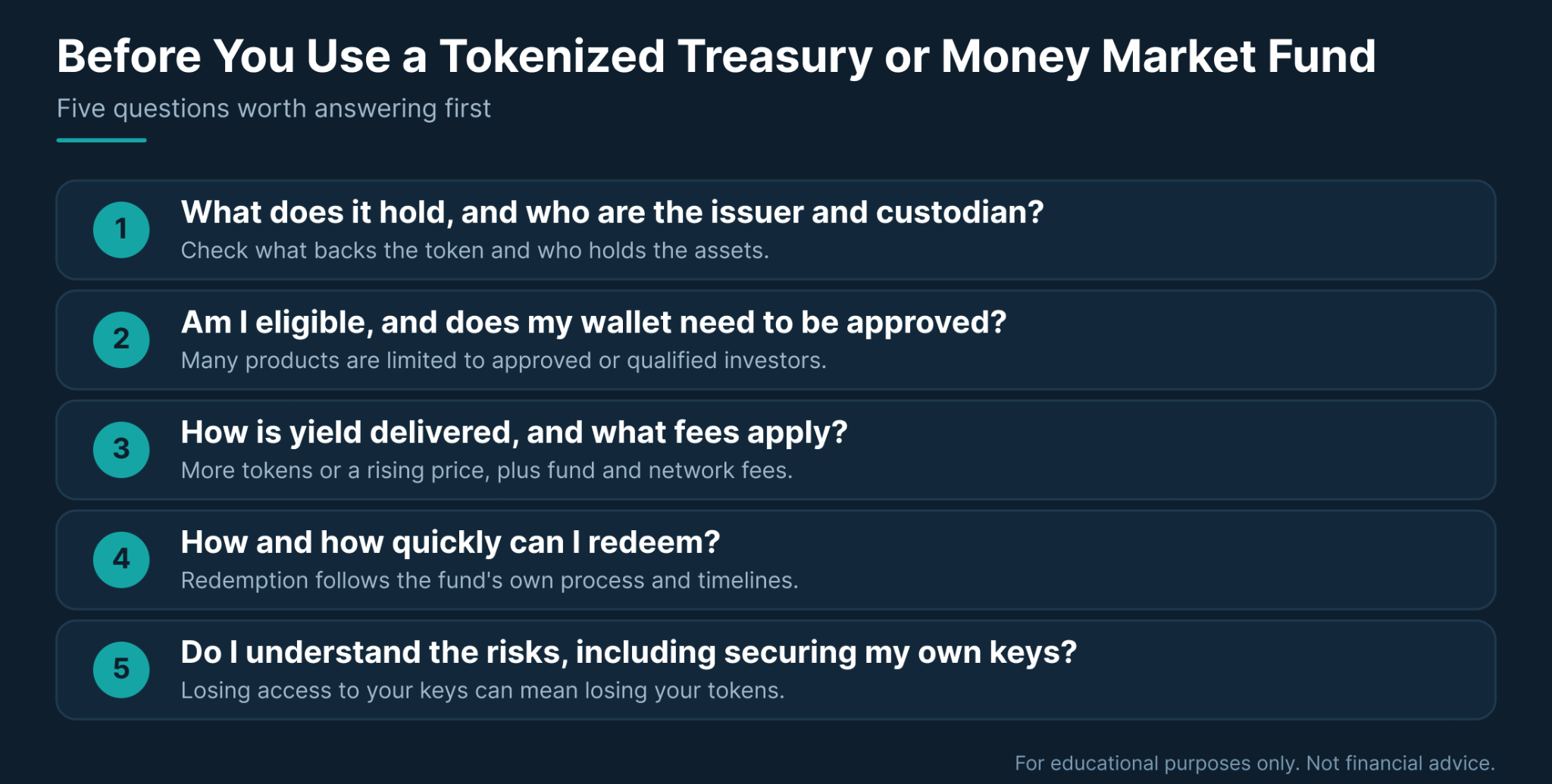
Finally, read the issuer's documentation carefully, and remember that transactions on the blockchain are final.
Thank you for checking out our article on Tokenized Treasuries and Money Market Funds: What They Are and How They Work! Make sure to follow us on X(Twitter) and let us know your thoughts. MEW rewards active traders — see our Rewards page for all ongoing campaigns. Sign up for our newsletter to stay up to date with MEW releases, and check out our weekly podcast Crypto Currents for the latest news in crypto. For more on tokenized real-world assets, check out our articles on What Are RWAs?, The Top Networks for RWAs and Tokenized Portfolios.